

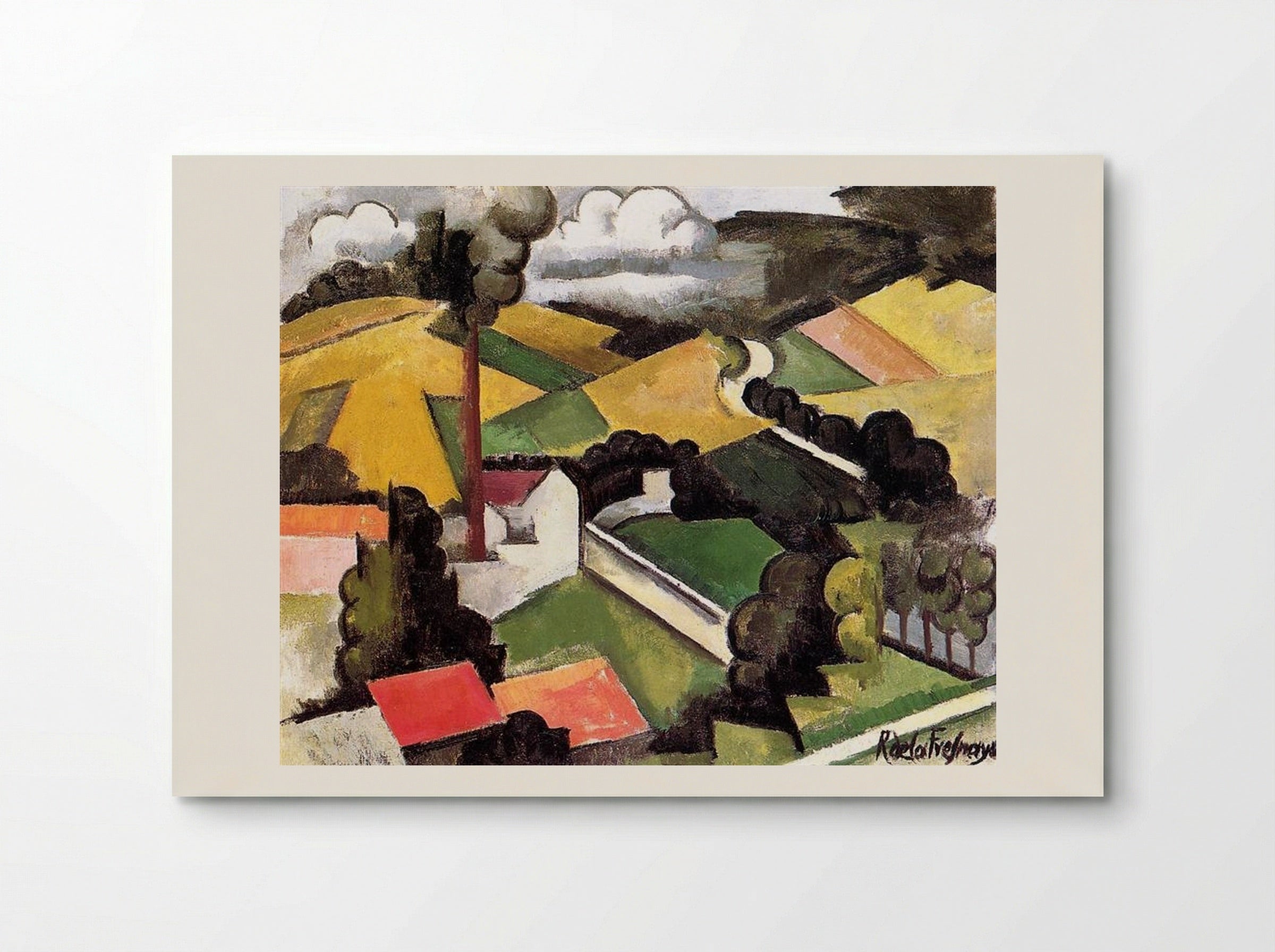
The Factory Chimney, Meulan Landscape - Roger de La Fresnaye
Archival giclée
Frames arrive ready to hang
Secure checkout
Made to order
Description
A Cubist-influenced landscape by Roger de La Fresnaye, 'The Factory Chimney, Meulan Landscape' depicts a semi-rural scene with geometric forms and a restrained colour palette, blending industrial and natural elements.
Roger de La Fresnaye, a French Cubist painter, created 'The Factory Chimney, Meulan Landscape'. The work depicts a semi-rural scene with geometric forms and a muted colour palette. The composition is divided into distinct planes, a characteristic of Cubist art, yet it retains a sense of depth and perspective. The titular factory chimney rises prominently from the centre, a vertical element contrasting with the horizontal fields and buildings. The artist uses simplified shapes to represent houses, trees, and fields, reducing them to their essential forms. The colour scheme is restrained, with shades of green, yellow, and brown dominating the canvas. Touches of red and white add subtle accents. The brushwork is visible, contributing to the painting's textured surface. The overall effect is one of serene order, where the industrial element of the chimney is integrated into the natural environment. La Fresnaye's work blends Cubist principles with a more traditional approach to representation. He sought to reconcile modern artistic techniques with classical ideals, resulting in a style that is both innovative and accessible. 'The Factory Chimney, Meulan Landscape' exemplifies this synthesis, capturing the changing French countryside in the early 20th century.
Return policy
Because every print is made to order, we don't offer change-of-mind returns, refunds or exchanges. If your order arrives faulty, damaged or incorrect, we'll replace it free of charge — just contact us within 48 hours of delivery. See our refunds page for full details.
Shipping
We ship worldwide, printing at the production hub nearest to your delivery address. Delivery times and costs vary by destination — you'll see the options available to you at checkout.
Manufacturing
Each print is produced to order using 12-colour giclée printing on FSC-certified archival paper. Designed in Britain and printed at your nearest production hub to reduce waste and speed up delivery.
The Factory Chimney, Meulan Landscape - Roger de La Fresnaye

Artist Biography
Roger De La Fresnaye
He was born in Le Mans in 1885 into an aristocratic family with an ancestral chateau in Falaise. He studied at the Academie Julian, the Ecole des Beaux-Arts and the Ranson Academy under Maurice Denis, moving from Symbolism to Cubism around 1910. He joined the Section d'Or group in 1912, exhibiting alongside Duchamp, Gleizes and Metzinger at Jacques Villon's studio.
His Cubism was always temperate. He never fully embraced the radical fragmentation of Braque and Picasso, retaining naturalistic colour and recognisable forms that helped popularise the movement without terrifying bourgeois audiences. The restraint was both a strength and a limitation: it made his work accessible, but it meant that the avant-garde moved past him before the war intervened. His colour remained lyrical and warm where analytical Cubism was grey and cerebral. He came from aristocratic stock, painted with aristocratic moderation, and died too young to see whether the moderation would have held.
Our Features
Designed for Lasting Impact
Specific Features
Every Solis piece is made to order with archival, gallery-quality materials built to last.
- Museum-grade giclée printing for rich, fade-resistant colour
- Archival matte fine-art paper, FSC-certified
- Multiple sizes and framing options available
- Frames in black, natural wood, dark wood or white
- Framed prints arrive ready to hang
Care & Cleaning
To keep your artwork looking its best:
- Dust gently with a soft, dry cloth
- Avoid prolonged direct sunlight
- Never use liquid cleaners on the print or canvas surface
- Keep in a dry, room-temperature space
- Handle prints with clean, dry hands
Materials & Sizing
Museum-grade giclée on FSC-certified archival matte paper, with framed and canvas options.
- Paper sizes: A4, A3, A2, A1, A0 and B2 (50×70 cm)
- Canvas: XS (20×30 cm) to Large (60×90 cm)
- Frames: black, natural wood, dark wood or white
Why Choose Us ?
Damage-free delivery guarantee
Fast Shipping
Museum-Quality Materials
Artist Biography
Roger de La Fresnaye
He was born in Le Mans in 1885 into an aristocratic family with an ancestral chateau in Falaise. He studied at the Academie Julian, the Ecole des Beaux-Arts and the Ranson Academy under Maurice Denis, moving from Symbolism to Cubism around 1910. He joined the Section d'Or group in 1912, exhibiting alongside Duchamp, Gleizes and Metzinger at Jacques Villon's studio.
His Cubism was always temperate. He never fully embraced the radical fragmentation of Braque and Picasso, retaining naturalistic colour and recognisable forms that helped popularise the movement without terrifying bourgeois audiences. The restraint was both a strength and a limitation: it made his work accessible, but it meant that the avant-garde moved past him before the war intervened. His colour remained lyrical and warm where analytical Cubism was grey and cerebral. He came from aristocratic stock, painted with aristocratic moderation, and died too young to see whether the moderation would have held.
You May Also Like