

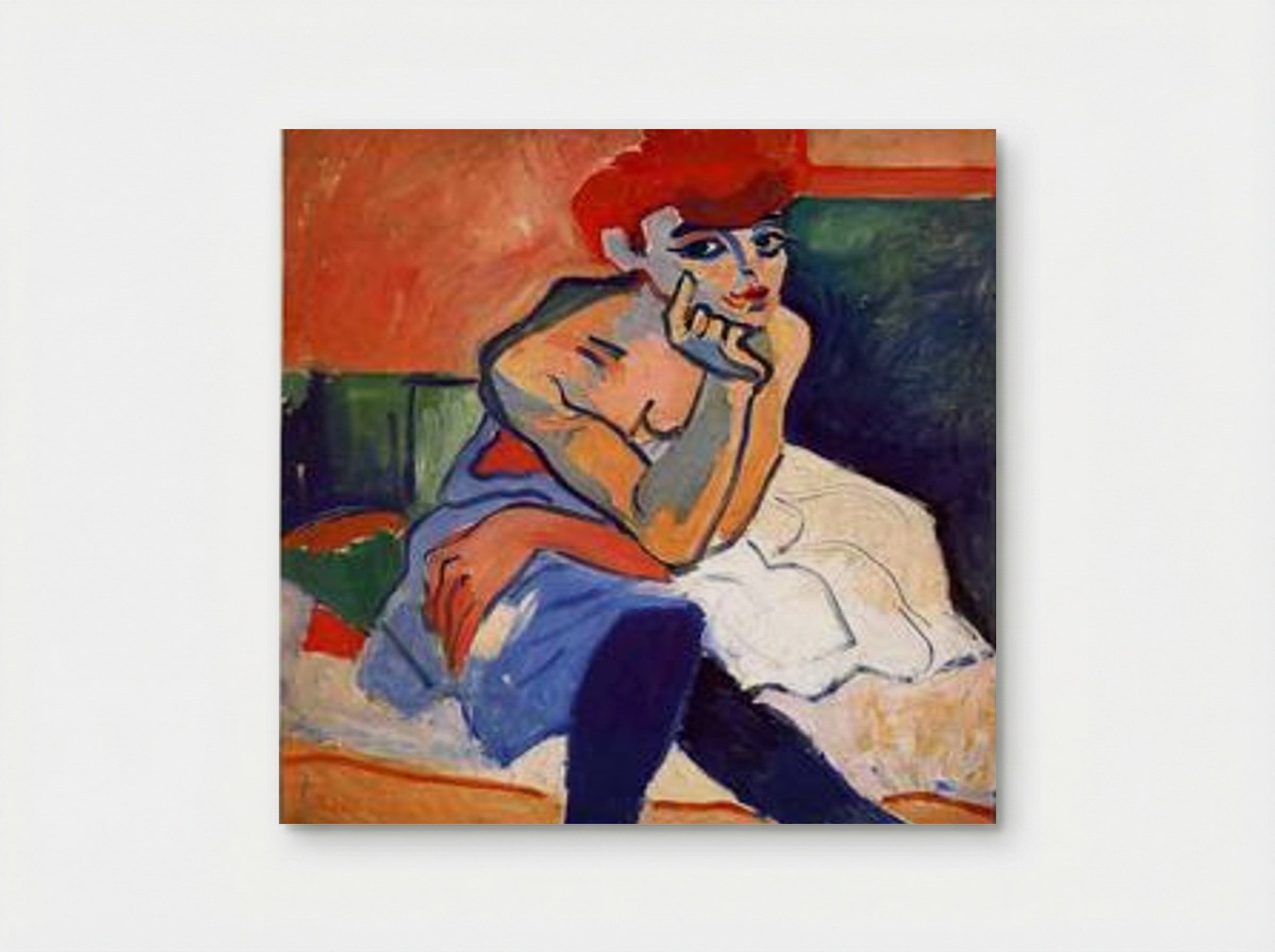
The Dancer - André Derain
Archival giclée
Frames arrive ready to hang
Secure checkout
Made to order
Description
A bold Fauvist portrait by André Derain, featuring expressive, non-naturalistic colours and simplified forms.
André Derain produced this work during the height of the Fauvist movement, a period defined by the rejection of naturalistic colour in favour of expressive, non-representational hues. The composition features a seated figure, rendered with bold, unblended brushwork that prioritises emotional impact over anatomical precision. The palette is dominated by high-contrast blocks of red, blue, and green, which create a sense of tension and immediacy. Derain, alongside Henri Matisse, sought to liberate colour from its descriptive function. In this portrait, the subject's skin tones are suggested through simplified planes of colour rather than subtle shading. The background is reduced to flat, geometric areas, which pushes the figure forward and flattens the pictorial space. This approach reflects the influence of post-impressionist techniques, particularly the work of Paul Gauguin and Vincent van Gogh, while pushing towards a more radical abstraction of form. The dancer is captured in a moment of repose, yet the energy of the painting remains kinetic. The heavy outlines and the deliberate choice of discordant colours suggest a departure from traditional portraiture. By focusing on the subjective experience of the subject, Derain invites the viewer to engage with the painting as a construction of colour and line. This piece remains a clear example of the experimental spirit that characterised the early twentieth-century Parisian avant-garde, where artists sought to redefine the relationship between the canvas and the reality it depicted.
Return policy
Because every print is made to order, we don't offer change-of-mind returns, refunds or exchanges. If your order arrives faulty, damaged or incorrect, we'll replace it free of charge — just contact us within 48 hours of delivery. See our refunds page for full details.
Shipping
We ship worldwide, printing at the production hub nearest to your delivery address. Delivery times and costs vary by destination — you'll see the options available to you at checkout.
Manufacturing
Each print is produced to order using 12-colour giclée printing on FSC-certified archival paper. Designed in Britain and printed at your nearest production hub to reduce waste and speed up delivery.
The Dancer - André Derain

Artist Biography
Andre Derain
He was born in Chatou in 1880 and had originally studied to become an engineer. He met Matisse in 1898 while attending painting classes under Eugene Carriere. The Fauvist paintings are explosions of unnatural colour: trees in orange, water in violet, shadows in green. They were among the most radical works produced in Paris at the turn of the century.
By 1908, Derain was already breaking with the style. He turned to Cezanne, then passed through a Cubist phase, and by the 1920s had arrived at a fully Neoclassical manner. The wildest of the Fauves became one of the most conservative painters in France. The conservative turn brought financial success and mainstream praise. During the Second World War, the Nazis approved of his Neoclassical work. After the war, he was unjustly accused of collaboration. His reputation never fully recovered. He died in 1954.
Our Features
Designed for Lasting Impact
Specific Features
Every Solis piece is made to order with archival, gallery-quality materials built to last.
- Museum-grade giclée printing for rich, fade-resistant colour
- Archival matte fine-art paper, FSC-certified
- Multiple sizes and framing options available
- Frames in black, natural wood, dark wood or white
- Framed prints arrive ready to hang
Care & Cleaning
To keep your artwork looking its best:
- Dust gently with a soft, dry cloth
- Avoid prolonged direct sunlight
- Never use liquid cleaners on the print or canvas surface
- Keep in a dry, room-temperature space
- Handle prints with clean, dry hands
Materials & Sizing
Museum-grade giclée on FSC-certified archival matte paper, with framed and canvas options.
- Paper sizes: A4, A3, A2, A1, A0 and B2 (50×70 cm)
- Canvas: XS (20×30 cm) to Large (60×90 cm)
- Frames: black, natural wood, dark wood or white
Why Choose Us ?
Damage-free delivery guarantee
Fast Shipping
Museum-Quality Materials
Artist Biography
André Derain
He was born in Chatou in 1880 and had originally studied to become an engineer. He met Matisse in 1898 while attending painting classes under Eugene Carriere. The Fauvist paintings are explosions of unnatural colour: trees in orange, water in violet, shadows in green. They were among the most radical works produced in Paris at the turn of the century.
By 1908, Derain was already breaking with the style. He turned to Cezanne, then passed through a Cubist phase, and by the 1920s had arrived at a fully Neoclassical manner. The wildest of the Fauves became one of the most conservative painters in France. The conservative turn brought financial success and mainstream praise. During the Second World War, the Nazis approved of his Neoclassical work. After the war, he was unjustly accused of collaboration. His reputation never fully recovered. He died in 1954.
You May Also Like