

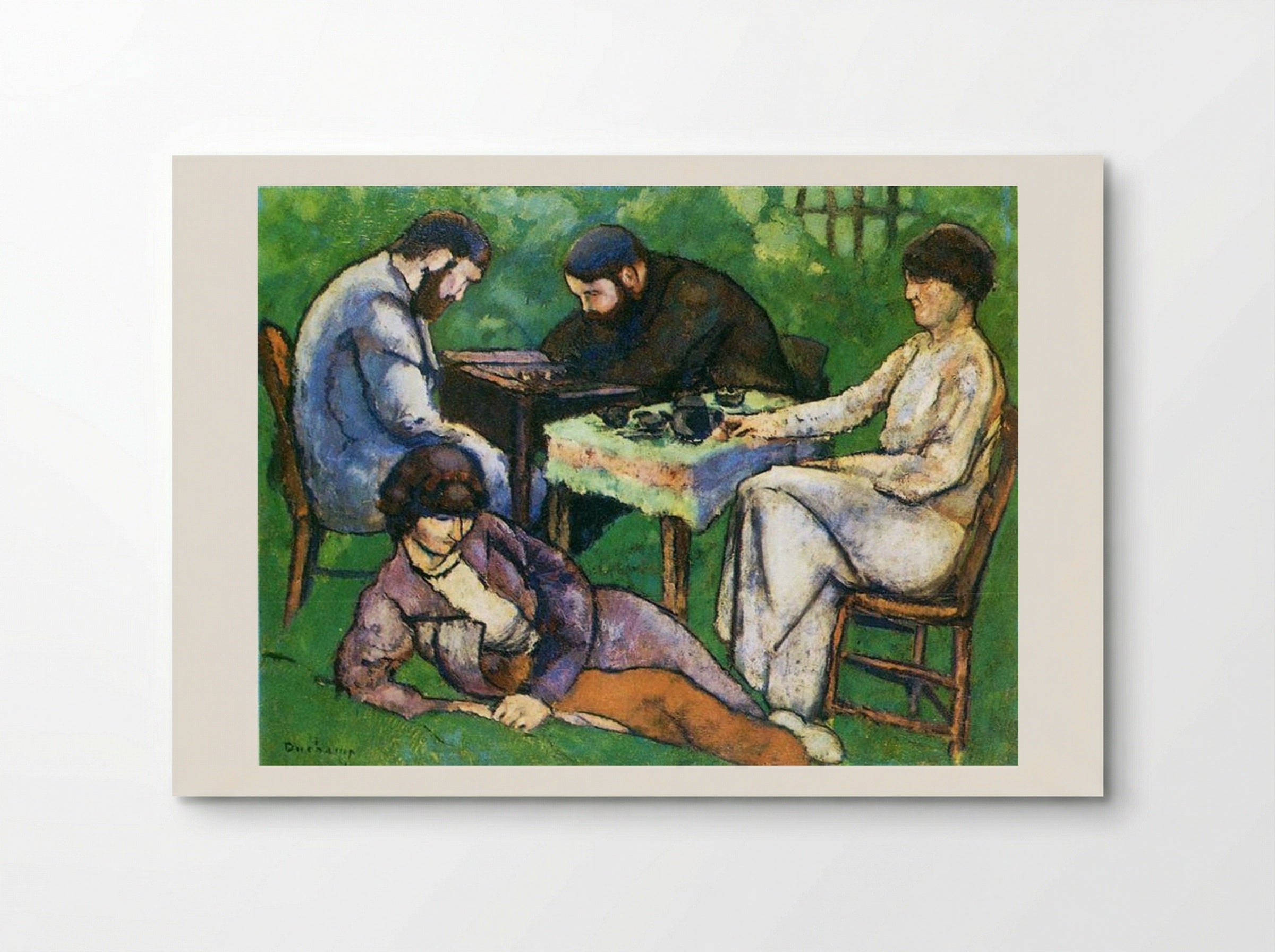
The Chess Game - Marcel Duchamp
Archival giclée
Frames arrive ready to hang
Secure checkout
Made to order
Description
A 1910 oil painting by Marcel Duchamp depicting his brothers playing chess in a garden, showing the influence of Post-Impressionist techniques.
Painted in 1910, The Chess Game captures a quiet, domestic scene featuring the artist's brothers, Gaston Duchamp (Jacques Villon) and Raymond Duchamp-Villon, engaged in a match. A woman, likely Gabrielle Duchamp, sits nearby, while another figure reclines in the foreground. The composition is set within a garden, where the figures are arranged around a small table. The work reflects the influence of Paul Cézanne, particularly in the application of paint and the construction of the figures through distinct, blocky forms. Duchamp employs a palette dominated by greens, ochres, and muted purples. The brushwork is deliberate, creating a sense of weight and solidity in the figures. Unlike his later conceptual works, this painting demonstrates his early engagement with traditional subjects and the formal concerns of the period. The spatial arrangement is somewhat compressed, with the garden background merging with the foreground, a technique that flattens the pictorial space. The focus remains on the psychological stillness of the subjects, who appear absorbed in their respective activities, detached from the viewer. This piece provides insight into the artist's formative years before his transition toward Dadaism and his eventual abandonment of traditional painting. It shows a clear interest in the domestic life of his family, rendered with a sombre, contemplative mood. The painting is part of a series of works from this period that explore the intersection of daily life and artistic experimentation. By examining the interplay of light and shadow, Duchamp creates a scene that feels both intimate and detached, offering a glimpse into the private world of the Duchamp brothers during their time in Puteaux.
Return policy
Because every print is made to order, we don't offer change-of-mind returns, refunds or exchanges. If your order arrives faulty, damaged or incorrect, we'll replace it free of charge — just contact us within 48 hours of delivery. See our refunds page for full details.
Shipping
We ship worldwide, printing at the production hub nearest to your delivery address. Delivery times and costs vary by destination — you'll see the options available to you at checkout.
Manufacturing
Each print is produced to order using 12-colour giclée printing on FSC-certified archival paper. Designed in Britain and printed at your nearest production hub to reduce waste and speed up delivery.
Care and materials
Specific Features
Every Solis piece is made to order with archival, gallery-quality materials built to last.
- Museum-grade giclée printing for rich, fade-resistant colour
- Archival matte fine-art paper, FSC-certified
- Multiple sizes and framing options available
- Frames in black, natural wood, dark wood or white
- Framed prints arrive ready to hang
Care & Cleaning
To keep your artwork looking its best:
- Dust gently with a soft, dry cloth
- Avoid prolonged direct sunlight
- Never use liquid cleaners on the print or canvas surface
- Keep in a dry, room-temperature space
- Handle prints with clean, dry hands
Materials & Sizing
Museum-grade giclée on FSC-certified archival matte paper, with framed and canvas options.
- Paper sizes: A4, A3, A2, A1, A0 and B2 (50×70 cm)
- Canvas: XS (20×30 cm) to Large (60×90 cm)
- Frames: black, natural wood, dark wood or white
The Chess Game - Marcel Duchamp
The Artwork
The Chess Game
Our guide to the original work behind this print.

Artist Biography
Marcel Duchamp
He was born near Rouen in Normandy, the brother of the sculptor Raymond Duchamp-Villon and the painter Jacques Villon. The family produced three significant artists, which is unusual. Marcel was the youngest and the most destructive.
His early career moved through Impressionism, Fauvism, and Cubism in rapid succession. Nude Descending a Staircase No. 2 (1912), a Cubist-Futurist painting of fragmented motion, caused a scandal at the New York Armory Show in 1913. One critic called it 'an explosion in a shingle factory'. The painting made Duchamp famous in America before he had set foot there.
He moved to New York in 1915. His contribution to art from this point was largely conceptual. The 'readymades', ordinary manufactured objects designated as art by the artist's choice (a bottle rack, a snow shovel, the urinal), dismantled the idea that art required skill, craft, or even making. The artist's decision was sufficient.
He spent twenty years officially retired from art, playing chess at a competitive level. In secret, he was building Etant Donnes, an installation visible only through two peepholes in a door. It was revealed after his death in 1968 and is permanently installed at the Philadelphia Museum of Art. He had been working on it for twenty years while telling everyone he had stopped making art.
Why Choose Us ?
Damage-free delivery guarantee
Fast Shipping
Museum-Quality Materials
You May Also Like