

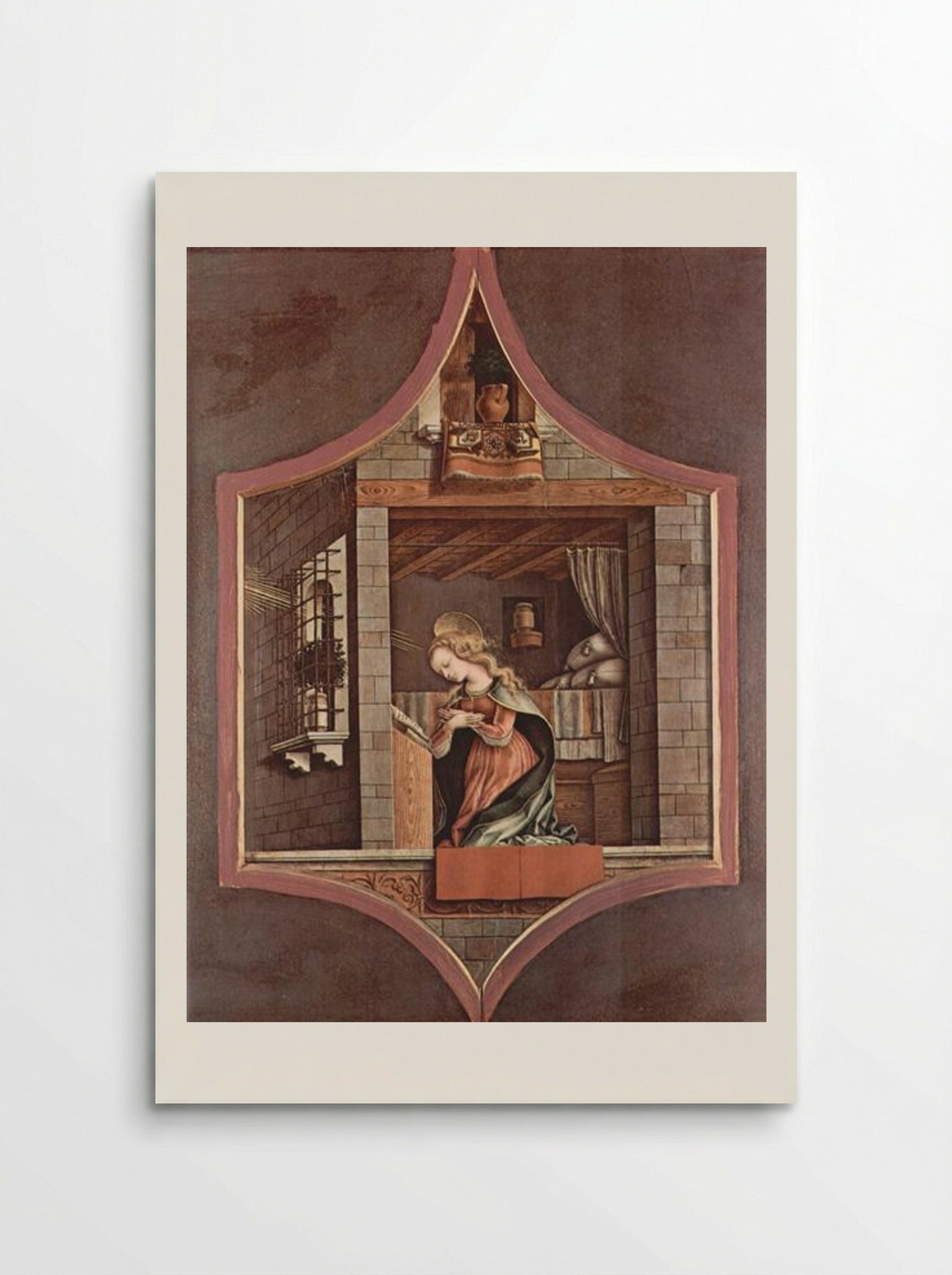
The Annunciation with Saint Emidius - Carlo Crivelli
Archival giclée
Frames arrive ready to hang
Secure checkout
Made to order
Description
Carlo Crivelli's "The Annunciation with Saint Emidius" (1486) captures the moment of the Annunciation with meticulous detail and serene beauty. This tempera on panel work blends Gothic and Renaissance elements, showcasing Crivelli's distinctive style.
Carlo Crivelli's "The Annunciation with Saint Emidius", painted in 1486, is a tempera on panel work that exemplifies the Early Renaissance style. Crivelli, an Italian painter, is known for his distinctive and decorative style, which blends Gothic and Renaissance elements. This painting was commissioned to commemorate the granting of self-government to the town of Ascoli Piceno by Pope Sixtus IV, an event said to have occurred on the Feast of the Annunciation. Saint Emidius, the town's patron saint, is included in the scene holding a model of the town. The painting depicts the moment of the Annunciation, where the Archangel Gabriel informs the Virgin Mary that she will conceive and bear a son. Mary is shown kneeling in a chamber, bathed in light streaming through a window. The architectural setting is rendered with meticulous detail, showcasing Crivelli's skill in creating depth and perspective. The inclusion of various symbolic objects, such as the vase of lilies representing Mary's purity, adds layers of meaning to the composition. The overall effect is one of serene beauty and spiritual significance, characteristic of Crivelli's artistic output.
Return policy
Because every print is made to order, we don't offer change-of-mind returns, refunds or exchanges. If your order arrives faulty, damaged or incorrect, we'll replace it free of charge — just contact us within 48 hours of delivery. See our refunds page for full details.
Shipping
We ship worldwide, printing at the production hub nearest to your delivery address. Delivery times and costs vary by destination — you'll see the options available to you at checkout.
Manufacturing
Each print is produced to order using 12-colour giclée printing on FSC-certified archival paper. Designed in Britain and printed at your nearest production hub to reduce waste and speed up delivery.
Care and materials
Specific Features
Every Solis piece is made to order with archival, gallery-quality materials built to last.
- Museum-grade giclée printing for rich, fade-resistant colour
- Archival matte fine-art paper, FSC-certified
- Multiple sizes and framing options available
- Frames in black, natural wood, dark wood or white
- Framed prints arrive ready to hang
Care & Cleaning
To keep your artwork looking its best:
- Dust gently with a soft, dry cloth
- Avoid prolonged direct sunlight
- Never use liquid cleaners on the print or canvas surface
- Keep in a dry, room-temperature space
- Handle prints with clean, dry hands
Materials & Sizing
Museum-grade giclée on FSC-certified archival matte paper, with framed and canvas options.
- Paper sizes: A4, A3, A2, A1, A0 and B2 (50×70 cm)
- Canvas: XS (20×30 cm) to Large (60×90 cm)
- Frames: black, natural wood, dark wood or white
The Annunciation with Saint Emidius - Carlo Crivelli

Artist Biography
Carlo Crivelli
He had left Venice by 1458, possibly following a conviction for adultery in 1457 that may have made continued residence uncomfortable. The Marche towns, Ascoli Piceno above all, became his territory. He painted nothing but religious subjects: polyptychs, Madonnas, altarpieces designed for specific church niches where the gold-ground backgrounds and the theatrical use of festoons, fruit, and cucumbers would catch the light at specific hours.
The 1486 Annunciation with Saint Emidius, now in the National Gallery in London, is the work that most condenses his method. The architectural setting is precise and Flemish in its love of depth and surface texture; the figures are described with a wiry, almost metallic clarity that owes something to engraving. On the panel he signed it "Opus Caroli Crivelli Veneti Militis", he had been knighted by the Prince of Capua that same year.
His style was conservative by the standards of the 1480s, when Bellini was moving towards atmospheric sfumato and Venetian colour. Crivelli's answer was greater elaboration, not revision.
Why Choose Us ?
Damage-free delivery guarantee
Fast Shipping
Museum-Quality Materials
You May Also Like