

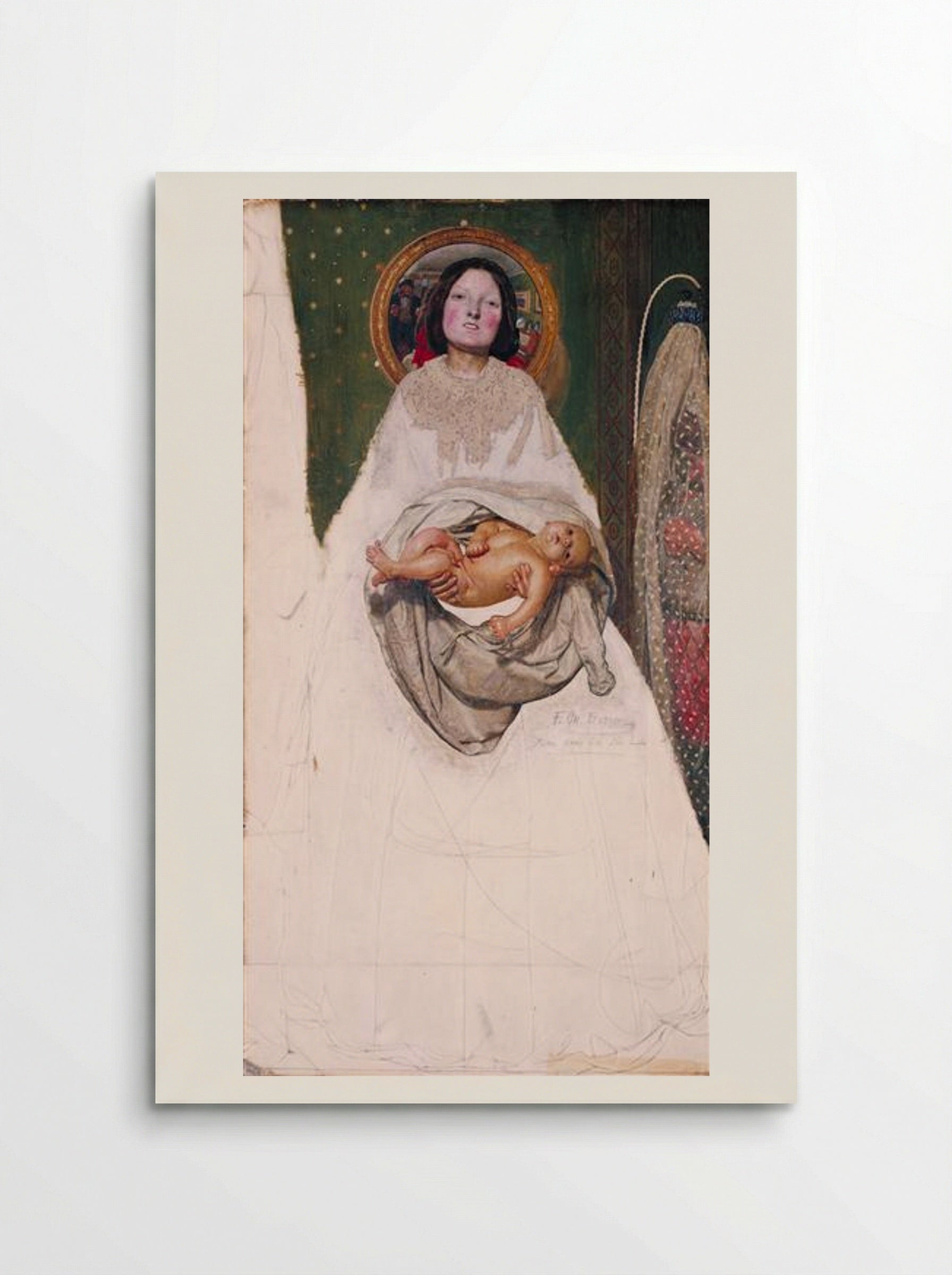
Take your Son, Sir - Ford Madox Brown
Archival giclée
Frames arrive ready to hang
Secure checkout
Made to order
Description
An unfinished Pre-Raphaelite masterpiece by Ford Madox Brown. It depicts a mother presenting her newborn child, featuring a convex mirror reflection and detailed figurative work against a sketched background.
Ford Madox Brown began this oil painting in 1851. It remains one of the most enigmatic works associated with the Pre-Raphaelite circle. The composition depicts a woman holding out a newborn infant toward the viewer. This woman is Emma Hill, the artist's second wife. The title, Take your Son, Sir, suggests a confrontational moment of domestic reality rather than a sentimental scene. The central figure is positioned against a green wallpaper decorated with small stars. Behind her head, a convex mirror creates a circular frame. This placement mimics the traditional iconography of a halo, though the subject matter is firmly secular and contemporary. Within the mirror, the reflection of the father is visible. He reaches out his arms to receive the child. This reflected figure is a self-portrait of Brown himself. The use of the mirror expands the narrative space and places the viewer in the position of the father. The painting is famously unfinished. While the faces of the mother and child are highly detailed, the lower portion of the woman's white dress consists of basic pencil outlines. This technical state allows viewers to see the artist's initial drafting process. The woman's face is pale, with distinct pink patches on her cheeks. Her expression is direct and weary. She wears a white dress with a wide lace collar. The texture of the lace is rendered with the precision typical of the Pre-Raphaelite Brotherhood. Brown worked on the canvas intermittently until 1856. The subject likely relates to the birth of his son, Arthur, in 1856, though he started the work years earlier. The piece captures the tension of Victorian social attitudes toward family and legitimacy. Emma Hill and Brown did not marry until 1853, after the birth of their first child together. The stark lighting and the direct gaze of the mother remove the typical gloss found in Victorian depictions of motherhood.
Return policy
Because every print is made to order, we don't offer change-of-mind returns, refunds or exchanges. If your order arrives faulty, damaged or incorrect, we'll replace it free of charge — just contact us within 48 hours of delivery. See our refunds page for full details.
Shipping
We ship worldwide, printing at the production hub nearest to your delivery address. Delivery times and costs vary by destination — you'll see the options available to you at checkout.
Manufacturing
Each print is produced to order using 12-colour giclée printing on FSC-certified archival paper. Designed in Britain and printed at your nearest production hub to reduce waste and speed up delivery.
Take your Son, Sir - Ford Madox Brown

Artist Biography
Ford Madox Brown
He was born in Calais in 1821, trained across Europe, and settled in London. Though never an official member of the Pre-Raphaelite Brotherhood, he was their most important older ally and the teacher who most shaped their ambitions. His insistence on painting outdoors in natural light, often to the point of physical discomfort, and his dense, moralising compositions made him a bridge between the Nazarenes he had studied with in Rome and the young English radicals who followed.
He also designed stained glass and furniture for Morris and Co. He died in 1893, at seventy-two.
Our Features
Designed for Lasting Impact
Specific Features
Every Solis piece is made to order with archival, gallery-quality materials built to last.
- Museum-grade giclée printing for rich, fade-resistant colour
- Archival matte fine-art paper, FSC-certified
- Multiple sizes and framing options available
- Frames in black, natural wood, dark wood or white
- Framed prints arrive ready to hang
Care & Cleaning
To keep your artwork looking its best:
- Dust gently with a soft, dry cloth
- Avoid prolonged direct sunlight
- Never use liquid cleaners on the print or canvas surface
- Keep in a dry, room-temperature space
- Handle prints with clean, dry hands
Materials & Sizing
Museum-grade giclée on FSC-certified archival matte paper, with framed and canvas options.
- Paper sizes: A4, A3, A2, A1, A0 and B2 (50×70 cm)
- Canvas: XS (20×30 cm) to Large (60×90 cm)
- Frames: black, natural wood, dark wood or white
Why Choose Us ?
Damage-free delivery guarantee
Fast Shipping
Museum-Quality Materials
Artist Biography
Ford Madox Brown
He was born in Calais in 1821, trained across Europe, and settled in London. Though never an official member of the Pre-Raphaelite Brotherhood, he was their most important older ally and the teacher who most shaped their ambitions. His insistence on painting outdoors in natural light, often to the point of physical discomfort, and his dense, moralising compositions made him a bridge between the Nazarenes he had studied with in Rome and the young English radicals who followed.
He also designed stained glass and furniture for Morris and Co. He died in 1893, at seventy-two.
You May Also Like