

Fine Art Poster
From £28
A giclée print on 200gsm matte fine art paper, using a twelve-colour process for accurate, fade-resistant colour. Supplied unframed, delivered flat or rolled.



Archival giclée
Frames arrive ready to hang
Secure checkout
Made to order
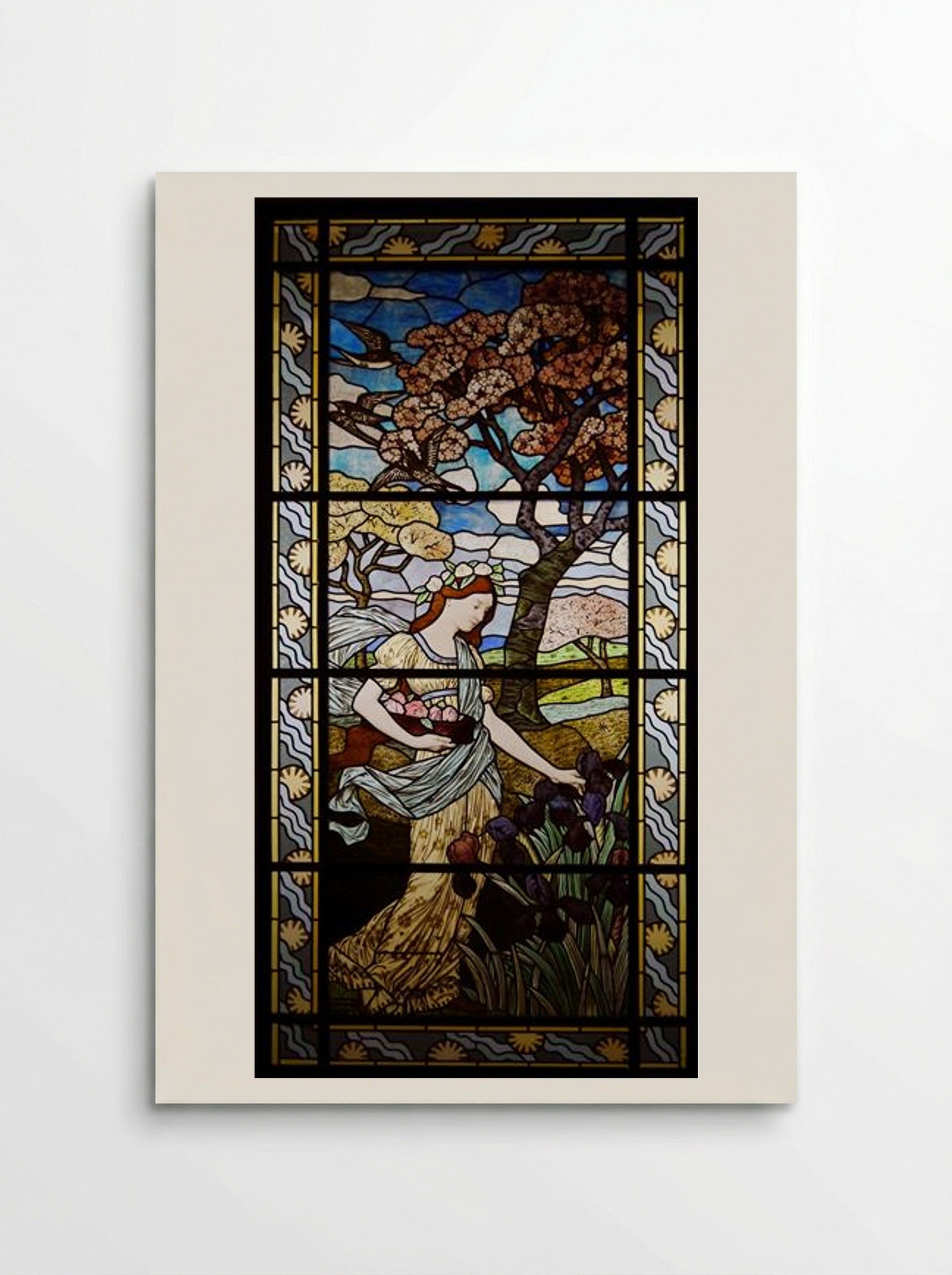
An allegorical stained glass design by Eugène Grasset, depicting a female figure representing spring amidst flowering irises and a blossoming tree.
Eugène Grasset, a Swiss designer active in France, produced this work during the height of the Art Nouveau movement. The composition depicts a female figure personifying the season of spring. She wears a floral crown and carries a basket of blossoms, while reaching towards a cluster of irises. The background features a flowering tree and birds in flight, framed by a decorative border of repeating wave and sun motifs. Grasset was a significant figure in the development of modern graphic design and decorative arts. His approach combined a study of natural forms with the stylised geometry characteristic of the period. The use of leaded lines in this stained glass piece defines the contours of the figure and the surrounding flora, creating a clear separation between the foreground and the sky. The colour palette relies on soft blues, earthy browns, and muted yellows, which reflect the transition from winter to the warmer months. This piece demonstrates the influence of Japanese woodblock prints on European artists of the late nineteenth century, particularly in the flat treatment of the sky and the rhythmic arrangement of the border. The figure is rendered with a sense of grace, typical of Grasset's illustrations for posters and books. The work functions as a decorative panel, intended to bring the natural world into an interior space through the medium of light and glass. By focusing on the seasonal cycle, Grasset connects the viewer to the rhythms of nature, a common theme in his broader body of work. The balance between the organic shapes of the flowers and the structured grid of the lead cames provides a sense of order to the scene, ensuring the composition remains coherent when viewed as a whole.
Because every print is made to order, we don't offer change-of-mind returns, refunds or exchanges. If your order arrives faulty, damaged or incorrect, we'll replace it free of charge — just contact us within 48 hours of delivery. See our refunds page for full details.
We ship worldwide, printing at the production hub nearest to your delivery address. Delivery times and costs vary by destination — you'll see the options available to you at checkout.
Each print is produced to order using 12-colour giclée printing on FSC-certified archival paper. Designed in Britain and printed at your nearest production hub to reduce waste and speed up delivery.

Artist Biography
Our Features
Designed for Lasting Impact
Every Solis piece is made to order with archival, gallery-quality materials built to last.
To keep your artwork looking its best:
Museum-grade giclée on FSC-certified archival matte paper, with framed and canvas options.
Made to order
Every piece is printed to order. These are the five finishes, and what makes each one different.
From £28
A giclée print on 200gsm matte fine art paper, using a twelve-colour process for accurate, fade-resistant colour. Supplied unframed, delivered flat or rolled.

From £45
The same fine art print in a solid wood frame with UV-protective acrylic glaze and rigid backing. Five frame colours. Arrives ready to hang.

From £85
A deeper solid wood frame: 33mm deep with a 20mm face and Perspex glaze. The print sits unmounted for a clean gallery presentation. Black, white or natural.

From £30
Hand-stretched canvas with neat gallery-wrapped edges, giving the artwork surface texture and depth. Arrives ready to hang.

From £135
Stretched canvas set in a floating wood frame, our most substantial finish. Arrives ready to hang.
Why Choose Us ?
Damage-free delivery guarantee
Fast Shipping
Museum-Quality Materials
Artist Biography
Eugène Grasset
You May Also Like
We use cookies to measure our marketing and see which prints people love.We use cookies to measure our marketing.
By continuing to browse, you agree · Privacy Policy