

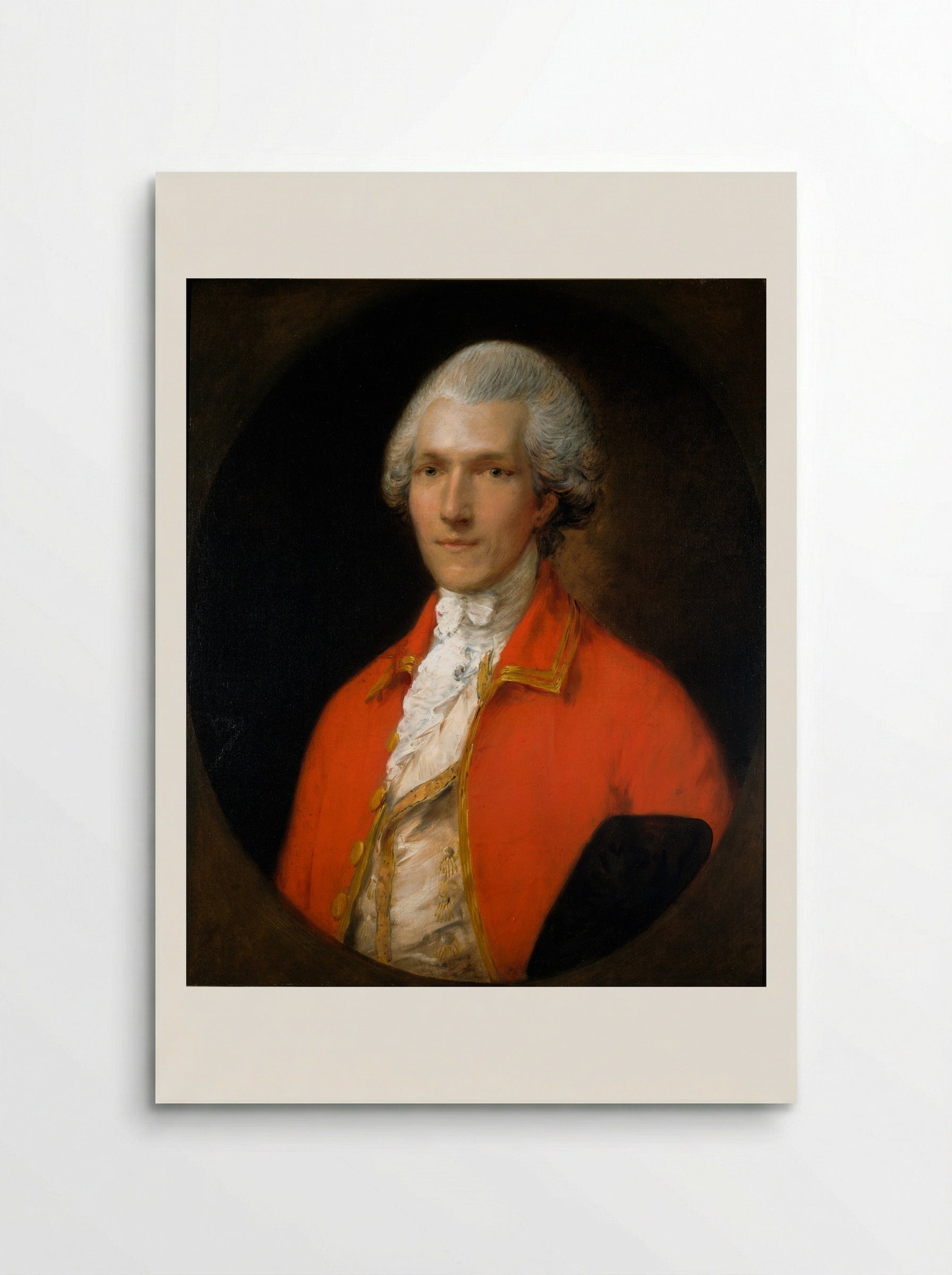
Sir Benjamin Thompson, later Count Rumford - Thomas Gainsborough
Archival giclée
Frames arrive ready to hang
Secure checkout
Made to order
Description
A portrait of the scientist Sir Benjamin Thompson by Thomas Gainsborough, featuring the subject in a distinctive red coat.
This portrait depicts Sir Benjamin Thompson, a scientist and inventor who later became known as Count Rumford. Painted by Thomas Gainsborough around 1783, the work captures the subject in a formal military-style coat of striking red, contrasted against a dark, atmospheric background. Gainsborough employs his characteristic fluid brushwork, particularly visible in the treatment of the subject's powdered wig and the delicate lace cravat at his throat. The composition is framed within a painted oval, a common device in eighteenth-century portraiture to focus the viewer's attention on the sitter's features. Thompson is presented with a calm, composed expression, reflecting the intellectual confidence of a man whose career spanned military service, scientific research, and social reform. The play of light across the red fabric of his coat demonstrates Gainsborough's ability to render texture and colour with economy and grace. Gainsborough was one of the most successful portraitists of his era, often favouring a lighter, more painterly touch than his contemporaries. In this piece, the artist avoids rigid formality, opting instead for a sense of immediacy. The sitter's gaze is direct, engaging the viewer while maintaining a sense of aristocratic distance. The palette is restrained, allowing the warmth of the red coat to dominate the visual field without overwhelming the subtle flesh tones of the face. This print offers a clear reproduction of the original oil painting, preserving the nuances of Gainsborough's technique and the historical character of the sitter.
Return policy
Because every print is made to order, we don't offer change-of-mind returns, refunds or exchanges. If your order arrives faulty, damaged or incorrect, we'll replace it free of charge — just contact us within 48 hours of delivery. See our refunds page for full details.
Shipping
We ship worldwide, printing at the production hub nearest to your delivery address. Delivery times and costs vary by destination — you'll see the options available to you at checkout.
Manufacturing
Each print is produced to order using 12-colour giclée printing on FSC-certified archival paper. Designed in Britain and printed at your nearest production hub to reduce waste and speed up delivery.
Care and materials
Specific Features
Every Solis piece is made to order with archival, gallery-quality materials built to last.
- Museum-grade giclée printing for rich, fade-resistant colour
- Archival matte fine-art paper, FSC-certified
- Multiple sizes and framing options available
- Frames in black, natural wood, dark wood or white
- Framed prints arrive ready to hang
Care & Cleaning
To keep your artwork looking its best:
- Dust gently with a soft, dry cloth
- Avoid prolonged direct sunlight
- Never use liquid cleaners on the print or canvas surface
- Keep in a dry, room-temperature space
- Handle prints with clean, dry hands
Materials & Sizing
Museum-grade giclée on FSC-certified archival matte paper, with framed and canvas options.
- Paper sizes: A4, A3, A2, A1, A0 and B2 (50×70 cm)
- Canvas: XS (20×30 cm) to Large (60×90 cm)
- Frames: black, natural wood, dark wood or white
Sir Benjamin Thompson, later Count Rumford - Thomas Gainsborough

Artist Biography
Thomas Gainsborough
He was born in Sudbury, Suffolk, in 1727. His father went bankrupt in 1733. He moved to London as a teenager and trained under the French engraver Hubert-Francois Gravelot. By his thirties he was one of the two dominant portrait painters in Georgian England, the other being Joshua Reynolds. The rivalry with Reynolds defined both their careers.
The Blue Boy is probably his most famous painting, though he would have preferred to be remembered for his landscapes. On his deathbed he reconciled with Reynolds. Reynolds later wrote that the Royal Academy had lost one of its greatest ornaments. Gainsborough died in 1788, aged sixty-one.
Why Choose Us ?
Damage-free delivery guarantee
Fast Shipping
Museum-Quality Materials
You May Also Like