

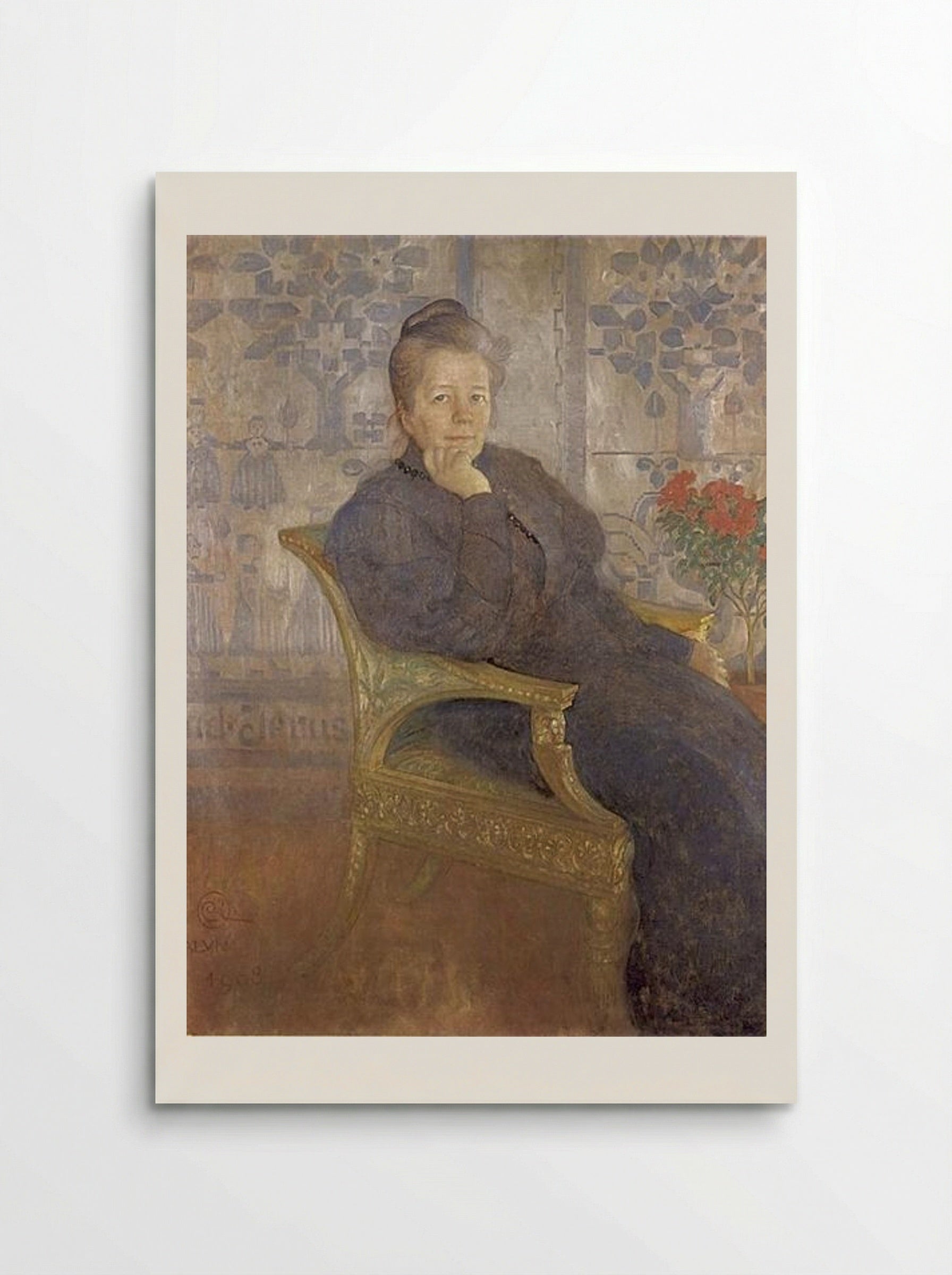
Selma Lagerlöf - Carl Larsson
Archival giclée
Frames arrive ready to hang
Secure checkout
Made to order
Description
A portrait of Selma Lagerlöf by Carl Larsson, painted in 1908. The artwork captures the Swedish author in a moment of quiet reflection, rendered with warmth and attention to detail.
This portrait by Carl Larsson depicts Selma Lagerlöf, the Swedish author and Nobel laureate. Painted in 1908, the work captures Lagerlöf in a moment of quiet contemplation. Larsson, known for his idyllic scenes of Swedish family life, brings a more formal approach to this commission, yet retains his characteristic warmth and attention to detail. Lagerlöf is seated in an ornate chair, her dark dress contrasting with the patterned wallpaper behind her. The composition is carefully balanced, with a vase of red flowers adding a touch of colour to the muted palette. Larsson's skill in rendering textures and light is evident in the way he portrays Lagerlöf's features and the details of her surroundings. The portrait offers a glimpse into the world of one of Sweden's most celebrated writers, captured by a leading artist of the time. The painting reflects the cultural milieu of early 20th-century Sweden, a period of artistic and literary flourishing.
Return policy
Because every print is made to order, we don't offer change-of-mind returns, refunds or exchanges. If your order arrives faulty, damaged or incorrect, we'll replace it free of charge — just contact us within 48 hours of delivery. See our refunds page for full details.
Shipping
We ship worldwide, printing at the production hub nearest to your delivery address. Delivery times and costs vary by destination — you'll see the options available to you at checkout.
Manufacturing
Each print is produced to order using 12-colour giclée printing on FSC-certified archival paper. Designed in Britain and printed at your nearest production hub to reduce waste and speed up delivery.
Care and materials
Specific Features
Every Solis piece is made to order with archival, gallery-quality materials built to last.
- Museum-grade giclée printing for rich, fade-resistant colour
- Archival matte fine-art paper, FSC-certified
- Multiple sizes and framing options available
- Frames in black, natural wood, dark wood or white
- Framed prints arrive ready to hang
Care & Cleaning
To keep your artwork looking its best:
- Dust gently with a soft, dry cloth
- Avoid prolonged direct sunlight
- Never use liquid cleaners on the print or canvas surface
- Keep in a dry, room-temperature space
- Handle prints with clean, dry hands
Materials & Sizing
Museum-grade giclée on FSC-certified archival matte paper, with framed and canvas options.
- Paper sizes: A4, A3, A2, A1, A0 and B2 (50×70 cm)
- Canvas: XS (20×30 cm) to Large (60×90 cm)
- Frames: black, natural wood, dark wood or white
Selma Lagerlöf - Carl Larsson

Artist Biography
Carl Larsson
He struggled for years, working as an illustrator and retoucher of photographs while trying to establish himself as a painter. In 1882, at an artists' colony in Grez-sur-Loing outside Paris, he met the artist Karin Bergoo. They married, and everything changed. The watercolours he began painting in Grez were lighter, more fluid and more personal than anything he had produced before.
In 1888 Karin's father gave them a small house called Lilla Hyttnas in Sundborn, a village in Dalarna. The house became their joint project: Carl painted it, Karin designed the interiors, the furniture, the textiles, the colour schemes. The result was one of the most influential domestic interiors in Scandinavian design, a prototype for what would eventually become Swedish modernism. He painted the house and the family inside it (they had eight children) in watercolours that were published as a book, Ett Hem (A Home), in 1899. It sold across Europe.
The paintings of Sundborn are warm, bright and apparently effortless, which made people assume his life was too. It was not. He suffered depression in his later years and had a stroke in 1919. His most ambitious painting, Midvinterblot, a monumental canvas of a Viking midwinter sacrifice, was rejected by the National Museum. He admitted in his memoirs that the pictures of his family and home had become the most lasting part of his work. He was right.
Why Choose Us ?
Damage-free delivery guarantee
Fast Shipping
Museum-Quality Materials
You May Also Like