

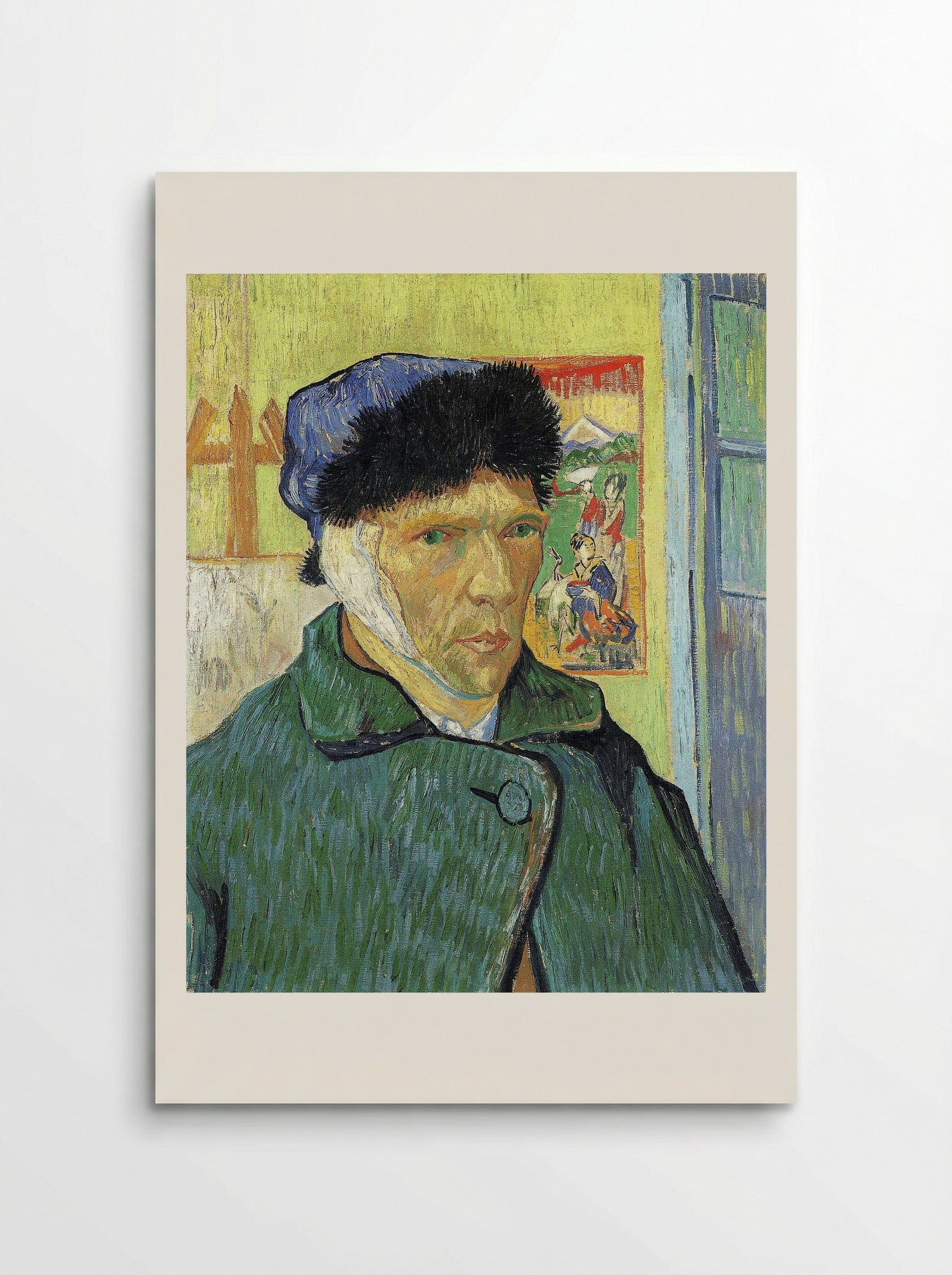


Self-Portrait with Bandaged Ear - Vincent van Gogh
Archival giclée
Ready to hang
Secure checkout
Made to order
Description
Vincent van Gogh's 'Self-Portrait with Bandaged Ear', painted in 1889, is a powerful depiction of the artist during a period of mental distress, showcasing his distinctive brushwork and use of colour.
Painted in 1889, this self-portrait captures Vincent van Gogh shortly after a mental breakdown that led to the self-mutilation of his ear. The work is one of several self-portraits he created during his stay at an asylum in Saint-Rémy, France. These portraits served as a means for the artist to explore his identity and mental state during a period of intense personal turmoil. Van Gogh's distinctive brushwork is evident in the swirling strokes that define his features and clothing. The colour palette is subdued, dominated by greens and blues, which contribute to the overall mood of introspection and melancholy. The bandage covering his ear is a stark reminder of his suffering, yet his gaze remains direct and unwavering. In the background, a Japanese print can be seen, reflecting Van Gogh's interest in Japanese art and culture, which influenced his use of colour and composition.
Return policy
Because every print is made to order, we don't offer change-of-mind returns, refunds or exchanges. If your order arrives faulty, damaged or incorrect, we'll replace it free of charge — just contact us within 48 hours of delivery. EU customers have a 14-day cooling-off right. See our refunds page for full details.
Shipping
We ship worldwide, printing at the production hub nearest to your delivery address. Delivery times and costs vary by destination — you'll see the options available to you at checkout.
Manufacturing
Each print is produced to order using 12-colour giclée printing on FSC-certified archival paper. Designed in Britain and printed at your nearest production hub to reduce waste and speed up delivery.
Self-Portrait with Bandaged Ear - Vincent van Gogh
Our Features
Designed for Lasting Impact
Specific Features
Every Solis piece is made to order with archival, gallery-quality materials built to last.
- Museum-grade giclée printing for rich, fade-resistant colour
- Archival matte fine-art paper, FSC-certified
- Choose poster, framed print, canvas or framed canvas
- Frames in black, natural wood, dark wood or white
- Framed prints arrive ready to hang
Care & Cleaning
To keep your artwork looking its best:
- Dust gently with a soft, dry cloth
- Avoid prolonged direct sunlight
- Never use liquid cleaners on the print or canvas surface
- Keep in a dry, room-temperature space
- Handle prints with clean, dry hands
Materials & Sizing
Museum-grade giclée on FSC-certified archival matte paper, with framed and canvas options.
- Paper sizes: A4, A3, A2, A1, A0 and B2 (50×70 cm)
- Canvas: XS (20×30 cm) to Large (60×90 cm)
- Frames: black, natural wood, dark wood or white
Why Choose Us ?
100% Satisfaction Guarantee
Fast Shipping
Museum-Quality Materials

Artist Biography
Vincent van Gogh
He taught himself to draw by copying prints and working through textbooks. His brother Theo, an art dealer in Paris, sent money every month for the rest of Vincent's life. Without Theo there are no paintings. The letters between them, over 600, are one of the most complete records of any artist's thinking. Van Gogh wrote about colour theory, composition, what he ate, what he read, how much he spent on paint. He was articulate and well-read and not, despite the popular version, simply mad.
He moved to Paris in 1886 and encountered Impressionism. The palette changed immediately: from the dark browns of his Dutch period to the colours people actually associate with his work. He met Gauguin, Pissarro, Signac, Toulouse-Lautrec. He absorbed Pointillism and Japanese prints. Then he moved to Arles in the south of France, where the light was better and people were fewer.
The Arles period produced Sunflowers, The Bedroom, Starry Night Over the Rhone. The breakdown followed: the argument with Gauguin, the severed ear (he cut part of his left ear, not the whole thing), the asylum at Saint-Remy, and then Auvers-sur-Oise, where he painted seventy canvases in seventy days before dying from a gunshot wound at thirty-seven. He sold one painting during his lifetime, or possibly two. Theo died six months later.
You May Also Like