



Self-Portrait of the Painter Jan Toorop - Jan Toorop
Archival giclée
Ready to hang
Secure checkout
Made to order
Description
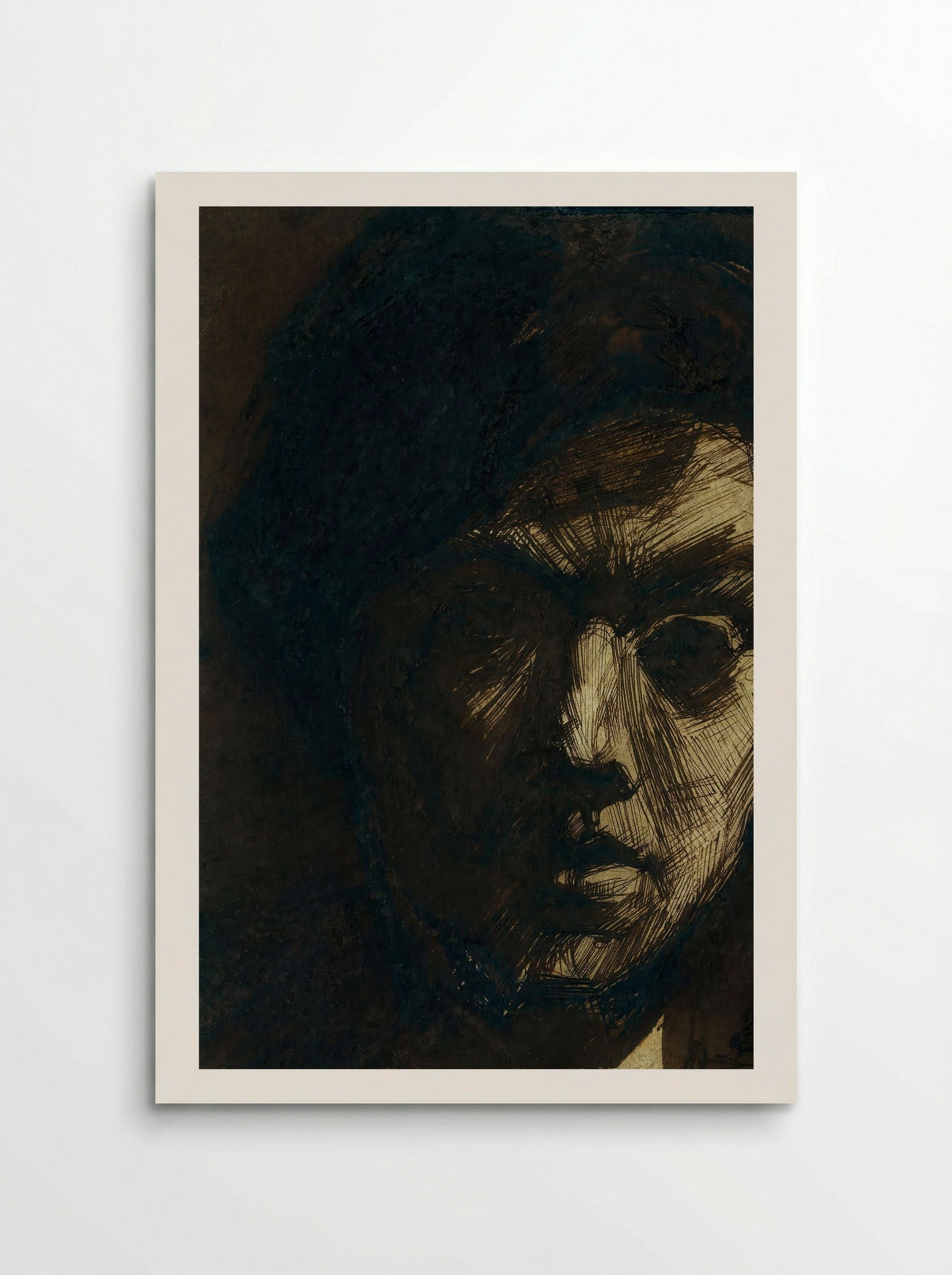
A dramatic self-portrait by Dutch Symbolist Jan Toorop, rendered in strong lines and a dark palette. This intense image offers a glimpse into the artist's early development and would make a sophisticated addition to any home.
This striking self-portrait by Jan Toorop, created in 1880, offers a glimpse into the artist's early development. Toorop, a Dutch artist who later became a significant figure in the Symbolist movement, captures his own likeness with a raw and expressive intensity. The portrait is rendered in a monochromatic palette, dominated by dark browns and blacks, which adds to its dramatic effect. The artist's face emerges from the shadows, with strong, angular lines defining his features. The use of hatching and cross-hatching creates a sense of depth and texture, while also conveying a feeling of introspection and perhaps even unease. Toorop's self-portrait is a compelling example of late 19th-century portraiture, reflecting the growing interest in psychological depth and emotional expression. As a fine art print, this image would make a sophisticated addition to any home. Its dramatic composition and intense gaze are sure to draw the eye, while its historical significance adds a layer of intellectual interest. It would be particularly well-suited to a study, living room, or hallway, where its dark palette and expressive lines can be fully appreciated.
Return policy
Because every print is made to order, we don't offer change-of-mind returns, refunds or exchanges. If your order arrives faulty, damaged or incorrect, we'll replace it free of charge — just contact us within 48 hours of delivery. EU customers have a 14-day cooling-off right. See our refunds page for full details.
Shipping
We ship worldwide, printing at the production hub nearest to your delivery address. Delivery times and costs vary by destination — you'll see the options available to you at checkout.
Manufacturing
Each print is produced to order using 12-colour giclée printing on FSC-certified archival paper. Designed in Britain and printed at your nearest production hub to reduce waste and speed up delivery.
Self-Portrait of the Painter Jan Toorop - Jan Toorop
Our Features
Designed for Lasting Impact
Specific Features
Every Solis piece is made to order with archival, gallery-quality materials built to last.
- Museum-grade giclée printing for rich, fade-resistant colour
- Archival matte fine-art paper, FSC-certified
- Choose poster, framed print, canvas or framed canvas
- Frames in black, natural wood, dark wood or white
- Framed prints arrive ready to hang
Care & Cleaning
To keep your artwork looking its best:
- Dust gently with a soft, dry cloth
- Avoid prolonged direct sunlight
- Never use liquid cleaners on the print or canvas surface
- Keep in a dry, room-temperature space
- Handle prints with clean, dry hands
Materials & Sizing
Museum-grade giclée on FSC-certified archival matte paper, with framed and canvas options.
- Paper sizes: A4, A3, A2, A1, A0 and B2 (50×70 cm)
- Canvas: XS (20×30 cm) to Large (60×90 cm)
- Frames: black, natural wood, dark wood or white
Why Choose Us ?
100% Satisfaction Guarantee
Fast Shipping
Museum-Quality Materials

Artist Biography
Jan Toorop
Toorop's willingness to experiment extended beyond style to subject matter. He captured not only ethereal visions but also the realities of working-class life, as seen in his depictions of labourers in the docks of Rotterdam. This social consciousness, combined with his stylistic versatility, made him a key figure in the development of modern Dutch art. He was a vital link between the Hague School and later movements.
Despite his significance, Toorop remains somewhat under-appreciated outside the Netherlands. His impact on artists such as Gustav Klimt is well-documented, and his synthesis of Eastern and Western influences feels remarkably contemporary. Owning a Jan Toorop print is not just acquiring a beautiful image; it's possessing a piece of art history, a testament to the power of cross-cultural dialogue and artistic innovation.
You May Also Like