

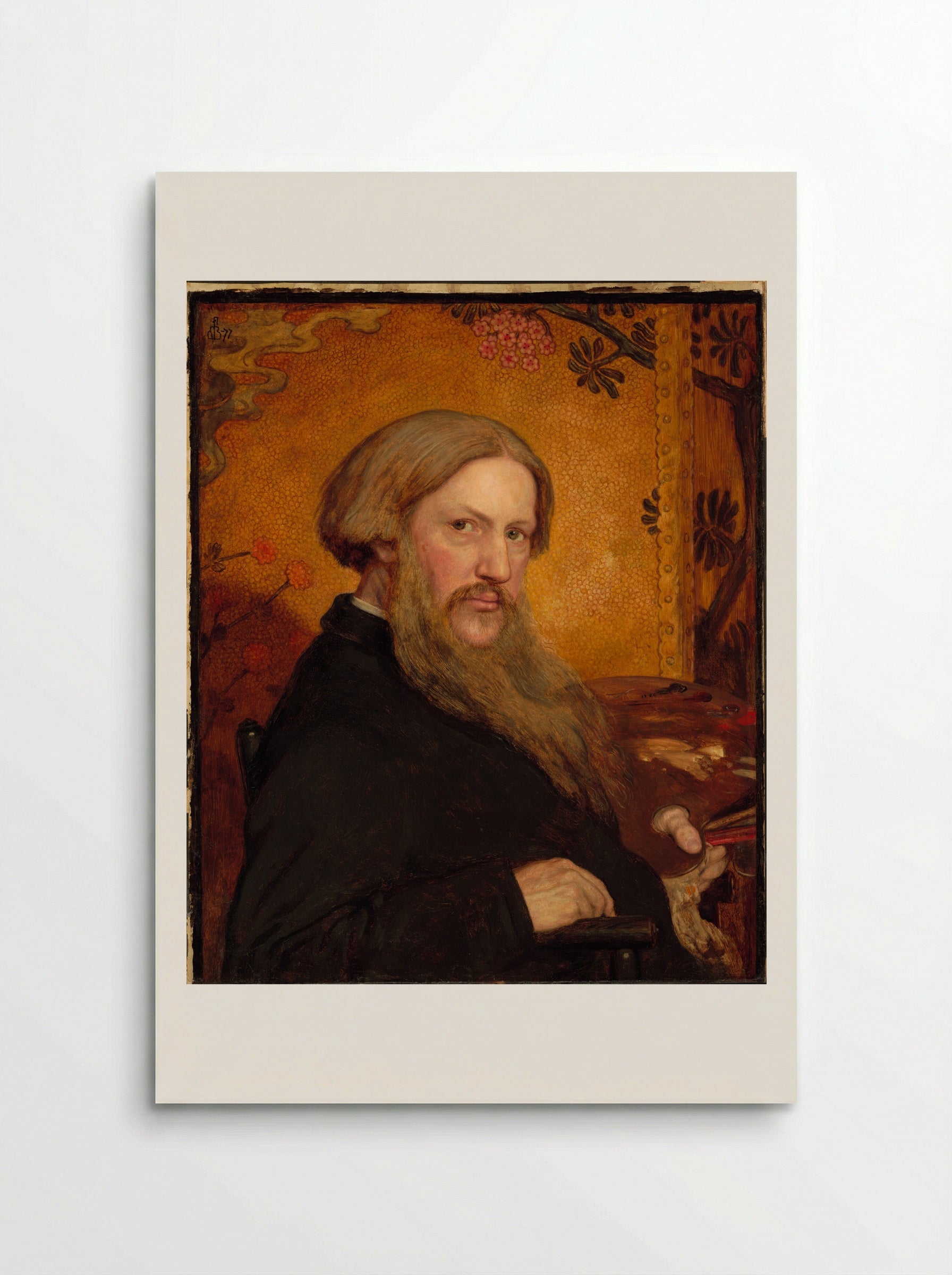
Self-Portrait - Ford Madox Brown
Archival giclée
Frames arrive ready to hang
Secure checkout
Made to order
Description
A striking 1877 self-portrait by Ford Madox Brown, featuring the artist with his palette against a decorative, golden-hued background.
Ford Madox Brown painted this self-portrait in 1877, a period when his mature style had moved towards a decorative, almost flattened treatment of space. The artist depicts himself in a three-quarter view, holding a palette, which identifies him clearly as a working painter. His long, flowing beard and direct gaze provide a sense of immediate presence. The background is particularly notable for its departure from traditional portraiture: it features a textured, golden surface adorned with stylised floral motifs, reminiscent of the aesthetic interests shared by the Pre-Raphaelite circle and the emerging Arts and Crafts movement. Brown was a central figure in the British art scene of the nineteenth century, though he remained technically outside the official Pre-Raphaelite Brotherhood. His work often combined moral narrative with a rigorous attention to detail. In this portrait, the contrast between the dark, sombre tones of his clothing and the luminous, amber-hued background creates a distinct visual tension. The application of paint is precise, reflecting his training in the continental academies, yet the composition feels modern in its rejection of deep, illusionistic space in favour of a more graphic, surface-oriented arrangement. The monogram in the upper left corner, accompanied by the date, confirms the work as a deliberate statement of his identity as an artist during his later years in Manchester. This piece offers a window into the personal and professional world of a man who navigated the shifting currents of Victorian art with independence and technical skill.
Return policy
Because every print is made to order, we don't offer change-of-mind returns, refunds or exchanges. If your order arrives faulty, damaged or incorrect, we'll replace it free of charge — just contact us within 48 hours of delivery. See our refunds page for full details.
Shipping
We ship worldwide, printing at the production hub nearest to your delivery address. Delivery times and costs vary by destination — you'll see the options available to you at checkout.
Manufacturing
Each print is produced to order using 12-colour giclée printing on FSC-certified archival paper. Designed in Britain and printed at your nearest production hub to reduce waste and speed up delivery.
Self-Portrait - Ford Madox Brown

Artist Biography
Ford Madox Brown
He was born in Calais in 1821, trained across Europe, and settled in London. Though never an official member of the Pre-Raphaelite Brotherhood, he was their most important older ally and the teacher who most shaped their ambitions. His insistence on painting outdoors in natural light, often to the point of physical discomfort, and his dense, moralising compositions made him a bridge between the Nazarenes he had studied with in Rome and the young English radicals who followed.
He also designed stained glass and furniture for Morris and Co. He died in 1893, at seventy-two.
Our Features
Designed for Lasting Impact
Specific Features
Every Solis piece is made to order with archival, gallery-quality materials built to last.
- Museum-grade giclée printing for rich, fade-resistant colour
- Archival matte fine-art paper, FSC-certified
- Multiple sizes and framing options available
- Frames in black, natural wood, dark wood or white
- Framed prints arrive ready to hang
Care & Cleaning
To keep your artwork looking its best:
- Dust gently with a soft, dry cloth
- Avoid prolonged direct sunlight
- Never use liquid cleaners on the print or canvas surface
- Keep in a dry, room-temperature space
- Handle prints with clean, dry hands
Materials & Sizing
Museum-grade giclée on FSC-certified archival matte paper, with framed and canvas options.
- Paper sizes: A4, A3, A2, A1, A0 and B2 (50×70 cm)
- Canvas: XS (20×30 cm) to Large (60×90 cm)
- Frames: black, natural wood, dark wood or white
Why Choose Us ?
Damage-free delivery guarantee
Fast Shipping
Museum-Quality Materials
Artist Biography
Ford Madox Brown
He was born in Calais in 1821, trained across Europe, and settled in London. Though never an official member of the Pre-Raphaelite Brotherhood, he was their most important older ally and the teacher who most shaped their ambitions. His insistence on painting outdoors in natural light, often to the point of physical discomfort, and his dense, moralising compositions made him a bridge between the Nazarenes he had studied with in Rome and the young English radicals who followed.
He also designed stained glass and furniture for Morris and Co. He died in 1893, at seventy-two.
You May Also Like