

Fine Art Poster
From £28
A giclée print on 200gsm matte fine art paper, using a twelve-colour process for accurate, fade-resistant colour. Supplied unframed, delivered flat or rolled.



Archival giclée
Frames arrive ready to hang
Secure checkout
Made to order
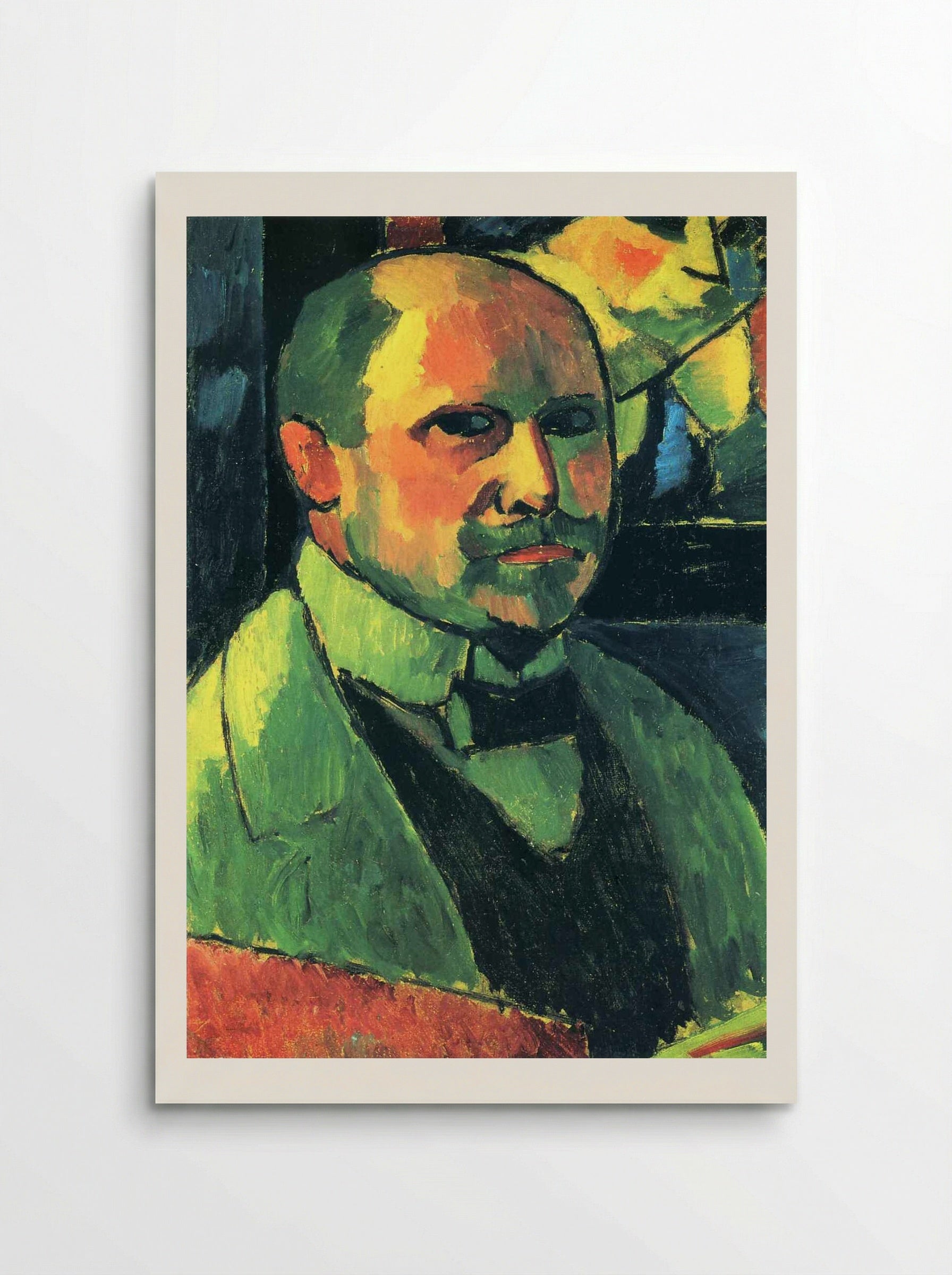
A striking 1912 self-portrait by Alexej von Jawlensky, featuring bold, non-naturalistic colours and strong outlines characteristic of his Expressionist style.
This self-portrait by Alexej von Jawlensky, painted in 1912, captures the artist during his period of association with the Der Blaue Reiter group in Munich. Jawlensky, a Russian painter who spent much of his career in Germany, utilised a bold, non-naturalistic palette to convey psychological intensity rather than mere physical likeness. The composition is dominated by strong, flat planes of colour, a technique influenced by his interest in both Fauvism and the spiritual dimensions of Russian icon painting. The artist depicts himself with a direct, unblinking gaze. His face is constructed from contrasting zones of yellow, orange, and green, which depart from traditional skin tones to suggest an internal state of being. The dark, heavy outlines define the facial features and the lapels of his jacket, creating a sense of structural solidity against the more fluid, abstract background. The use of a bright green hue across the lower portion of the face and the jacket serves to anchor the figure, while the background elements remain ambiguous and suggestive. Jawlensky often explored the human face as a vehicle for spiritual expression. In this work, the reduction of form and the deliberate choice of colour demonstrate his move away from representational accuracy toward a more subjective mode of depiction. The painting reflects the broader European interest in the early twentieth century for using colour as an autonomous element, capable of communicating emotion independently of the subject matter. This print reproduces the textures of the original oil on board, maintaining the intensity of the pigments and the deliberate brushwork that characterises Jawlensky's approach to the portrait genre during his most productive years in Germany.
Because every print is made to order, we don't offer change-of-mind returns, refunds or exchanges. If your order arrives faulty, damaged or incorrect, we'll replace it free of charge — just contact us within 48 hours of delivery. See our refunds page for full details.
We ship worldwide, printing at the production hub nearest to your delivery address. Delivery times and costs vary by destination — you'll see the options available to you at checkout.
Each print is produced to order using 12-colour giclée printing on FSC-certified archival paper. Designed in Britain and printed at your nearest production hub to reduce waste and speed up delivery.

Artist Biography
Our Features
Designed for Lasting Impact
Every Solis piece is made to order with archival, gallery-quality materials built to last.
To keep your artwork looking its best:
Museum-grade giclée on FSC-certified archival matte paper, with framed and canvas options.
Made to order
Every piece is printed to order. These are the five finishes, and what makes each one different.
From £28
A giclée print on 200gsm matte fine art paper, using a twelve-colour process for accurate, fade-resistant colour. Supplied unframed, delivered flat or rolled.

From £45
The same fine art print in a solid wood frame with UV-protective acrylic glaze and rigid backing. Five frame colours. Arrives ready to hang.

From £85
A deeper solid wood frame: 33mm deep with a 20mm face and Perspex glaze. The print sits unmounted for a clean gallery presentation. Black, white or natural.

From £30
Hand-stretched canvas with neat gallery-wrapped edges, giving the artwork surface texture and depth. Arrives ready to hang.

From £135
Stretched canvas set in a floating wood frame, our most substantial finish. Arrives ready to hang.
Why Choose Us ?
Damage-free delivery guarantee
Fast Shipping
Museum-Quality Materials
Artist Biography
Alexej von Jawlensky
You May Also Like
Cookies show us which prints people love, so we hang the right art. Help us fill it?
Essential cookies only if you prefer · Privacy Policy