

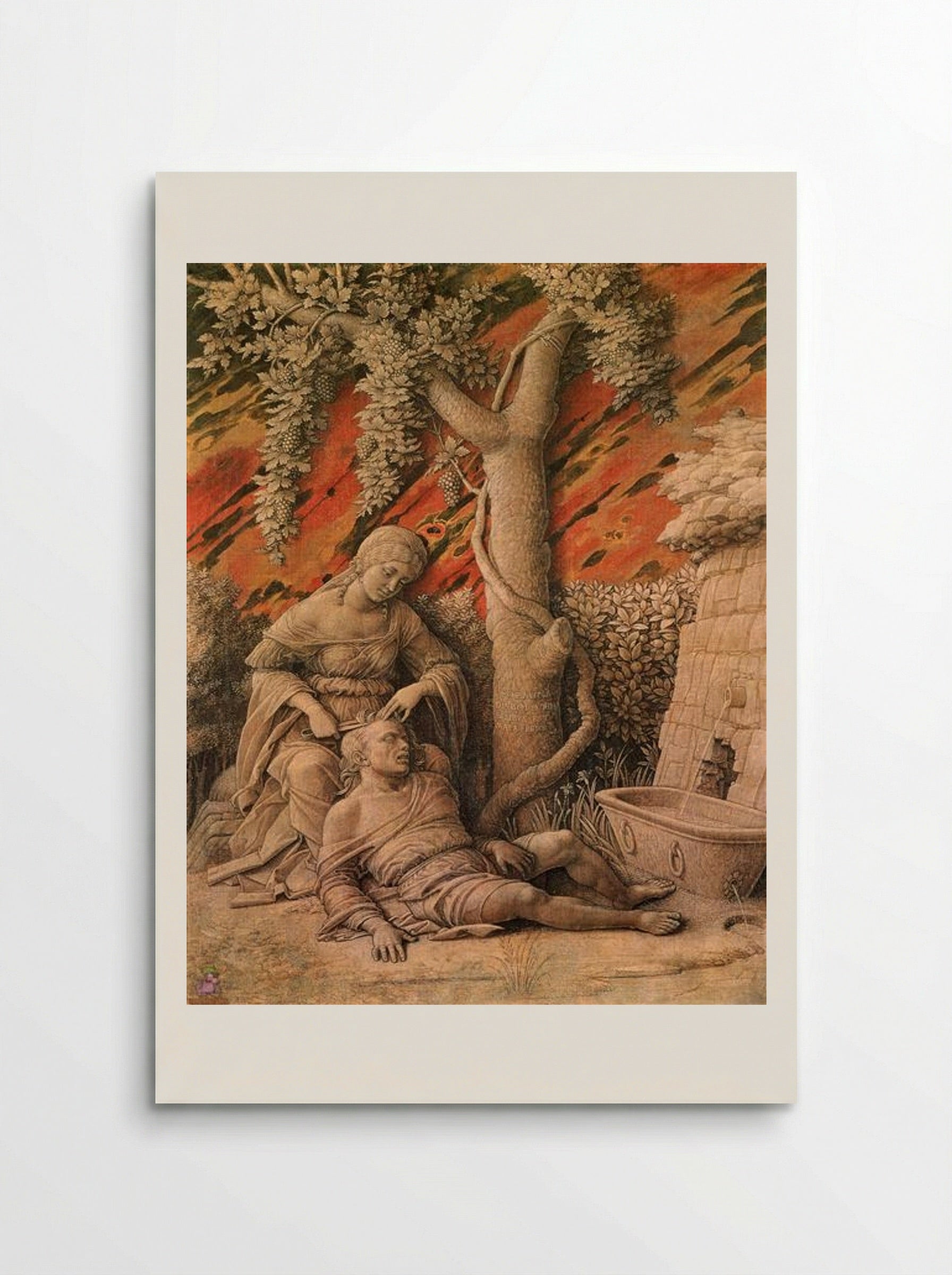
Samson and Delilah - Andrea Mantegna
Archival giclée
Frames arrive ready to hang
Secure checkout
Made to order
Description
Andrea Mantegna's *Samson and Delilah* depicts the biblical scene in grisaille, showcasing the artist's mastery of form and perspective during the Early Renaissance.
Andrea Mantegna's painting, *Samson and Delilah*, presents a scene from the Old Testament story. The work employs a grisaille technique, using shades of grey to mimic the appearance of sculpture. This was a common practice during the Early Renaissance, reflecting an interest in classical forms and a desire to demonstrate artistic skill through monochrome rendering. Mantegna, an Italian painter and printmaker, was known for his mastery of perspective and his detailed, almost sculptural, treatment of figures. The composition depicts Delilah cutting Samson's hair, the source of his strength, while he rests his head in her lap. A tree dominates the centre of the image, its branches laden with grapes. Behind the figures, a reddish-brown background suggests a rocky or mountainous area. To the right, a stone structure with a basin adds to the sense of depth and space. The figures are rendered with careful attention to anatomy and drapery, characteristic of Mantegna's style. The overall effect is one of restrained drama, with the focus on the narrative and the formal qualities of the composition.
Return policy
Because every print is made to order, we don't offer change-of-mind returns, refunds or exchanges. If your order arrives faulty, damaged or incorrect, we'll replace it free of charge — just contact us within 48 hours of delivery. See our refunds page for full details.
Shipping
We ship worldwide, printing at the production hub nearest to your delivery address. Delivery times and costs vary by destination — you'll see the options available to you at checkout.
Manufacturing
Each print is produced to order using 12-colour giclée printing on FSC-certified archival paper. Designed in Britain and printed at your nearest production hub to reduce waste and speed up delivery.
Care and materials
Specific Features
Every Solis piece is made to order with archival, gallery-quality materials built to last.
- Museum-grade giclée printing for rich, fade-resistant colour
- Archival matte fine-art paper, FSC-certified
- Multiple sizes and framing options available
- Frames in black, natural wood, dark wood or white
- Framed prints arrive ready to hang
Care & Cleaning
To keep your artwork looking its best:
- Dust gently with a soft, dry cloth
- Avoid prolonged direct sunlight
- Never use liquid cleaners on the print or canvas surface
- Keep in a dry, room-temperature space
- Handle prints with clean, dry hands
Materials & Sizing
Museum-grade giclée on FSC-certified archival matte paper, with framed and canvas options.
- Paper sizes: A4, A3, A2, A1, A0 and B2 (50×70 cm)
- Canvas: XS (20×30 cm) to Large (60×90 cm)
- Frames: black, natural wood, dark wood or white
Samson and Delilah - Andrea Mantegna

Artist Biography
Andrea Mantegna
Padua in the 1440s was the first centre of Renaissance humanism in northern Italy. Donatello was working there on the bronze reliefs for the Basilica of Sant'Antonio; Paolo Uccello and Filippo Lippi had both passed through. Mantegna absorbed their experiments with perspective and classical form, then pushed further. His frescoes in the Ovetari Chapel (completed 1457, largely destroyed by Allied bombing in 1944) showed figures seen from below with an architectural conviction no northern Italian painter had attempted before.
In 1453 he married Nicolosia Bellini, daughter of the Venetian painter Jacopo Bellini, binding himself to the most powerful artistic dynasty in the Veneto. The relationship was productive in both directions: Giovanni Bellini, his brother-in-law, learned from Mantegna's sculptural precision while Mantegna gradually absorbed the Venetians' sensitivity to light and atmosphere, though he never fully abandoned his preference for hard, lapidary surfaces.
From 1460 until his death in 1506, Mantegna served as court painter to the Gonzaga family in Mantua. The Camera degli Sposi (completed 1474) was the first room in European painting to use illusionistic decoration across walls and ceiling as a unified architectural space. The ceiling's famous oculus, a circular opening revealing figures peering down from a balustrade against open sky, was a joke that fooled visitors and influenced decorative painting for two centuries.
Why Choose Us ?
Damage-free delivery guarantee
Fast Shipping
Museum-Quality Materials
You May Also Like