

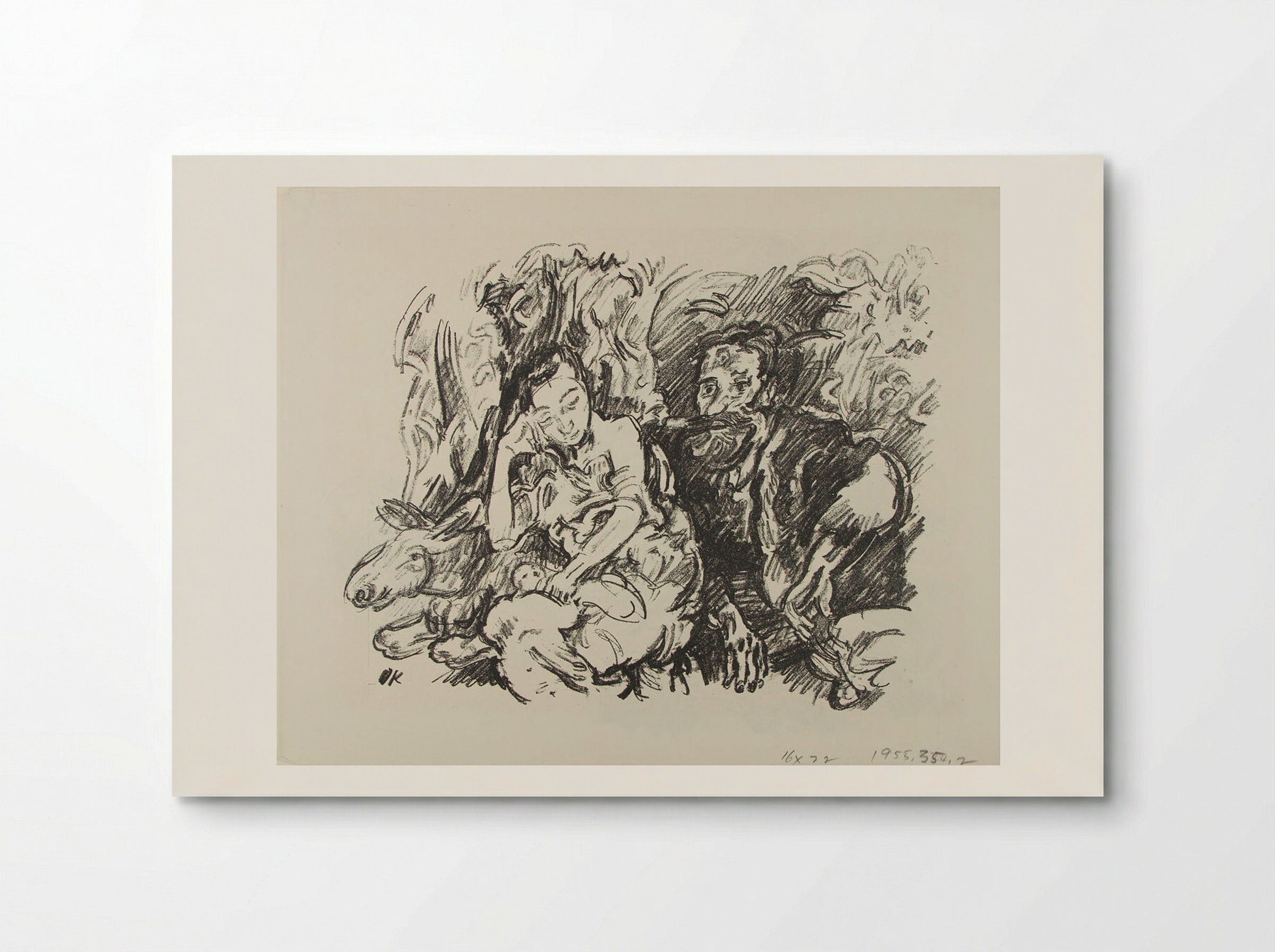
Rest on the Flight to Egypt - Oskar Kokoschka
Archival giclée
Frames arrive ready to hang
Secure checkout
Made to order
Description
A raw, expressive lithograph by Oskar Kokoschka depicting the Holy Family in a moment of weary respite during their flight to Egypt.
This lithograph by Oskar Kokoschka, titled Rest on the Flight to Egypt, appeared in the periodical Der Bildermann on 20 December 1916. The work captures a quiet, humanised moment within a traditional biblical narrative. Kokoschka employs a raw, gestural line quality that is characteristic of his contribution to the Austrian Expressionist movement. Rather than focusing on the divine or miraculous aspects of the journey, the artist depicts the Holy Family as weary travellers seeking respite. The composition is dense, with the figures of Mary, Joseph, and the infant Jesus huddled together against a backdrop of agitated, scribbled marks. These marks suggest the surrounding foliage or the darkness of the night, creating a sense of enclosure and intimacy. Mary is shown with her head resting on her hand, her expression one of exhaustion, while Joseph sits beside her, his gaze directed towards the viewer or perhaps into the distance. The presence of the donkey, positioned to the left, anchors the scene in the reality of their arduous travel. Kokoschka’s technique here relies on the immediacy of the lithographic crayon. The lines are not polished or refined: they are urgent, conveying the psychological weight of the subjects. This approach strips away the idealised iconography often associated with religious art, replacing it with a focus on the physical and emotional toll of the flight. The work reflects the broader anxieties of the period, as the artist produced this image while recovering from severe injuries sustained during the First World War. It is a study in human vulnerability, rendered with the stark, unvarnished honesty that defines Kokoschka’s graphic output during his middle years.
Return policy
Because every print is made to order, we don't offer change-of-mind returns, refunds or exchanges. If your order arrives faulty, damaged or incorrect, we'll replace it free of charge — just contact us within 48 hours of delivery. See our refunds page for full details.
Shipping
We ship worldwide, printing at the production hub nearest to your delivery address. Delivery times and costs vary by destination — you'll see the options available to you at checkout.
Manufacturing
Each print is produced to order using 12-colour giclée printing on FSC-certified archival paper. Designed in Britain and printed at your nearest production hub to reduce waste and speed up delivery.
Rest on the Flight to Egypt - Oskar Kokoschka

Artist Biography
Oskar Kokoschka
He was born in 1886 in Pochlarn, Austria. He was shot through the head in Ukraine and bayoneted in the chest in Russia. He survived both.
After the war, he commissioned a Munich dollmaker named Hermine Moos to create a life-size replica of Alma, sending detailed instructions about the feel of her skin and the weight of her body. Moos covered the figure in feathers instead. Kokoschka eventually staged a public execution: he decapitated the doll and smashed a bottle of wine over its head on his lawn. The police arrived the next morning, thinking he had murdered a woman.
The Nazis declared him a degenerate artist. He fled Czechoslovakia for London after the Munich Agreement and became a British citizen in 1947. His Expressionist portraits are among the most psychologically penetrating of the twentieth century: raw, agitated surfaces that seem to expose the sitter's interior state. He lived to ninety-four.
Our Features
Designed for Lasting Impact
Specific Features
Every Solis piece is made to order with archival, gallery-quality materials built to last.
- Museum-grade giclée printing for rich, fade-resistant colour
- Archival matte fine-art paper, FSC-certified
- Multiple sizes and framing options available
- Frames in black, natural wood, dark wood or white
- Framed prints arrive ready to hang
Care & Cleaning
To keep your artwork looking its best:
- Dust gently with a soft, dry cloth
- Avoid prolonged direct sunlight
- Never use liquid cleaners on the print or canvas surface
- Keep in a dry, room-temperature space
- Handle prints with clean, dry hands
Materials & Sizing
Museum-grade giclée on FSC-certified archival matte paper, with framed and canvas options.
- Paper sizes: A4, A3, A2, A1, A0 and B2 (50×70 cm)
- Canvas: XS (20×30 cm) to Large (60×90 cm)
- Frames: black, natural wood, dark wood or white
Why Choose Us ?
Damage-free delivery guarantee
Fast Shipping
Museum-Quality Materials
Artist Biography
Oskar Kokoschka
He was born in 1886 in Pochlarn, Austria. He was shot through the head in Ukraine and bayoneted in the chest in Russia. He survived both.
After the war, he commissioned a Munich dollmaker named Hermine Moos to create a life-size replica of Alma, sending detailed instructions about the feel of her skin and the weight of her body. Moos covered the figure in feathers instead. Kokoschka eventually staged a public execution: he decapitated the doll and smashed a bottle of wine over its head on his lawn. The police arrived the next morning, thinking he had murdered a woman.
The Nazis declared him a degenerate artist. He fled Czechoslovakia for London after the Munich Agreement and became a British citizen in 1947. His Expressionist portraits are among the most psychologically penetrating of the twentieth century: raw, agitated surfaces that seem to expose the sitter's interior state. He lived to ninety-four.
You May Also Like