

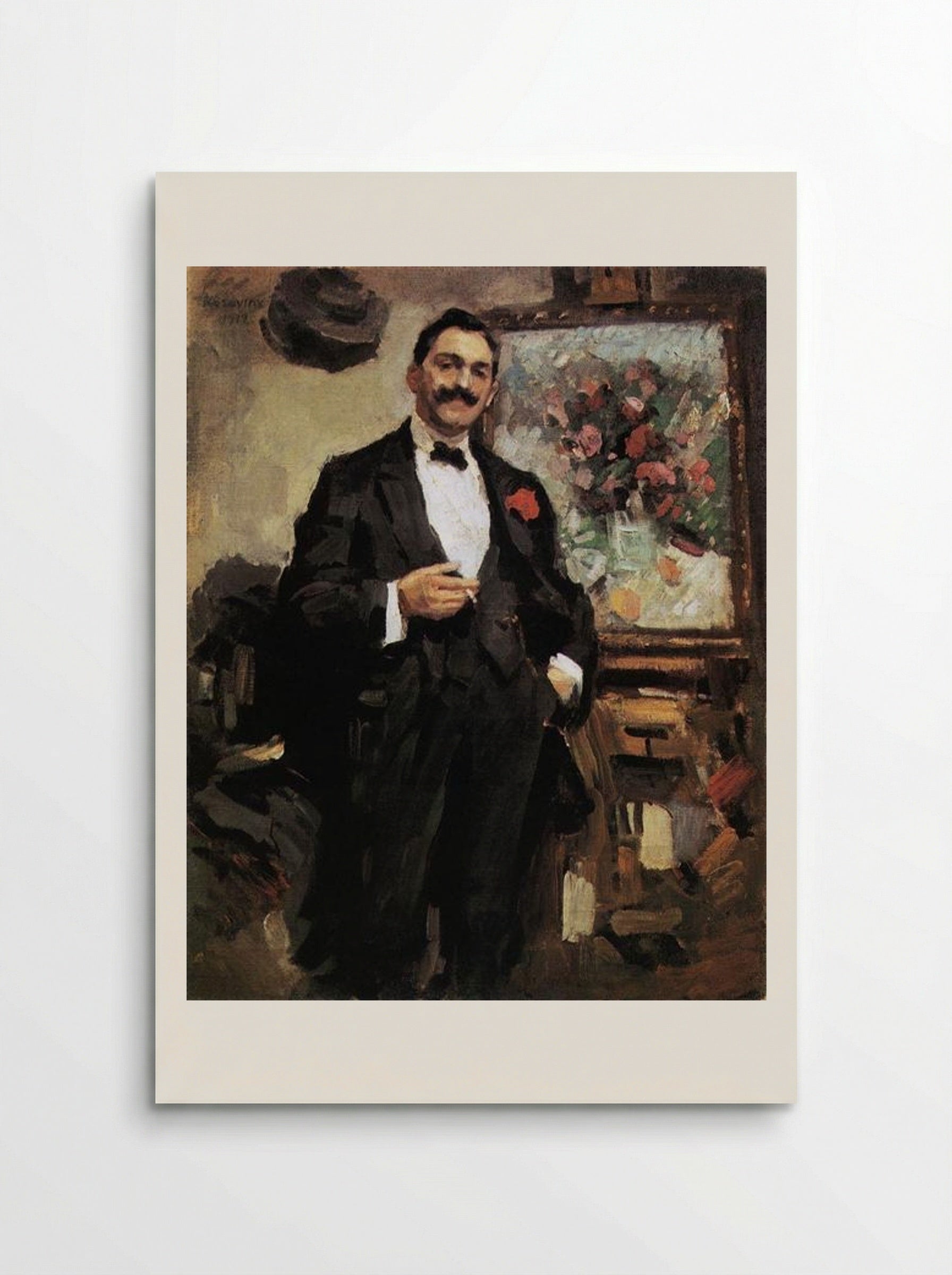
Portrait of József Rippl-Rónai - Konstantin Korovin
Archival giclée
Frames arrive ready to hang
Secure checkout
Made to order
Description
A 1912 Impressionist portrait of the Hungarian painter József Rippl-Rónai by Konstantin Korovin, featuring loose brushwork and a formal studio setting.
Konstantin Korovin painted this portrait of the Hungarian artist József Rippl-Rónai in 1912. Korovin is recognised as a pioneer of Impressionism in Russia. He moved away from the academic traditions of his time to embrace a style defined by light and movement. Rippl-Rónai was a contemporary of Korovin and a significant figure in the Nabis movement in France. This painting captures a moment of connection between two influential artists of the early twentieth century. The composition centres on the figure of Rippl-Rónai. He is depicted in formal evening attire, wearing a black tuxedo and a white shirt. A small red flower in his lapel provides a sharp point of colour against the dark fabric. He holds a cigarette in one hand, contributing to a relaxed and confident posture. Korovin uses broad, gestural brushstrokes to define the form. The artist avoids sharp outlines, instead using patches of paint to suggest the play of light across the fabric and skin. In the background, an easel supports a painting of flowers. This inclusion identifies the sitter as a fellow painter and adds a layer of visual interest to the studio setting. The surrounding space is rendered with loose strokes of ochre, grey, and brown. Korovin employs a balanced palette that emphasises the contrast between the dark suit and the bright white of the shirt. The light source appears to be positioned to the left, casting soft shadows and defining the contours of the face. This work is a factual record of the artistic community in Europe before the First World War. It demonstrates Korovin's ability to capture character through a spontaneous and modern technique.
Return policy
Because every print is made to order, we don't offer change-of-mind returns, refunds or exchanges. If your order arrives faulty, damaged or incorrect, we'll replace it free of charge — just contact us within 48 hours of delivery. See our refunds page for full details.
Shipping
We ship worldwide, printing at the production hub nearest to your delivery address. Delivery times and costs vary by destination — you'll see the options available to you at checkout.
Manufacturing
Each print is produced to order using 12-colour giclée printing on FSC-certified archival paper. Designed in Britain and printed at your nearest production hub to reduce waste and speed up delivery.
Portrait of József Rippl-Rónai - Konstantin Korovin

Artist Biography
Konstantin Korovin
He was born in Moscow in 1861 and studied under Savrasov and Polenov at the Moscow School. He was close to Mamontov's Abramtsevo circle and designed prolifically for the Bolshoi and Mariinsky theatres. His Parisian cafe scenes and Crimean landscapes use loose, luminous brushwork. After the Revolution he emigrated to Paris in 1923. He died in Paris in 1939.
Our Features
Designed for Lasting Impact
Specific Features
Every Solis piece is made to order with archival, gallery-quality materials built to last.
- Museum-grade giclée printing for rich, fade-resistant colour
- Archival matte fine-art paper, FSC-certified
- Multiple sizes and framing options available
- Frames in black, natural wood, dark wood or white
- Framed prints arrive ready to hang
Care & Cleaning
To keep your artwork looking its best:
- Dust gently with a soft, dry cloth
- Avoid prolonged direct sunlight
- Never use liquid cleaners on the print or canvas surface
- Keep in a dry, room-temperature space
- Handle prints with clean, dry hands
Materials & Sizing
Museum-grade giclée on FSC-certified archival matte paper, with framed and canvas options.
- Paper sizes: A4, A3, A2, A1, A0 and B2 (50×70 cm)
- Canvas: XS (20×30 cm) to Large (60×90 cm)
- Frames: black, natural wood, dark wood or white
Why Choose Us ?
Damage-free delivery guarantee
Fast Shipping
Museum-Quality Materials
Artist Biography
Konstantin Korovin
He was born in Moscow in 1861 and studied under Savrasov and Polenov at the Moscow School. He was close to Mamontov's Abramtsevo circle and designed prolifically for the Bolshoi and Mariinsky theatres. His Parisian cafe scenes and Crimean landscapes use loose, luminous brushwork. After the Revolution he emigrated to Paris in 1923. He died in Paris in 1939.
You May Also Like