

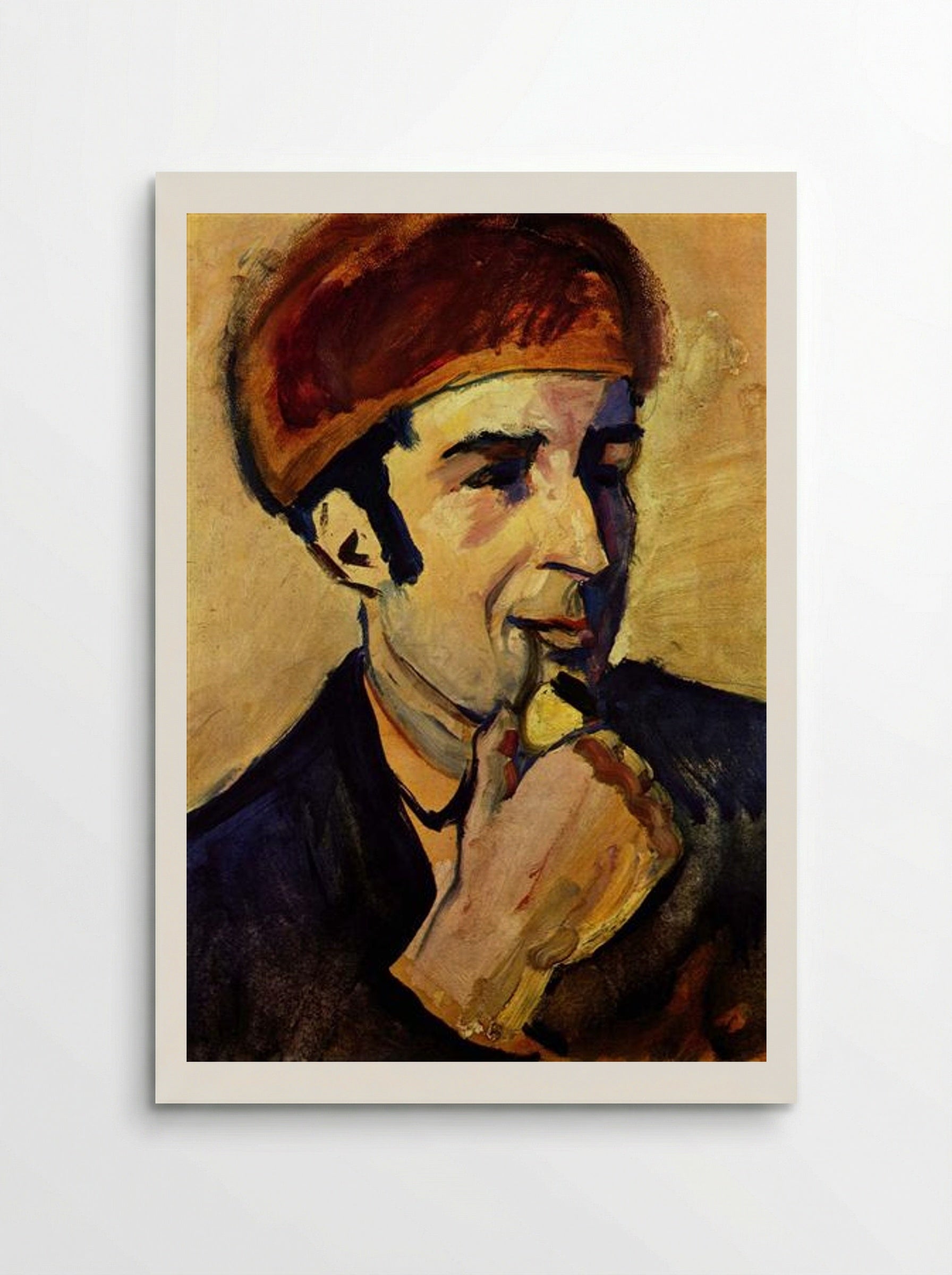
Portrait of Franz Marc - August Macke
Archival giclée
Frames arrive ready to hang
Secure checkout
Made to order
Description
A portrait of Franz Marc by August Macke, rendered in an expressive style with bold brushwork and a warm colour palette. This work captures the spirit of the German Expressionist movement.
This oil on canvas portrait by August Macke (1887-1914) depicts the artist Franz Marc. Macke and Marc were central figures in the German Expressionist movement, particularly within the group known as Der Blaue Reiter (The Blue Rider). This artistic circle aimed to express spiritual truths through abstract forms and symbolic colours. Their work rejected the constraints of traditional representation, instead favouring emotional and subjective experience. In this portrait, Marc is shown in a contemplative pose, his hand raised to his chin. Macke's brushwork is loose and expressive, with bold strokes defining the planes of Marc's face and the contours of his figure. The colour palette is warm, dominated by ochre, umber, and touches of red. These colours create a sense of intimacy and warmth, reflecting the close friendship between the two artists. The background is kept simple, drawing attention to the subject's face and expression. The overall effect is one of immediacy and emotional intensity, characteristic of Expressionist portraiture.
Return policy
Because every print is made to order, we don't offer change-of-mind returns, refunds or exchanges. If your order arrives faulty, damaged or incorrect, we'll replace it free of charge — just contact us within 48 hours of delivery. See our refunds page for full details.
Shipping
We ship worldwide, printing at the production hub nearest to your delivery address. Delivery times and costs vary by destination — you'll see the options available to you at checkout.
Manufacturing
Each print is produced to order using 12-colour giclée printing on FSC-certified archival paper. Designed in Britain and printed at your nearest production hub to reduce waste and speed up delivery.
Portrait of Franz Marc - August Macke

Artist Biography
August Macke
He grew up in a family of building contractors in Meschede, Westphalia, with no artistic connections. He visited Paris multiple times and absorbed Impressionism, Fauvism and Cubism in rapid succession, but his paintings look like none of those movements. What he took from France was colour: warm, saturated, joyful. His street scenes, market squares and park promenades glow with a light that belongs to someone who finds the world beautiful and wants to record it before it changes.
He met Franz Marc in 1910, and through Marc became involved with Der Blaue Reiter. His temperament was the opposite of Kandinsky's theoretical intensity. Macke painted intuitively, quickly, and with an optimism that made him the most approachable of the German Expressionists.
The Tunisian watercolours are his finest work: small, luminous, almost abstract in their reduction of architecture and figures to planes of colour. Klee wrote afterward that colour had taken possession of him. The same could be said of Macke, who had been working toward that moment for years.
He was drafted immediately when war broke out. His wife Elisabeth received notification of his death six weeks later. Marc, his closest friend, was killed at Verdun in 1916.
Our Features
Designed for Lasting Impact
Specific Features
Every Solis piece is made to order with archival, gallery-quality materials built to last.
- Museum-grade giclée printing for rich, fade-resistant colour
- Archival matte fine-art paper, FSC-certified
- Multiple sizes and framing options available
- Frames in black, natural wood, dark wood or white
- Framed prints arrive ready to hang
Care & Cleaning
To keep your artwork looking its best:
- Dust gently with a soft, dry cloth
- Avoid prolonged direct sunlight
- Never use liquid cleaners on the print or canvas surface
- Keep in a dry, room-temperature space
- Handle prints with clean, dry hands
Materials & Sizing
Museum-grade giclée on FSC-certified archival matte paper, with framed and canvas options.
- Paper sizes: A4, A3, A2, A1, A0 and B2 (50×70 cm)
- Canvas: XS (20×30 cm) to Large (60×90 cm)
- Frames: black, natural wood, dark wood or white
Why Choose Us ?
Damage-free delivery guarantee
Fast Shipping
Museum-Quality Materials
Artist Biography
August Macke
He grew up in a family of building contractors in Meschede, Westphalia, with no artistic connections. He visited Paris multiple times and absorbed Impressionism, Fauvism and Cubism in rapid succession, but his paintings look like none of those movements. What he took from France was colour: warm, saturated, joyful. His street scenes, market squares and park promenades glow with a light that belongs to someone who finds the world beautiful and wants to record it before it changes.
He met Franz Marc in 1910, and through Marc became involved with Der Blaue Reiter. His temperament was the opposite of Kandinsky's theoretical intensity. Macke painted intuitively, quickly, and with an optimism that made him the most approachable of the German Expressionists.
The Tunisian watercolours are his finest work: small, luminous, almost abstract in their reduction of architecture and figures to planes of colour. Klee wrote afterward that colour had taken possession of him. The same could be said of Macke, who had been working toward that moment for years.
He was drafted immediately when war broke out. His wife Elisabeth received notification of his death six weeks later. Marc, his closest friend, was killed at Verdun in 1916.
You May Also Like