

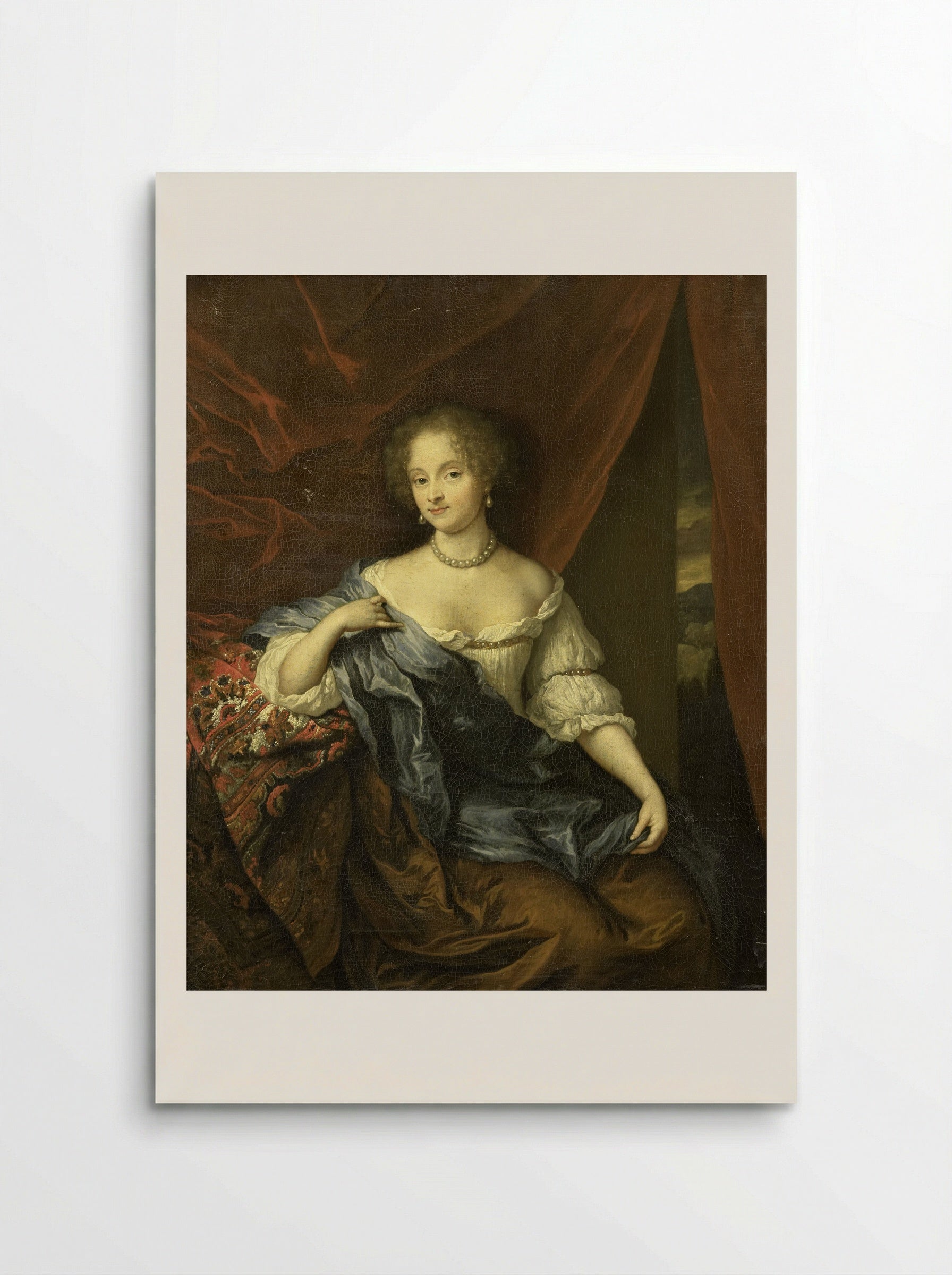
Portrait of a Woman, Possibly a Member of the Van Citters Family - Caspar Netscher
Archival giclée
Frames arrive ready to hang
Secure checkout
Made to order
Description
A refined portrait attributed to Caspar Netscher, a Dutch Golden Age painter known for his elegant and detailed depictions of the elite. The sitter, possibly a member of the Van Citters family, is portrayed with understated opulence and refined beauty.
This portrait, attributed to Caspar Netscher, depicts a woman believed to be a member of the Van Citters family. Netscher, a Dutch Golden Age painter, was known for his refined portraits and genre scenes, often characterised by their elegance and attention to detail. His style blended elements of Dutch realism with the sophistication of French court portraiture, reflecting the artistic tastes of his clientele. The sitter is portrayed with a delicate complexion and elaborate hairstyle, adorned with pearls. Her off-the-shoulder dress, with its ruffled sleeves and pearl embellishments, speaks to the fashion of the period. A blue shawl is draped across her shoulders, adding a touch of colour to the composition. She is seated, with one hand resting gracefully on her lap. Behind her, a red curtain and a glimpse of a distant, hazy outdoor scene provide a backdrop that enhances the sense of depth and luxury. The overall effect is one of understated opulence and refined beauty, typical of Netscher's portraiture.
Return policy
Because every print is made to order, we don't offer change-of-mind returns, refunds or exchanges. If your order arrives faulty, damaged or incorrect, we'll replace it free of charge — just contact us within 48 hours of delivery. See our refunds page for full details.
Shipping
We ship worldwide, printing at the production hub nearest to your delivery address. Delivery times and costs vary by destination — you'll see the options available to you at checkout.
Manufacturing
Each print is produced to order using 12-colour giclée printing on FSC-certified archival paper. Designed in Britain and printed at your nearest production hub to reduce waste and speed up delivery.
Portrait of a Woman, Possibly a Member of the Van Citters Family - Caspar Netscher

Artist Biography
Caspar Netscher
He was born around 1639, probably in Heidelberg or Prague. His father, a sculptor from Stuttgart, died when Caspar was two. During the siege of Heidelberg his mother fled with four children; two older brothers died of hunger. He was placed with the painter Hendrick Coster in Arnhem, then became a student of Gerard ter Borch in Deventer. Ter Borch was the most important influence on his work; Netscher appears as a model in several of Ter Borch's paintings.
His portraits and genre scenes of The Hague's fashionable society were painted with a precision that earned comparisons to Vermeer. He rendered fabrics, lace and reflected light with miniaturist exactitude. Cosimo III de' Medici bought his work. He kept drawings of finished paintings as records (ricordi), noting prices, patron names and colour choices.
He was plagued by gout but remained productive, sometimes painting from bed. Two of his sons, Constantyn and Theodorus, became painters in his style. A third, Anthonie, emigrated to Batavia. He died in The Hague in 1684, at about forty-five.
Our Features
Designed for Lasting Impact
Specific Features
Every Solis piece is made to order with archival, gallery-quality materials built to last.
- Museum-grade giclée printing for rich, fade-resistant colour
- Archival matte fine-art paper, FSC-certified
- Multiple sizes and framing options available
- Frames in black, natural wood, dark wood or white
- Framed prints arrive ready to hang
Care & Cleaning
To keep your artwork looking its best:
- Dust gently with a soft, dry cloth
- Avoid prolonged direct sunlight
- Never use liquid cleaners on the print or canvas surface
- Keep in a dry, room-temperature space
- Handle prints with clean, dry hands
Materials & Sizing
Museum-grade giclée on FSC-certified archival matte paper, with framed and canvas options.
- Paper sizes: A4, A3, A2, A1, A0 and B2 (50×70 cm)
- Canvas: XS (20×30 cm) to Large (60×90 cm)
- Frames: black, natural wood, dark wood or white
Why Choose Us ?
Damage-free delivery guarantee
Fast Shipping
Museum-Quality Materials
Artist Biography
Caspar Netscher
He was born around 1639, probably in Heidelberg or Prague. His father, a sculptor from Stuttgart, died when Caspar was two. During the siege of Heidelberg his mother fled with four children; two older brothers died of hunger. He was placed with the painter Hendrick Coster in Arnhem, then became a student of Gerard ter Borch in Deventer. Ter Borch was the most important influence on his work; Netscher appears as a model in several of Ter Borch's paintings.
His portraits and genre scenes of The Hague's fashionable society were painted with a precision that earned comparisons to Vermeer. He rendered fabrics, lace and reflected light with miniaturist exactitude. Cosimo III de' Medici bought his work. He kept drawings of finished paintings as records (ricordi), noting prices, patron names and colour choices.
He was plagued by gout but remained productive, sometimes painting from bed. Two of his sons, Constantyn and Theodorus, became painters in his style. A third, Anthonie, emigrated to Batavia. He died in The Hague in 1684, at about forty-five.
You May Also Like