

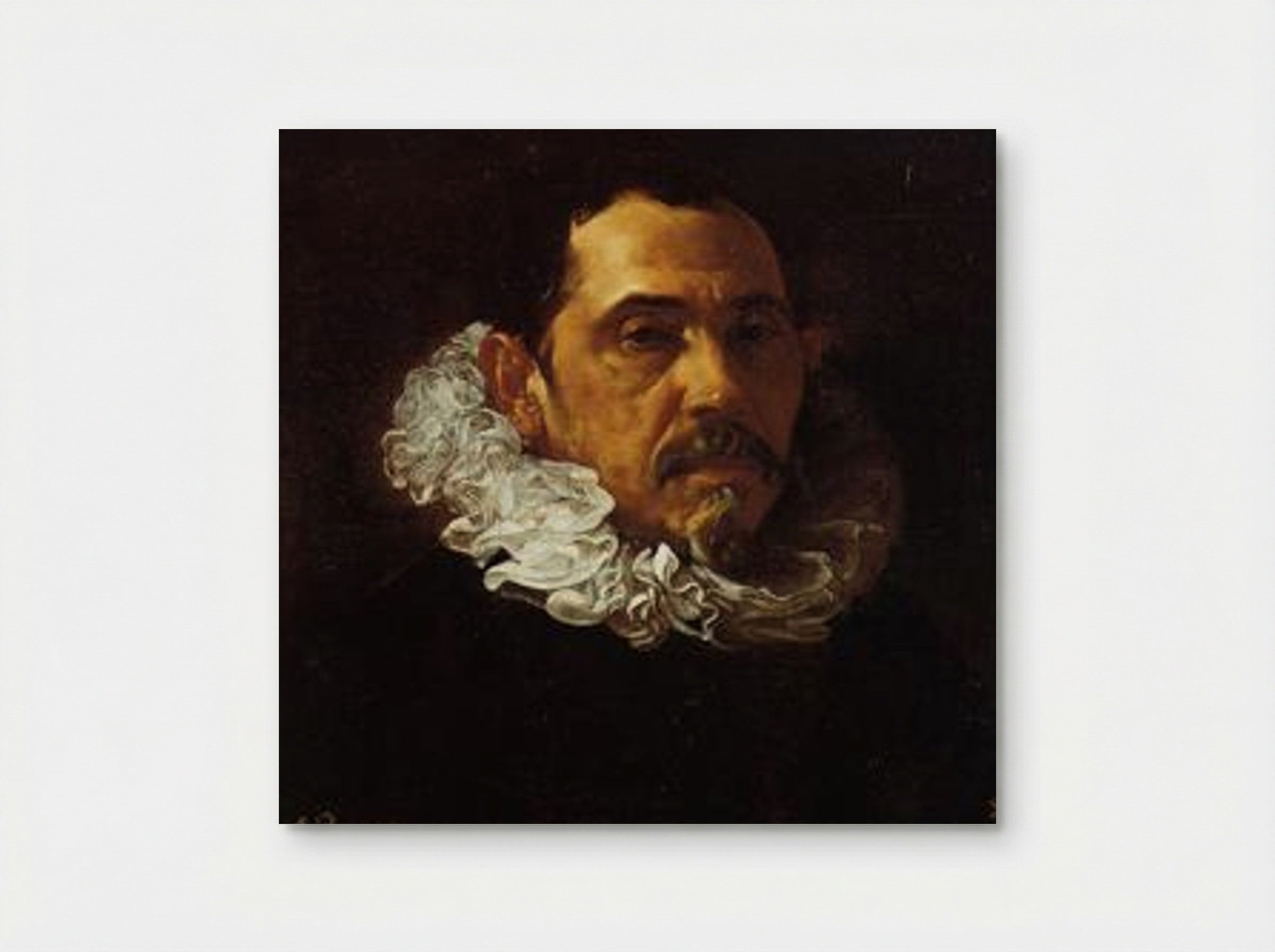
Portrait of a Man with a Goatee - Diego Velázquez
Archival giclée
Frames arrive ready to hang
Secure checkout
Made to order
Description
A striking Baroque portrait by Diego Velázquez, featuring a man in a traditional ruff collar rendered with masterful light and shadow.
This portrait, attributed to the Spanish master Diego Velázquez, captures a man in a moment of quiet observation. The subject is depicted against a dark, indistinct background, a technique that directs the viewer's attention to the facial features and the stark white ruff collar. The ruff, a common fashion element of the early seventeenth century, is rendered with loose, confident brushwork that contrasts with the more precise modelling of the man's face. Velázquez employs a limited palette, relying on deep shadows and warm, earthy tones to create a sense of volume and presence. The lighting is directional, catching the side of the man's face and the folds of the collar, which adds a degree of psychological depth to the composition. The man's expression is neutral, yet his gaze suggests a direct engagement with the observer. This work reflects the artist's early period in Madrid, where he began to refine his ability to capture character through subtle shifts in light and shadow. As a fine art print, this piece retains the atmospheric quality of the original oil painting. The dark tones are reproduced with clarity, ensuring that the texture of the paint and the delicate highlights on the ruff remain visible. It is a study in restraint, demonstrating the artist's early mastery of the human form and his ability to convey personality without the need for elaborate settings or props. The composition is balanced, focusing entirely on the sitter, which allows the viewer to appreciate the technical skill involved in the application of paint and the subtle gradation of colour across the skin tones.
Return policy
Because every print is made to order, we don't offer change-of-mind returns, refunds or exchanges. If your order arrives faulty, damaged or incorrect, we'll replace it free of charge — just contact us within 48 hours of delivery. See our refunds page for full details.
Shipping
We ship worldwide, printing at the production hub nearest to your delivery address. Delivery times and costs vary by destination — you'll see the options available to you at checkout.
Manufacturing
Each print is produced to order using 12-colour giclée printing on FSC-certified archival paper. Designed in Britain and printed at your nearest production hub to reduce waste and speed up delivery.
Care and materials
Specific Features
Every Solis piece is made to order with archival, gallery-quality materials built to last.
- Museum-grade giclée printing for rich, fade-resistant colour
- Archival matte fine-art paper, FSC-certified
- Multiple sizes and framing options available
- Frames in black, natural wood, dark wood or white
- Framed prints arrive ready to hang
Care & Cleaning
To keep your artwork looking its best:
- Dust gently with a soft, dry cloth
- Avoid prolonged direct sunlight
- Never use liquid cleaners on the print or canvas surface
- Keep in a dry, room-temperature space
- Handle prints with clean, dry hands
Materials & Sizing
Museum-grade giclée on FSC-certified archival matte paper, with framed and canvas options.
- Paper sizes: A4, A3, A2, A1, A0 and B2 (50×70 cm)
- Canvas: XS (20×30 cm) to Large (60×90 cm)
- Frames: black, natural wood, dark wood or white
Portrait of a Man with a Goatee - Diego Velázquez

Artist Biography
Diego Velázquez
He was born in Seville in 1599 and apprenticed at eleven to Francisco Pacheco, the city's most prominent painter and art theorist. He married Pacheco's daughter Juana. At court, he was not just a painter but a bureaucrat, holding successive administrative positions and eventually managing the decoration and logistics of royal events.
He owned an enslaved man, Juan de Pareja, who was himself a painter. In 1650, while in Rome, Velazquez painted de Pareja's portrait, now at the Metropolitan Museum of Art. The painting won him election to the Accademia di San Luca. That November, he granted de Pareja his freedom, effective after a four-year probationary period.
Las Meninas (1656) is the painting that breaks everything. Velazquez painted himself painting in the royal studio. The Infanta Margarita and her attendants occupy the foreground. A mirror in the background reflects the king and queen, implying they are standing where the viewer stands. The composition makes the artist, not the monarchs, the central figure. A red cross of the Order of Santiago appears on Velazquez's chest, but he was not awarded the knighthood until 1659, three years after the painting was completed. The cross was added later. Whether by the king himself, by Velazquez, or by de Pareja after the master's death remains disputed.
He died on 6 August 1660 in Madrid, shortly after organising the decorations for the marriage of the Infanta Maria Teresa to Louis XIV at the French border.
Why Choose Us ?
Damage-free delivery guarantee
Fast Shipping
Museum-Quality Materials
You May Also Like