

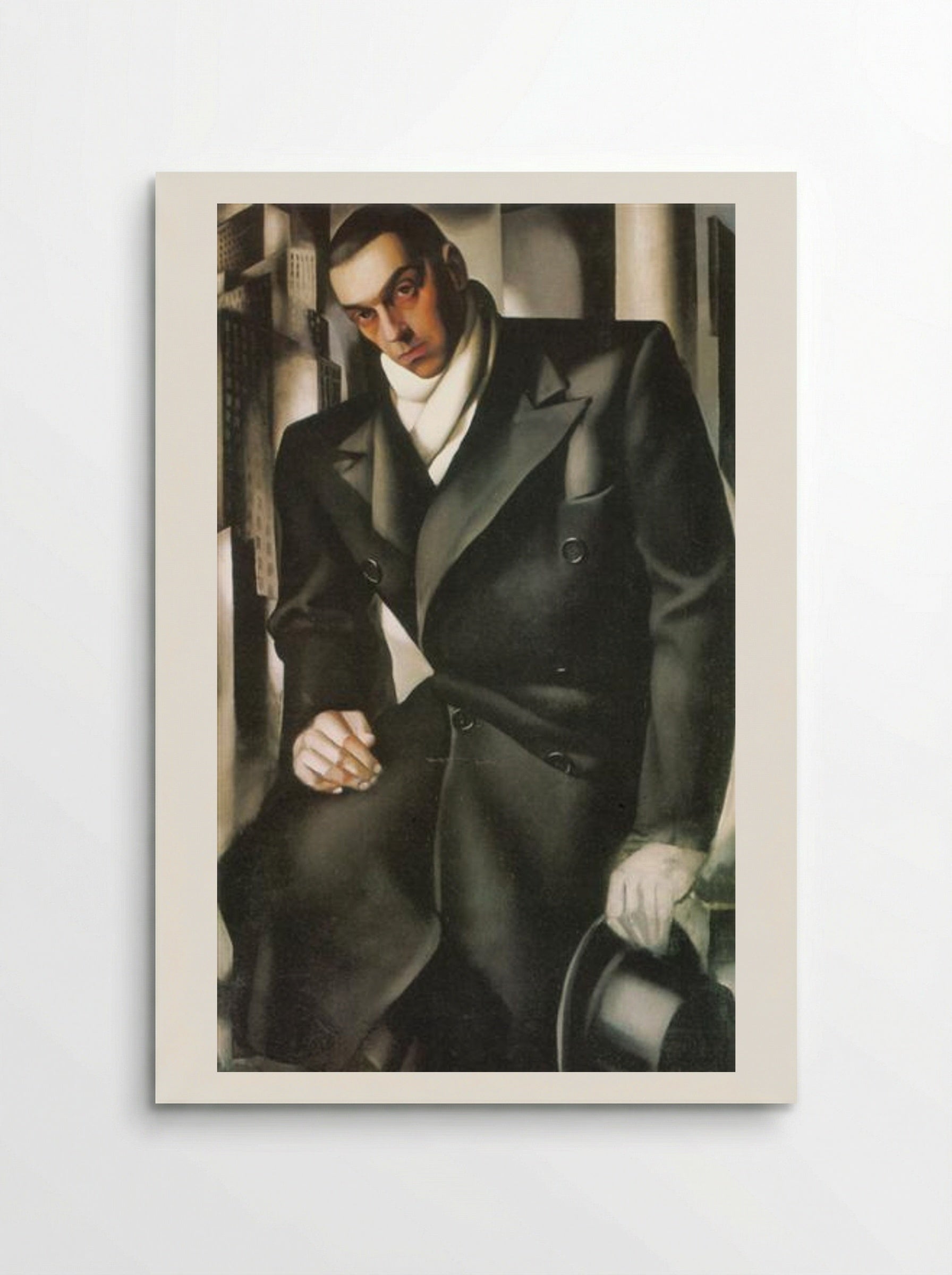
Portrait of a Man or Mr Tadeusz de Lempicki - Tamara de Lempicka
Archival giclée
Frames arrive ready to hang
Secure checkout
Made to order
Description
A striking Art Deco portrait by Tamara de Lempicka, possibly depicting her husband, Tadeusz de Lempicki. The painting showcases Lempicka's signature style with its sharp lines, smooth surfaces, and cool elegance.
Tamara de Lempicka (1898-1980) was a Polish artist known for her distinctive Art Deco portraits. She captured the glamour and sophistication of the Roaring Twenties with a style that combined elements of Cubism and Neoclassicism. Her subjects, often wealthy and fashionable, were rendered with sharp lines, smooth surfaces, and a cool, detached elegance. This portrait, titled "Portrait of a Man or Mr Tadeusz de Lempicki", exemplifies Lempicka's signature style. The sitter, possibly her husband, is depicted in a dark, tailored suit, his gaze direct and somewhat aloof. The background features stylised skyscrapers, a nod to the modern urban environment that Lempicka inhabited. The colour palette is restrained, dominated by blacks, greys, and whites, with subtle hints of colour in the face and hands. The composition is carefully balanced, with the figure occupying a dominant position in the frame. The overall effect is one of understated luxury and refined taste, characteristic of Lempicka's work and the Art Deco aesthetic.
Return policy
Because every print is made to order, we don't offer change-of-mind returns, refunds or exchanges. If your order arrives faulty, damaged or incorrect, we'll replace it free of charge — just contact us within 48 hours of delivery. See our refunds page for full details.
Shipping
We ship worldwide, printing at the production hub nearest to your delivery address. Delivery times and costs vary by destination — you'll see the options available to you at checkout.
Manufacturing
Each print is produced to order using 12-colour giclée printing on FSC-certified archival paper. Designed in Britain and printed at your nearest production hub to reduce waste and speed up delivery.
Portrait of a Man or Mr Tadeusz de Lempicki - Tamara de Lempicka

Artist Biography
Tamara De Lempicka
In December 1917, the Cheka arrested her husband Tadeusz Lempicki in the night, suspected of connections to the Tsar's secret police. She searched the prisons for him and reportedly secured his release by offering favours to the Swedish consul. They fled through Copenhagen and London to Paris. She initially signed her paintings Lempitzky, the masculine form of the name, to be taken more seriously. Critics praised the work, thinking a man had made it.
She moved in the lesbian and bisexual salons of 1920s Paris, a circle that included Vita Sackville-West and Colette. Her female portraits carry both the painter's gaze and the lover's. Perspective (The Two Girlfriends), shown at the 1923 Salon d'Automne, was among the earliest. Her style blended a late, polished Cubism with neoclassical form, influenced by Ingres but drenched in the glamour and geometry of Art Deco.
In 1929, she painted herself for the cover of the German fashion magazine Die Dame: Autoportrait (Tamara in a Green Bugatti). The car in the painting was a Bugatti. Her actual car was a yellow Renault.
She divorced Tadeusz in 1928 and married Baron Raoul Kuffner, an Austro-Hungarian art collector. They moved to America in 1939 to escape the war. She became a favourite of the Hollywood set. After the war, her work drifted into obscurity. The Art Deco revival brought her back: a 1972 retrospective at the Galerie du Luxembourg restored her reputation. A stage play called Tamara ran in Los Angeles for eleven years, from 1984 to 1995, the longest-running play in the city's history. Madonna became a major collector. She died in 1980.
Our Features
Designed for Lasting Impact
Specific Features
Every Solis piece is made to order with archival, gallery-quality materials built to last.
- Museum-grade giclée printing for rich, fade-resistant colour
- Archival matte fine-art paper, FSC-certified
- Multiple sizes and framing options available
- Frames in black, natural wood, dark wood or white
- Framed prints arrive ready to hang
Care & Cleaning
To keep your artwork looking its best:
- Dust gently with a soft, dry cloth
- Avoid prolonged direct sunlight
- Never use liquid cleaners on the print or canvas surface
- Keep in a dry, room-temperature space
- Handle prints with clean, dry hands
Materials & Sizing
Museum-grade giclée on FSC-certified archival matte paper, with framed and canvas options.
- Paper sizes: A4, A3, A2, A1, A0 and B2 (50×70 cm)
- Canvas: XS (20×30 cm) to Large (60×90 cm)
- Frames: black, natural wood, dark wood or white
Why Choose Us ?
Damage-free delivery guarantee
Fast Shipping
Museum-Quality Materials
Artist Biography
Tamara de Lempicka
In December 1917, the Cheka arrested her husband Tadeusz Lempicki in the night, suspected of connections to the Tsar's secret police. She searched the prisons for him and reportedly secured his release by offering favours to the Swedish consul. They fled through Copenhagen and London to Paris. She initially signed her paintings Lempitzky, the masculine form of the name, to be taken more seriously. Critics praised the work, thinking a man had made it.
She moved in the lesbian and bisexual salons of 1920s Paris, a circle that included Vita Sackville-West and Colette. Her female portraits carry both the painter's gaze and the lover's. Perspective (The Two Girlfriends), shown at the 1923 Salon d'Automne, was among the earliest. Her style blended a late, polished Cubism with neoclassical form, influenced by Ingres but drenched in the glamour and geometry of Art Deco.
In 1929, she painted herself for the cover of the German fashion magazine Die Dame: Autoportrait (Tamara in a Green Bugatti). The car in the painting was a Bugatti. Her actual car was a yellow Renault.
She divorced Tadeusz in 1928 and married Baron Raoul Kuffner, an Austro-Hungarian art collector. They moved to America in 1939 to escape the war. She became a favourite of the Hollywood set. After the war, her work drifted into obscurity. The Art Deco revival brought her back: a 1972 retrospective at the Galerie du Luxembourg restored her reputation. A stage play called Tamara ran in Los Angeles for eleven years, from 1984 to 1995, the longest-running play in the city's history. Madonna became a major collector. She died in 1980.
You May Also Like