

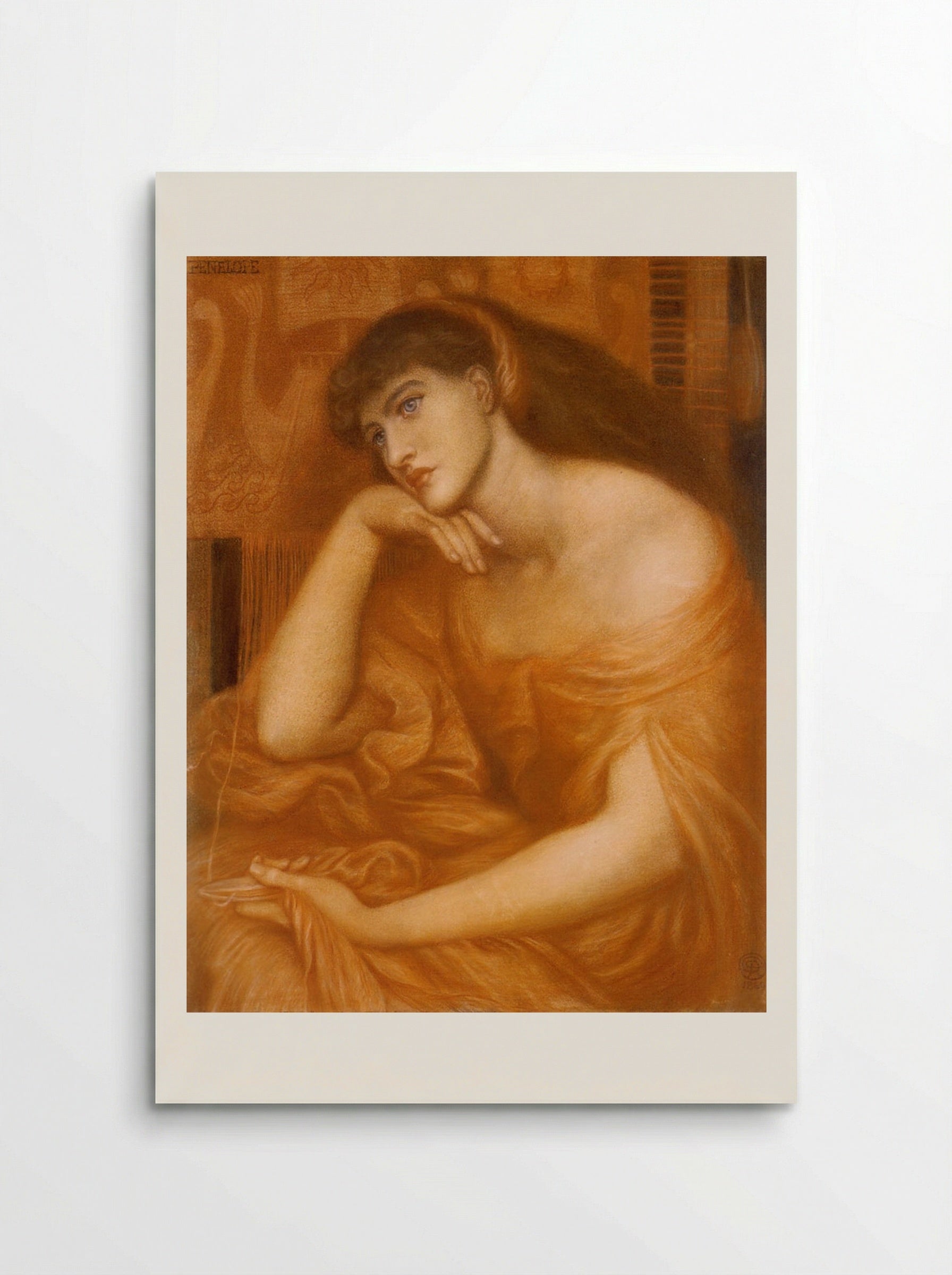
Penelope - Dante Gabriel Rossetti
Archival giclée
Frames arrive ready to hang
Secure checkout
Made to order
Description
A portrait of the mythological Penelope by Dante Gabriel Rossetti, captured in a moment of quiet contemplation with warm, amber tones.
Dante Gabriel Rossetti painted this portrait of Penelope in 1869. The work depicts the mythological figure from Homer's Odyssey, known for her patience and fidelity while awaiting the return of Odysseus. Rossetti presents her in a moment of quiet contemplation, her hand resting against her chin, a pose that suggests both weariness and steadfastness. The composition is dominated by warm, monochromatic tones of amber and ochre, which unify the figure with the background. In the background, one observes the suggestion of a loom, referencing the shroud Penelope wove and unpicked to delay her suitors. The artist focuses on the tactile quality of the fabric, with soft folds of drapery cascading across the subject. Her expression is characteristic of Rossetti's later period, featuring heavy-lidded eyes and a melancholic gaze. The light source appears soft and diffused, creating a gentle glow that emphasises the texture of the skin and the flowing hair. This piece reflects the Pre-Raphaelite interest in classical themes filtered through a romanticised, personal lens. Rather than focusing on the narrative action of the myth, Rossetti captures a psychological state. The painting is signed and dated in the lower right corner, consistent with his practice during this decade. The work remains a fine example of his ability to imbue literary subjects with a sense of intimate, human emotion, moving away from the rigid realism of his earlier career towards a more atmospheric and symbolic approach to portraiture.
Return policy
Because every print is made to order, we don't offer change-of-mind returns, refunds or exchanges. If your order arrives faulty, damaged or incorrect, we'll replace it free of charge — just contact us within 48 hours of delivery. See our refunds page for full details.
Shipping
We ship worldwide, printing at the production hub nearest to your delivery address. Delivery times and costs vary by destination — you'll see the options available to you at checkout.
Manufacturing
Each print is produced to order using 12-colour giclée printing on FSC-certified archival paper. Designed in Britain and printed at your nearest production hub to reduce waste and speed up delivery.
Penelope - Dante Gabriel Rossetti

Artist Biography
Dante Gabriel Rossetti
He was born in London to an Italian political exile and named after the author of the Divine Comedy. His father was a professor of Italian at King's College. The household ran on poetry, politics, and argument. Rossetti wrote verse throughout his life and considered himself a poet as much as a painter.
His early paintings are small, bright, and meticulously detailed in the Pre-Raphaelite manner. The Girlhood of Mary Virgin and Ecce Ancilla Domini have the flat, jewelled quality of medieval altarpieces. After 1860 the style changed. The paintings became larger, more sensual, and dominated by the face and figure of Jane Burden, who was William Morris's wife.
The relationship between Rossetti, Morris, and Jane is one of the more uncomfortable triangles in art history. Morris married her. Rossetti painted her obsessively. She modelled for Proserpine, La Pia de' Tolomei, and dozens of other works in which she appears as a mythological woman trapped in an unwanted situation. Whether the affair was physical remains debated. Morris, characteristically, said nothing publicly and channelled his feelings into wallpaper.
Rossetti buried a manuscript of his poems in his wife Lizzie Siddal's coffin when she died of a laudanum overdose in 1862. Seven years later he had the coffin exhumed to retrieve them. He published the poems. He was addicted to chloral hydrate by then and increasingly paranoid. He died in 1882, at fifty-three.
Our Features
Designed for Lasting Impact
Specific Features
Every Solis piece is made to order with archival, gallery-quality materials built to last.
- Museum-grade giclée printing for rich, fade-resistant colour
- Archival matte fine-art paper, FSC-certified
- Multiple sizes and framing options available
- Frames in black, natural wood, dark wood or white
- Framed prints arrive ready to hang
Care & Cleaning
To keep your artwork looking its best:
- Dust gently with a soft, dry cloth
- Avoid prolonged direct sunlight
- Never use liquid cleaners on the print or canvas surface
- Keep in a dry, room-temperature space
- Handle prints with clean, dry hands
Materials & Sizing
Museum-grade giclée on FSC-certified archival matte paper, with framed and canvas options.
- Paper sizes: A4, A3, A2, A1, A0 and B2 (50×70 cm)
- Canvas: XS (20×30 cm) to Large (60×90 cm)
- Frames: black, natural wood, dark wood or white
Why Choose Us ?
Damage-free delivery guarantee
Fast Shipping
Museum-Quality Materials
Artist Biography
Dante Gabriel Rossetti
He was born in London to an Italian political exile and named after the author of the Divine Comedy. His father was a professor of Italian at King's College. The household ran on poetry, politics, and argument. Rossetti wrote verse throughout his life and considered himself a poet as much as a painter.
His early paintings are small, bright, and meticulously detailed in the Pre-Raphaelite manner. The Girlhood of Mary Virgin and Ecce Ancilla Domini have the flat, jewelled quality of medieval altarpieces. After 1860 the style changed. The paintings became larger, more sensual, and dominated by the face and figure of Jane Burden, who was William Morris's wife.
The relationship between Rossetti, Morris, and Jane is one of the more uncomfortable triangles in art history. Morris married her. Rossetti painted her obsessively. She modelled for Proserpine, La Pia de' Tolomei, and dozens of other works in which she appears as a mythological woman trapped in an unwanted situation. Whether the affair was physical remains debated. Morris, characteristically, said nothing publicly and channelled his feelings into wallpaper.
Rossetti buried a manuscript of his poems in his wife Lizzie Siddal's coffin when she died of a laudanum overdose in 1862. Seven years later he had the coffin exhumed to retrieve them. He published the poems. He was addicted to chloral hydrate by then and increasingly paranoid. He died in 1882, at fifty-three.
You May Also Like