

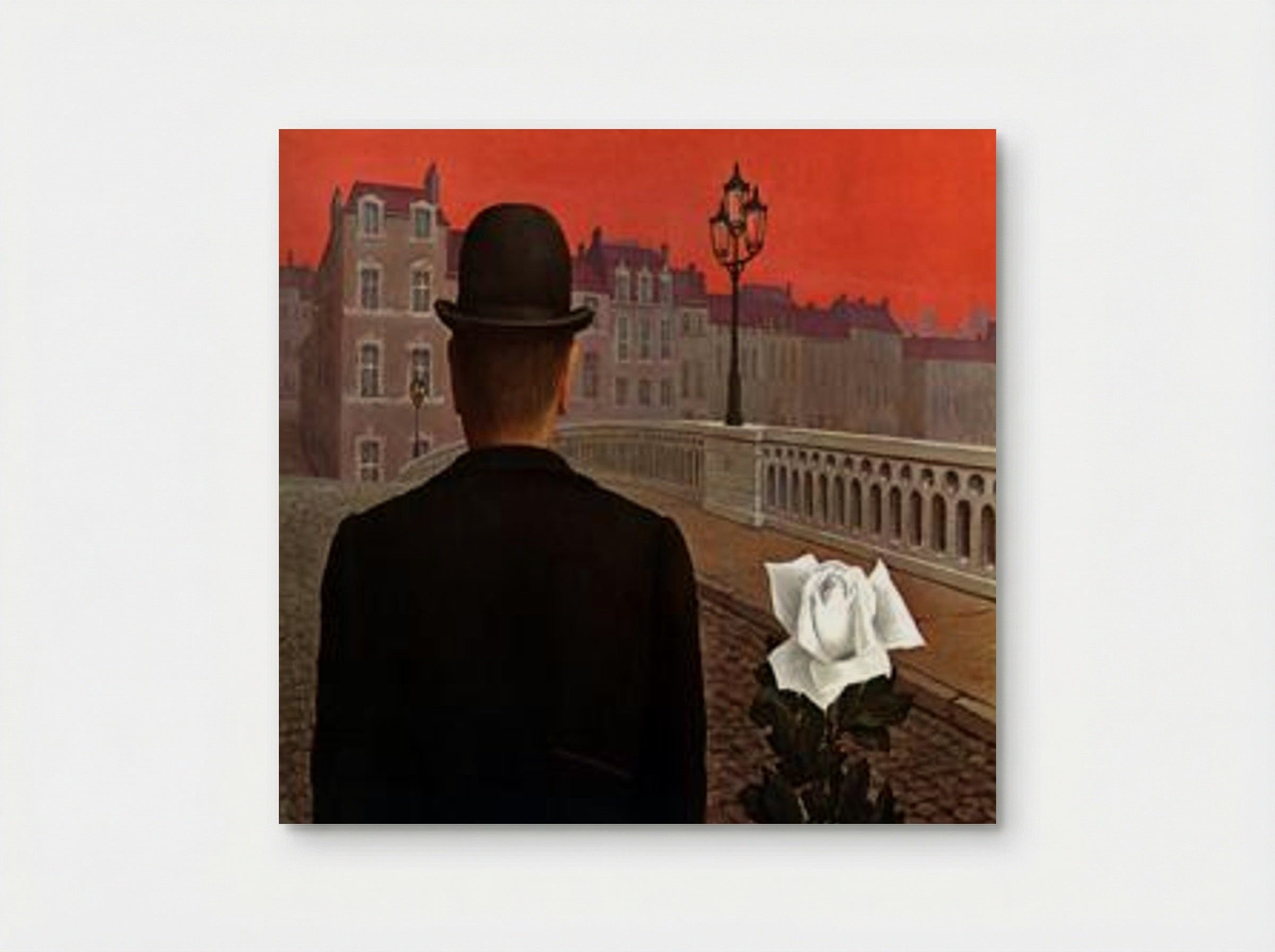
Pandora's Box - René Magritte
Archival giclée
Frames arrive ready to hang
Secure checkout
Made to order
Description
A classic Surrealist work by René Magritte, featuring his signature bowler-hatted figure against an atmospheric, red-hued urban backdrop.
René Magritte, a central figure in the Surrealist movement, frequently employed recurring motifs to question the nature of reality. In this composition, the viewer encounters a man seen from behind, wearing the iconic bowler hat that appears throughout the artist's body of work. He stands upon a bridge, overlooking a quiet urban scene bathed in an unnatural, fiery red sky. The presence of a single, stark white rose in the foreground introduces a jarring element of contrast against the muted tones of the architecture and the man's dark attire. Magritte often utilised the bowler-hatted figure as a surrogate for the everyman, or perhaps for himself. By obscuring the face, he forces the viewer to focus on the environment and the strange juxtaposition of objects. The title, Pandora's Box, invites interpretation regarding hidden knowledge, curiosity, and the consequences of opening what should remain closed. The painting does not offer a narrative resolution. Instead, it presents a visual puzzle where the familiar elements of a city street and a floral study are rearranged into an unsettling configuration. The technical execution is precise, favouring clean lines and a smooth application of paint that avoids visible brushwork. This approach allows the conceptual strangeness of the scene to take precedence over the physical texture of the canvas. The lighting is particularly curious, as the sky suggests a sunset or a distant fire, yet the shadows on the bridge and the buildings do not align with a natural light source. This deliberate manipulation of perspective and atmosphere is characteristic of Magritte's method, which seeks to disrupt the viewer's habitual perception of the world. The work remains an example of how the artist used mundane imagery to evoke a sense of mystery.
Return policy
Because every print is made to order, we don't offer change-of-mind returns, refunds or exchanges. If your order arrives faulty, damaged or incorrect, we'll replace it free of charge — just contact us within 48 hours of delivery. See our refunds page for full details.
Shipping
We ship worldwide, printing at the production hub nearest to your delivery address. Delivery times and costs vary by destination — you'll see the options available to you at checkout.
Manufacturing
Each print is produced to order using 12-colour giclée printing on FSC-certified archival paper. Designed in Britain and printed at your nearest production hub to reduce waste and speed up delivery.
Care and materials
Specific Features
Every Solis piece is made to order with archival, gallery-quality materials built to last.
- Museum-grade giclée printing for rich, fade-resistant colour
- Archival matte fine-art paper, FSC-certified
- Multiple sizes and framing options available
- Frames in black, natural wood, dark wood or white
- Framed prints arrive ready to hang
Care & Cleaning
To keep your artwork looking its best:
- Dust gently with a soft, dry cloth
- Avoid prolonged direct sunlight
- Never use liquid cleaners on the print or canvas surface
- Keep in a dry, room-temperature space
- Handle prints with clean, dry hands
Materials & Sizing
Museum-grade giclée on FSC-certified archival matte paper, with framed and canvas options.
- Paper sizes: A4, A3, A2, A1, A0 and B2 (50×70 cm)
- Canvas: XS (20×30 cm) to Large (60×90 cm)
- Frames: black, natural wood, dark wood or white
Pandora's Box - René Magritte

Artist Biography
Rene Magritte
He grew up in Lessines, Belgium. His mother drowned herself in the River Sambre when he was thirteen; her body was found with her nightdress wrapped around her face. Whether this explains the recurring covered faces in his paintings is a question biographers have insisted on and Magritte consistently refused to answer.
He studied at the Academie Royale des Beaux-Arts in Brussels and spent several years working as a commercial artist and wallpaper designer. The commercial work is relevant: his painting technique is deliberately flat, illustrative, and impersonal. There are no visible brushstrokes, no evidence of struggle. The surfaces look like advertisements for impossible things. He painted in a small room in his house, wearing a suit, with his easel next to the living room furniture.
He was a Surrealist but not the Parisian variety. He disliked Breton's intellectualising and preferred to work from home in Brussels. His version of Surrealism was cooler and more logical: ordinary objects placed in wrong contexts, familiar things made strange through simple displacement. A rock floating in the sky. An apple covering a face. A train emerging from a fireplace. Each painting poses a single visual problem and leaves you to solve it.
He made relatively few paintings compared to his contemporaries. Each one is self-contained. He did not develop through phases or wrestle with form. He found his approach early and refined it quietly for decades.
Why Choose Us ?
Damage-free delivery guarantee
Fast Shipping
Museum-Quality Materials
You May Also Like