

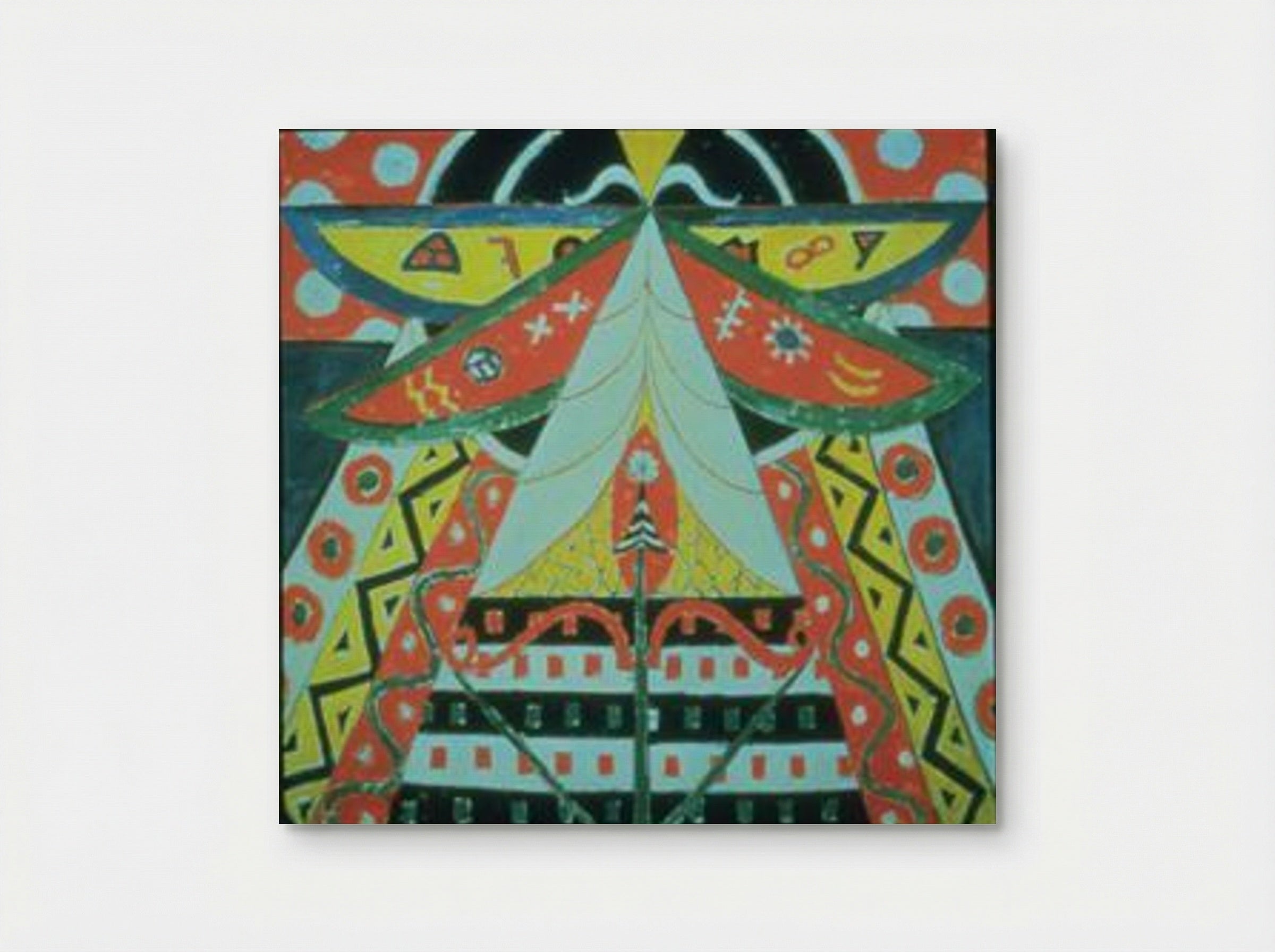
Painting No. 50 - Marsden Hartley
Archival giclée
Frames arrive ready to hang
Secure checkout
Made to order
Description
An abstract composition from Marsden Hartley's Berlin period, featuring military symbols and geometric patterns in bold colours.
Marsden Hartley painted this work during his residence in Berlin between 1914 and 1915. It belongs to a series of abstract compositions often referred to as the War Motifs or German Officer paintings. These works are characterised by their use of military insignia, heraldry, and personal symbols. Hartley was influenced by the pageantry of pre-war Berlin and the visual language of the German military. The composition is strictly symmetrical and built upon a black ground. It features a central white triangle that suggests a tent or a stylised figure. Within and around this shape, Hartley arranged various motifs including red circles, yellow zig-zags, and striped patterns. The upper portion contains curved forms resembling epaulettes or wings, decorated with small symbols and numbers. White polka dots on a red field appear in the upper corners, contrasting with the dark background. Hartley developed this style after moving away from his earlier interest in spiritualism and the theories of Wassily Kandinsky. He focused instead on the physical objects and uniforms he observed in the city. The use of numbers and letters in the work likely refers to specific regiments or personal associations. This painting represents a period where Hartley combined European avant-garde techniques with a personal symbolic vocabulary. The application of paint is flat and direct, with heavy outlines defining the geometric segments.
Return policy
Because every print is made to order, we don't offer change-of-mind returns, refunds or exchanges. If your order arrives faulty, damaged or incorrect, we'll replace it free of charge — just contact us within 48 hours of delivery. See our refunds page for full details.
Shipping
We ship worldwide, printing at the production hub nearest to your delivery address. Delivery times and costs vary by destination — you'll see the options available to you at checkout.
Manufacturing
Each print is produced to order using 12-colour giclée printing on FSC-certified archival paper. Designed in Britain and printed at your nearest production hub to reduce waste and speed up delivery.
Painting No. 50 - Marsden Hartley

Artist Biography
Marsden Hartley
Returning to the United States, Hartley sought to capture the essence of the American landscape and its people. He embraced a more representational style, focusing on the rugged beauty of his native Maine and the working-class communities he encountered. His "Dogtown" series, depicting the desolate landscape of a former settlement, showcases his ability to find beauty in the stark and unforgiving. These works are not mere landscapes; they are meditations on memory, loss, and the enduring power of nature.
Despite facing personal struggles and periods of obscurity, Hartley remained committed to his artistic vision. His willingness to experiment with different styles and subjects, from abstract symbolism to representational landscapes, makes him a truly unique and compelling figure. Marsden Hartley died in 1943, leaving behind a body of work that continues to challenge and inspire, inviting viewers to contemplate the complexities of identity, place, and the human condition.
Our Features
Designed for Lasting Impact
Specific Features
Every Solis piece is made to order with archival, gallery-quality materials built to last.
- Museum-grade giclée printing for rich, fade-resistant colour
- Archival matte fine-art paper, FSC-certified
- Multiple sizes and framing options available
- Frames in black, natural wood, dark wood or white
- Framed prints arrive ready to hang
Care & Cleaning
To keep your artwork looking its best:
- Dust gently with a soft, dry cloth
- Avoid prolonged direct sunlight
- Never use liquid cleaners on the print or canvas surface
- Keep in a dry, room-temperature space
- Handle prints with clean, dry hands
Materials & Sizing
Museum-grade giclée on FSC-certified archival matte paper, with framed and canvas options.
- Paper sizes: A4, A3, A2, A1, A0 and B2 (50×70 cm)
- Canvas: XS (20×30 cm) to Large (60×90 cm)
- Frames: black, natural wood, dark wood or white
Why Choose Us ?
Damage-free delivery guarantee
Fast Shipping
Museum-Quality Materials
Artist Biography
Marsden Hartley
Returning to the United States, Hartley sought to capture the essence of the American landscape and its people. He embraced a more representational style, focusing on the rugged beauty of his native Maine and the working-class communities he encountered. His "Dogtown" series, depicting the desolate landscape of a former settlement, showcases his ability to find beauty in the stark and unforgiving. These works are not mere landscapes; they are meditations on memory, loss, and the enduring power of nature.
Despite facing personal struggles and periods of obscurity, Hartley remained committed to his artistic vision. His willingness to experiment with different styles and subjects, from abstract symbolism to representational landscapes, makes him a truly unique and compelling figure. Marsden Hartley died in 1943, leaving behind a body of work that continues to challenge and inspire, inviting viewers to contemplate the complexities of identity, place, and the human condition.
You May Also Like