

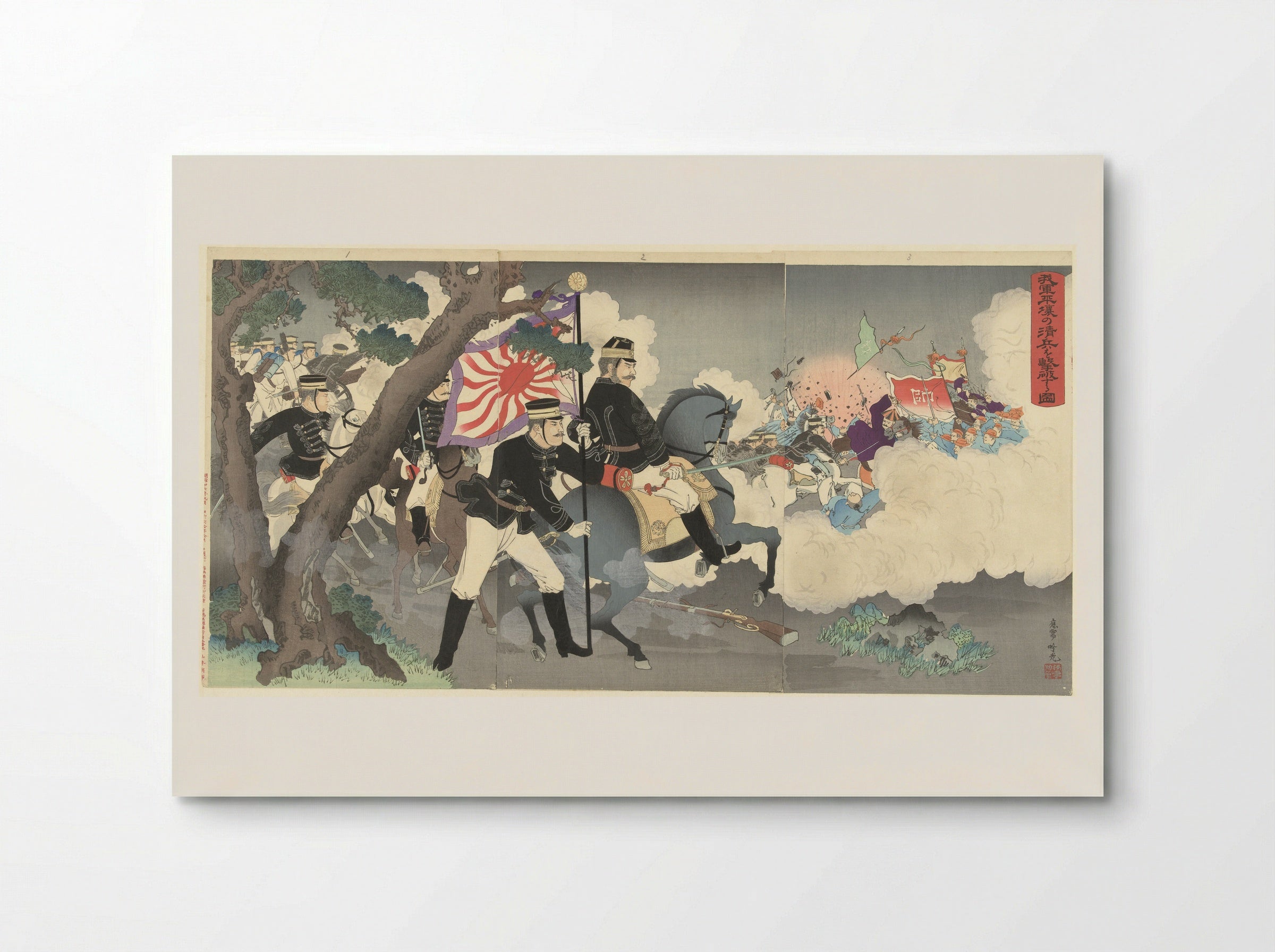
Our Forces Defeating the Chinese Soldiers at Pyongyang - Unknown Artist
Archival giclée
Frames arrive ready to hang
Secure checkout
Made to order
Description
A Japanese woodblock triptych from 1894 depicting the Battle of Pyongyang during the First Sino-Japanese War.
This woodblock print depicts a scene from the First Sino-Japanese War, specifically the Battle of Pyongyang in 1894. The composition is a triptych, a common format for Japanese war prints of the period, allowing for a wide, panoramic view of the conflict. On the left, Japanese soldiers are shown advancing under the cover of trees, while the central figure, mounted on horseback, carries the Rising Sun flag. The right side of the image is dominated by the chaos of battle, with billowing clouds of smoke obscuring the clash between Japanese and Chinese forces. The print belongs to the genre of senso-e, or war prints, which became popular in Japan during the late nineteenth century. These works served as a primary source of visual information for the public, documenting military campaigns through a blend of traditional ukiyo-e techniques and modern subject matter. The artist employs a clear, graphic style to distinguish the opposing sides, using uniform details and flags to denote national identity. The use of colour is restrained, relying on a palette of muted tones to convey the atmosphere of the battlefield, punctuated by the bright red of the Japanese flag. Technically, the print demonstrates the skill of the carvers and printers who produced these works under tight deadlines to satisfy public demand for news from the front. The lines are precise, defining the figures and equipment with clarity. While the depiction of the battle is stylised rather than documentary, it provides a window into the visual culture of Meiji Japan and the way the nation perceived its military expansion. The work remains a specimen of the intersection between traditional printmaking and the rapid modernisation of Japanese society during the late nineteenth century.
You might also like
Return policy
Because every print is made to order, we don't offer change-of-mind returns, refunds or exchanges. If your order arrives faulty, damaged or incorrect, we'll replace it free of charge — just contact us within 48 hours of delivery. See our refunds page for full details.
Shipping
We ship worldwide, printing at the production hub nearest to your delivery address. Delivery times and costs vary by destination — you'll see the options available to you at checkout.
Manufacturing
Each print is produced to order using 12-colour giclée printing on FSC-certified archival paper. Designed in Britain and printed at your nearest production hub to reduce waste and speed up delivery.
Our Forces Defeating the Chinese Soldiers at Pyongyang - Unknown Artist
Artist Biography
Unknown Artist
The artistic approach of the Unknown Artist varies between the formal composition of the carte-de-visite and the narrative style of the war prints. In the Moroccan portraits, the focus rests on the subject's posture and attire against a neutral studio backdrop. The Japanese prints use bold lines and flat colours to depict military movements and naval victories. Despite the lack of a specific attribution, these works demonstrate a high level of technical skill in both lithography and woodblock carving.
Modern collectors often value anonymous works for their mystery and focus on the image itself. These prints provide a direct connection to history without the distraction of a famous name. They function as windows into the 19th-century world, from the quiet dignity of a young girl in a studio to the chaos of a distant conflict. These pieces offer a sense of discovery for those who appreciate the aesthetic qualities of vintage photography and historical illustration.
Our Features
Designed for Lasting Impact
Specific Features
Every Solis piece is made to order with archival, gallery-quality materials built to last.
- Museum-grade giclée printing for rich, fade-resistant colour
- Archival matte fine-art paper, FSC-certified
- Multiple sizes and framing options available
- Frames in black, natural wood, dark wood or white
- Framed prints arrive ready to hang
Care & Cleaning
To keep your artwork looking its best:
- Dust gently with a soft, dry cloth
- Avoid prolonged direct sunlight
- Never use liquid cleaners on the print or canvas surface
- Keep in a dry, room-temperature space
- Handle prints with clean, dry hands
Materials & Sizing
Museum-grade giclée on FSC-certified archival matte paper, with framed and canvas options.
- Paper sizes: A4, A3, A2, A1, A0 and B2 (50×70 cm)
- Canvas: XS (20×30 cm) to Large (60×90 cm)
- Frames: black, natural wood, dark wood or white
Why Choose Us ?
Damage-free delivery guarantee
Fast Shipping
Museum-Quality Materials
Artist Biography
Unknown Artist
The artistic approach of the Unknown Artist varies between the formal composition of the carte-de-visite and the narrative style of the war prints. In the Moroccan portraits, the focus rests on the subject's posture and attire against a neutral studio backdrop. The Japanese prints use bold lines and flat colours to depict military movements and naval victories. Despite the lack of a specific attribution, these works demonstrate a high level of technical skill in both lithography and woodblock carving.
Modern collectors often value anonymous works for their mystery and focus on the image itself. These prints provide a direct connection to history without the distraction of a famous name. They function as windows into the 19th-century world, from the quiet dignity of a young girl in a studio to the chaos of a distant conflict. These pieces offer a sense of discovery for those who appreciate the aesthetic qualities of vintage photography and historical illustration.
You May Also Like