

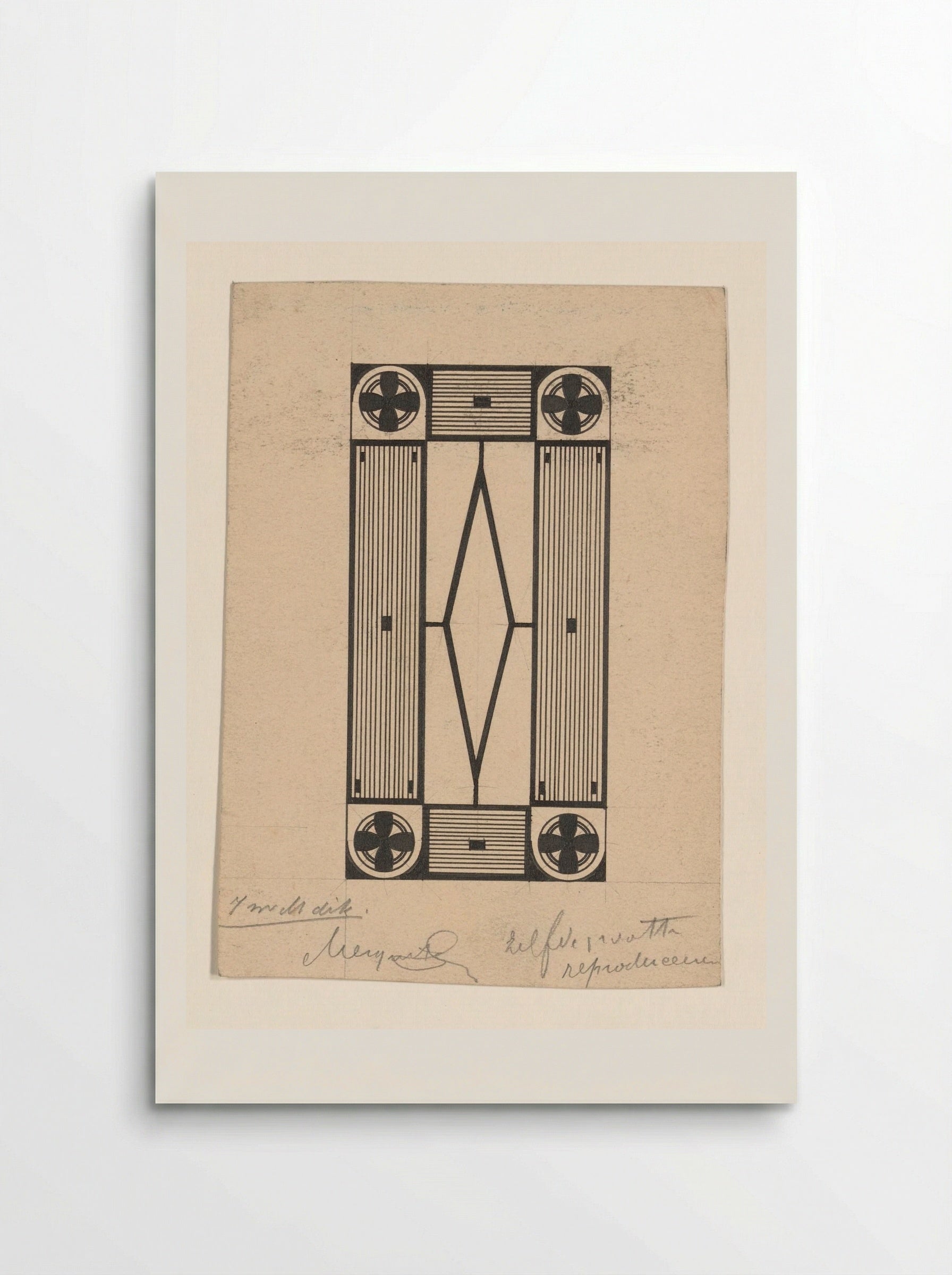
Ornament met bloem - Samuel Jessurun de Mesquita
Archival giclée
Frames arrive ready to hang
Secure checkout
Made to order
Description
A geometric design by Samuel Jessurun de Mesquita, 'Ornament met bloem' features a symmetrical arrangement of rectangular and circular elements, with a central diamond shape suggesting a simplified flower. The design is executed in black ink on a light background.
This geometric design, titled 'Ornament met bloem' (Ornament with Flower), is by Dutch artist Samuel Jessurun de Mesquita. De Mesquita, born in Amsterdam, was a printmaker, painter, and teacher known for his graphic work and woodcuts. His work often featured stylized depictions of animals, plants, and human figures, reflecting influences from Art Nouveau and Symbolism. He taught graphic techniques at the Academy of Fine Arts in Amsterdam, where his students included M.C. Escher. Tragically, de Mesquita and his family were murdered in Auschwitz during the Holocaust. His surviving works offer a glimpse into his distinctive artistic vision. This particular design showcases de Mesquita's interest in geometric abstraction and stylised floral motifs. The composition features a symmetrical arrangement of rectangular and circular elements, with a central diamond shape suggesting a simplified flower. The design is executed in black ink on a light background, with fine lines and precise details. The overall effect is one of restrained elegance and decorative simplicity, typical of Art Nouveau aesthetics. The piece likely functioned as a study for a larger textile or wallpaper design.
Return policy
Because every print is made to order, we don't offer change-of-mind returns, refunds or exchanges. If your order arrives faulty, damaged or incorrect, we'll replace it free of charge — just contact us within 48 hours of delivery. See our refunds page for full details.
Shipping
We ship worldwide, printing at the production hub nearest to your delivery address. Delivery times and costs vary by destination — you'll see the options available to you at checkout.
Manufacturing
Each print is produced to order using 12-colour giclée printing on FSC-certified archival paper. Designed in Britain and printed at your nearest production hub to reduce waste and speed up delivery.
Ornament met bloem - Samuel Jessurun de Mesquita

Artist Biography
Samuel Jessurun De Mesquita
He was born in Amsterdam in 1868, of Portuguese Sephardic Jewish origin. He trained there and was appointed teacher at the School of Architecture and Decorative Arts in Haarlem in 1902, where he remained until 1926. Escher was his most famous student; it was De Mesquita who convinced the young Escher to abandon architecture for graphic arts, a decision that changed twentieth-century visual culture.
De Mesquita produced over four hundred prints, including woodcuts, wood engravings, etchings and lithographs, plus drawings and textile designs. His animal and bird woodcuts, with their stark black-and-white stylisation influenced by Japanese ukiyo-e, are among his most distinctive work. He was not religiously observant despite his Sephardic community background. His wife Elisabeth was gassed alongside him at Auschwitz; their son Jaap perished at Theresienstadt a month later. He died at Auschwitz, around 11 February 1944, at seventy-five.
Our Features
Designed for Lasting Impact
Specific Features
Every Solis piece is made to order with archival, gallery-quality materials built to last.
- Museum-grade giclée printing for rich, fade-resistant colour
- Archival matte fine-art paper, FSC-certified
- Multiple sizes and framing options available
- Frames in black, natural wood, dark wood or white
- Framed prints arrive ready to hang
Care & Cleaning
To keep your artwork looking its best:
- Dust gently with a soft, dry cloth
- Avoid prolonged direct sunlight
- Never use liquid cleaners on the print or canvas surface
- Keep in a dry, room-temperature space
- Handle prints with clean, dry hands
Materials & Sizing
Museum-grade giclée on FSC-certified archival matte paper, with framed and canvas options.
- Paper sizes: A4, A3, A2, A1, A0 and B2 (50×70 cm)
- Canvas: XS (20×30 cm) to Large (60×90 cm)
- Frames: black, natural wood, dark wood or white
Why Choose Us ?
Damage-free delivery guarantee
Fast Shipping
Museum-Quality Materials
Artist Biography
Samuel Jessurun de Mesquita
He was born in Amsterdam in 1868, of Portuguese Sephardic Jewish origin. He trained there and was appointed teacher at the School of Architecture and Decorative Arts in Haarlem in 1902, where he remained until 1926. Escher was his most famous student; it was De Mesquita who convinced the young Escher to abandon architecture for graphic arts, a decision that changed twentieth-century visual culture.
De Mesquita produced over four hundred prints, including woodcuts, wood engravings, etchings and lithographs, plus drawings and textile designs. His animal and bird woodcuts, with their stark black-and-white stylisation influenced by Japanese ukiyo-e, are among his most distinctive work. He was not religiously observant despite his Sephardic community background. His wife Elisabeth was gassed alongside him at Auschwitz; their son Jaap perished at Theresienstadt a month later. He died at Auschwitz, around 11 February 1944, at seventy-five.
You May Also Like