

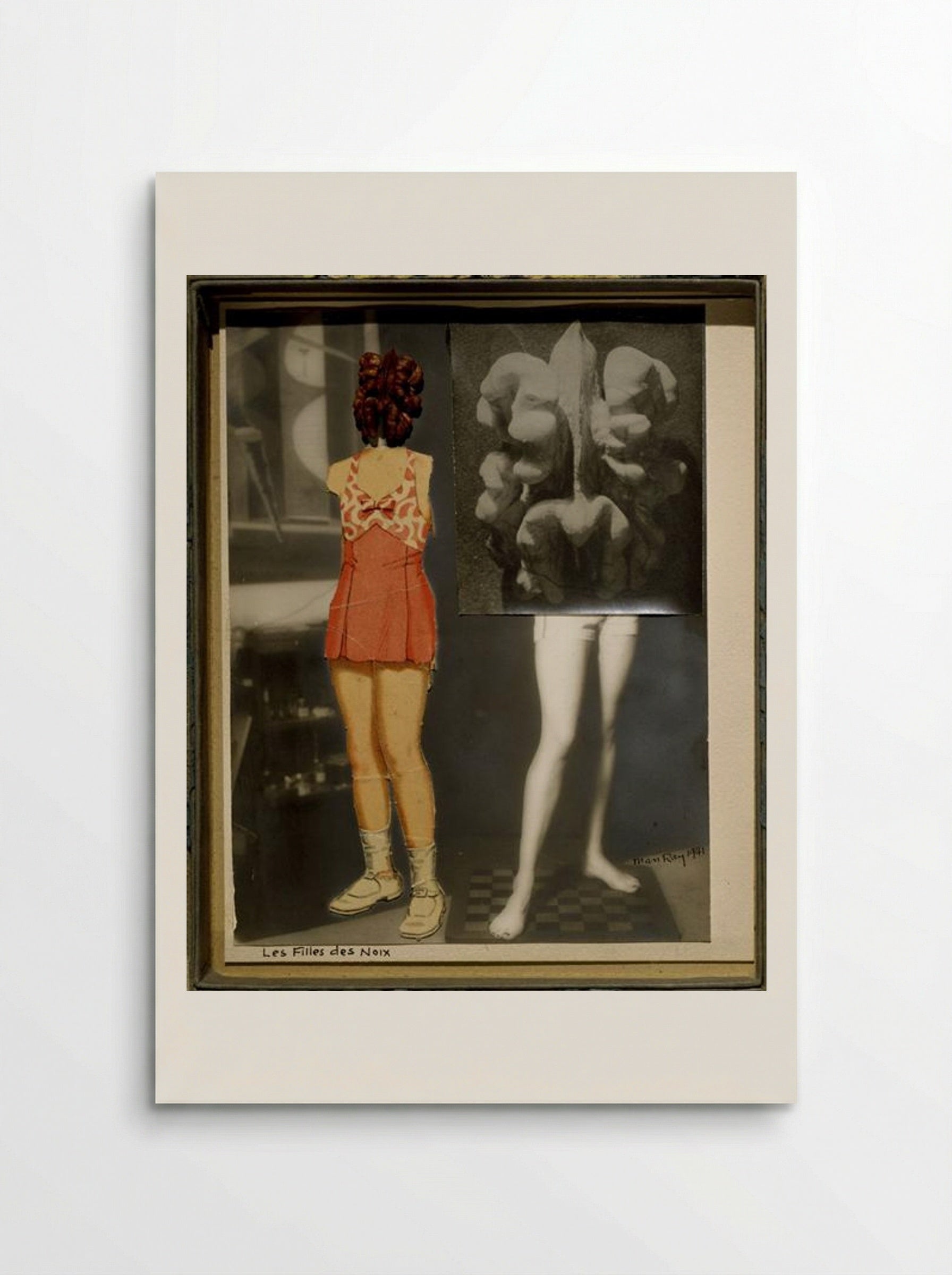
Nut Girls (Les Filles des Noix) - Man Ray
Archival giclée
Frames arrive ready to hang
Secure checkout
Made to order
Description
A surrealist photomontage from 1941 by Man Ray, featuring a playful and uncanny juxtaposition of a human figure and a walnut kernel.
Man Ray, born Emmanuel Radnitzky, was a central figure in the Dada and Surrealist movements. His work often subverted traditional artistic boundaries, blending photography with assemblage and collage. Nut Girls (Les Filles des Noix), created in 1941, is a characteristic example of his experimental approach to imagery during his time in the United States. The composition features a juxtaposition of disparate elements. On the left, a cut-out figure of a woman in a patterned swimsuit stands against a blurred, dark interior background. On the right, a large, monochromatic photograph of a walnut kernel is placed where the figure's head and torso should be, resting atop a pair of legs standing on a chequered surface. This displacement of the human form is a hallmark of Surrealist practice, intended to disrupt the viewer's perception of reality and logic. By replacing the human head with the organic, convoluted texture of a walnut, Man Ray invites a dialogue between the biological and the artificial. The title, Les Filles des Noix, adds a layer of linguistic play, typical of the artist's penchant for puns and double meanings. The work functions as a visual puzzle, where the viewer is tasked with reconciling the fragmented components. The inclusion of the chequered floor adds a sense of theatricality, suggesting a stage or a dreamscape. This piece demonstrates the artist's ability to transform mundane objects into uncanny subjects through simple yet effective manipulation of photographic material. It remains a curious study in the possibilities of the medium, reflecting the artist's interest in the subconscious and the irrational.
Return policy
Because every print is made to order, we don't offer change-of-mind returns, refunds or exchanges. If your order arrives faulty, damaged or incorrect, we'll replace it free of charge — just contact us within 48 hours of delivery. See our refunds page for full details.
Shipping
We ship worldwide, printing at the production hub nearest to your delivery address. Delivery times and costs vary by destination — you'll see the options available to you at checkout.
Manufacturing
Each print is produced to order using 12-colour giclée printing on FSC-certified archival paper. Designed in Britain and printed at your nearest production hub to reduce waste and speed up delivery.
Care and materials
Specific Features
Every Solis piece is made to order with archival, gallery-quality materials built to last.
- Museum-grade giclée printing for rich, fade-resistant colour
- Archival matte fine-art paper, FSC-certified
- Multiple sizes and framing options available
- Frames in black, natural wood, dark wood or white
- Framed prints arrive ready to hang
Care & Cleaning
To keep your artwork looking its best:
- Dust gently with a soft, dry cloth
- Avoid prolonged direct sunlight
- Never use liquid cleaners on the print or canvas surface
- Keep in a dry, room-temperature space
- Handle prints with clean, dry hands
Materials & Sizing
Museum-grade giclée on FSC-certified archival matte paper, with framed and canvas options.
- Paper sizes: A4, A3, A2, A1, A0 and B2 (50×70 cm)
- Canvas: XS (20×30 cm) to Large (60×90 cm)
- Frames: black, natural wood, dark wood or white
Nut Girls (Les Filles des Noix) - Man Ray

Artist Biography
Man Ray
He moved to Paris in 1921 and stayed for twenty years. He arrived knowing Marcel Duchamp, who had been his closest collaborator in New York. The two of them shared an instinct for provocation. Man Ray's contribution to Dada was the 'rayograph', made by placing objects directly on photographic paper and exposing them to light. No camera, no lens. The results look like X-rays of the unconscious: keys, springs, hands, fabrics, rendered as white silhouettes on black.
He became the portrait photographer of the Parisian avant-garde. Picasso, Hemingway, Gertrude Stein, Jean Cocteau, the Surrealists. The portraits are sharp, well-lit, and respectful, which is not what you would expect from a Dadaist. He also worked in fashion photography for Vogue and Harper's Bazaar, which paid the bills and gave him access to models and studios.
The most famous image is Le Violon d'Ingres (1924): a photograph of Kiki de Montparnasse's back with f-holes painted on it, turning a woman into a cello. It is witty, elegant, and uncomfortable in exactly the way Surrealism intended. He claimed to value his paintings more than his photographs. The world disagreed, and he never entirely forgave it.
He returned to Paris after the war and stayed until his death in 1976, at eighty-six.
Why Choose Us ?
Damage-free delivery guarantee
Fast Shipping
Museum-Quality Materials
You May Also Like