

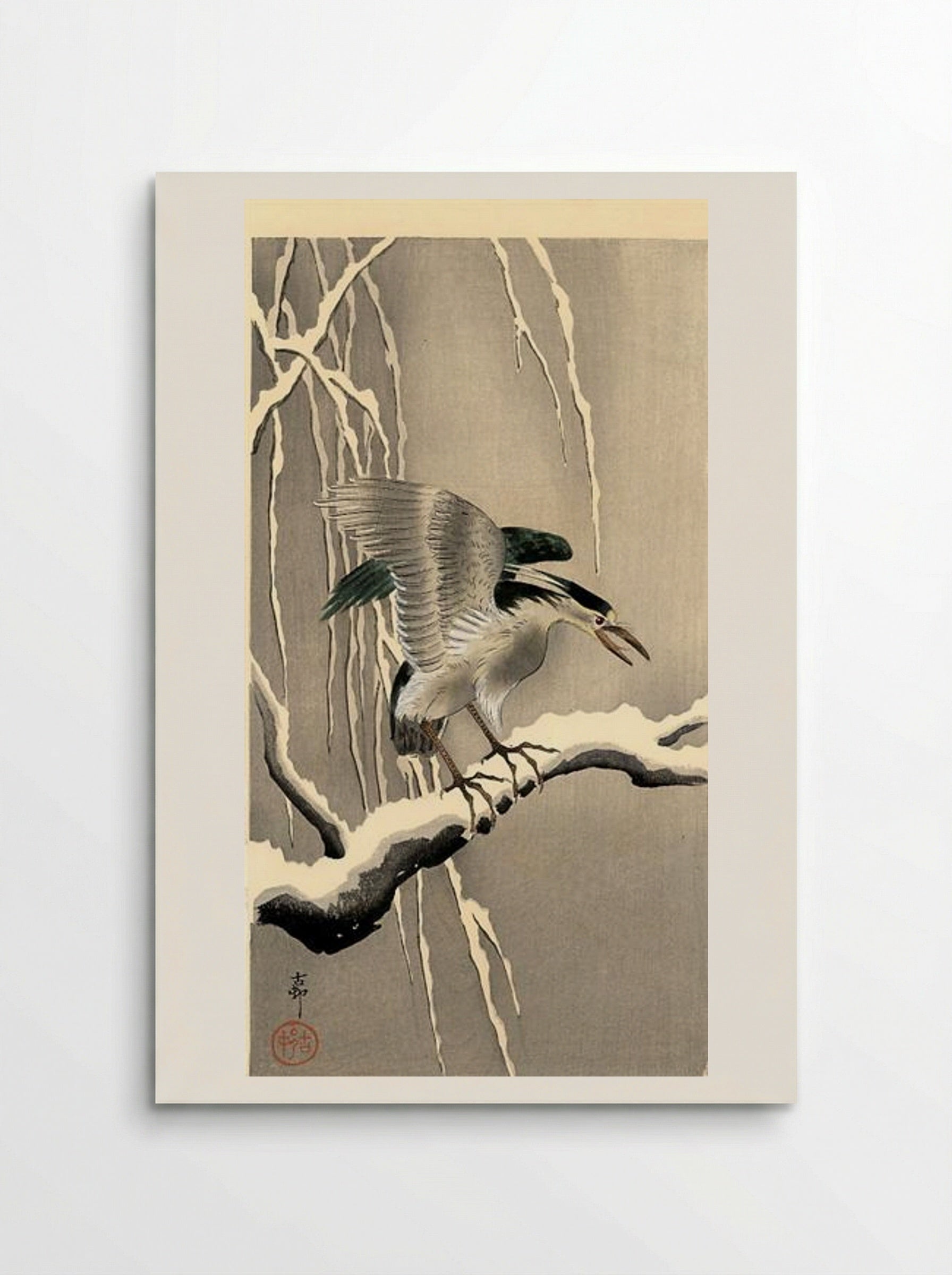
Night Heron on a Snowy Branch - Ohara Koson
Archival giclée
Frames arrive ready to hang
Secure checkout
Made to order
Description
A woodblock print by Ohara Koson, 'Night Heron on a Snowy Branch' depicts a heron perched on a snow-covered branch. The print showcases Koson's mastery of kacho-e, blending naturalism with decorative design.
Ohara Koson (1877-1945) was a Japanese artist renowned for his woodblock prints of birds and flowers, a category known as kacho-e. He initially trained in painting but later transitioned to printmaking, working with publishers such as Watanabe Shōzaburō and Kawaguchi. Koson's work blends traditional Ukiyo-e techniques with a more modern, Western aesthetic, aligning with the Shin-Hanga movement that aimed to revitalise traditional Japanese printmaking. His prints were particularly popular in Europe and America. 'Night Heron on a Snowy Branch' exemplifies Koson's skill in capturing the delicate balance between naturalism and decorative design. The print depicts a night heron perched on a snow-laden branch, its feathers rendered with fine detail. The composition is simple yet effective, with the stark white of the snow contrasting against the heron's grey and black plumage. The falling snow is suggested by thin vertical lines, adding a sense of depth to the scene. The overall effect is one of quiet contemplation, evoking the stillness of a winter night.
Return policy
Because every print is made to order, we don't offer change-of-mind returns, refunds or exchanges. If your order arrives faulty, damaged or incorrect, we'll replace it free of charge — just contact us within 48 hours of delivery. See our refunds page for full details.
Shipping
We ship worldwide, printing at the production hub nearest to your delivery address. Delivery times and costs vary by destination — you'll see the options available to you at checkout.
Manufacturing
Each print is produced to order using 12-colour giclée printing on FSC-certified archival paper. Designed in Britain and printed at your nearest production hub to reduce waste and speed up delivery.
Care and materials
Specific Features
Every Solis piece is made to order with archival, gallery-quality materials built to last.
- Museum-grade giclée printing for rich, fade-resistant colour
- Archival matte fine-art paper, FSC-certified
- Multiple sizes and framing options available
- Frames in black, natural wood, dark wood or white
- Framed prints arrive ready to hang
Care & Cleaning
To keep your artwork looking its best:
- Dust gently with a soft, dry cloth
- Avoid prolonged direct sunlight
- Never use liquid cleaners on the print or canvas surface
- Keep in a dry, room-temperature space
- Handle prints with clean, dry hands
Materials & Sizing
Museum-grade giclée on FSC-certified archival matte paper, with framed and canvas options.
- Paper sizes: A4, A3, A2, A1, A0 and B2 (50×70 cm)
- Canvas: XS (20×30 cm) to Large (60×90 cm)
- Frames: black, natural wood, dark wood or white
Night Heron on a Snowy Branch - Ohara Koson

Artist Biography
Ohara Koson
Koson's delicate compositions are celebrated for their serene beauty and exceptional attention to detail. His prints often feature songbirds poised on blossoming branches, herons standing in misty wetlands, or animals framed by seasonal flora. Using subtle color gradations and masterful linework, Koson created works that were both elegant and emotionally resonant. His collaboration with Western publishers such as Watanabe Shōzaburō helped bring his art to international audiences, especially in the United States and Europe, where collectors praised his modern yet timeless style.
Today, Ohara Koson is considered one of the finest nature printmakers of the 20th century. His work remains highly sought after by collectors and is held in major museum collections around the world, including the British Museum and the Smithsonian. As part of the shin-hanga revival, Koson's prints not only preserved traditional woodblock techniques but also brought new life to Japanese art through refined compositions that continue to captivate viewers with their peaceful grace and poetic charm.
Why Choose Us ?
Damage-free delivery guarantee
Fast Shipping
Museum-Quality Materials
You May Also Like