

Fine Art Poster
From £28
A giclée print on 200gsm matte fine art paper, using a twelve-colour process for accurate, fade-resistant colour. Supplied unframed, delivered flat or rolled.



Archival giclée
Frames arrive ready to hang
Secure checkout
Made to order
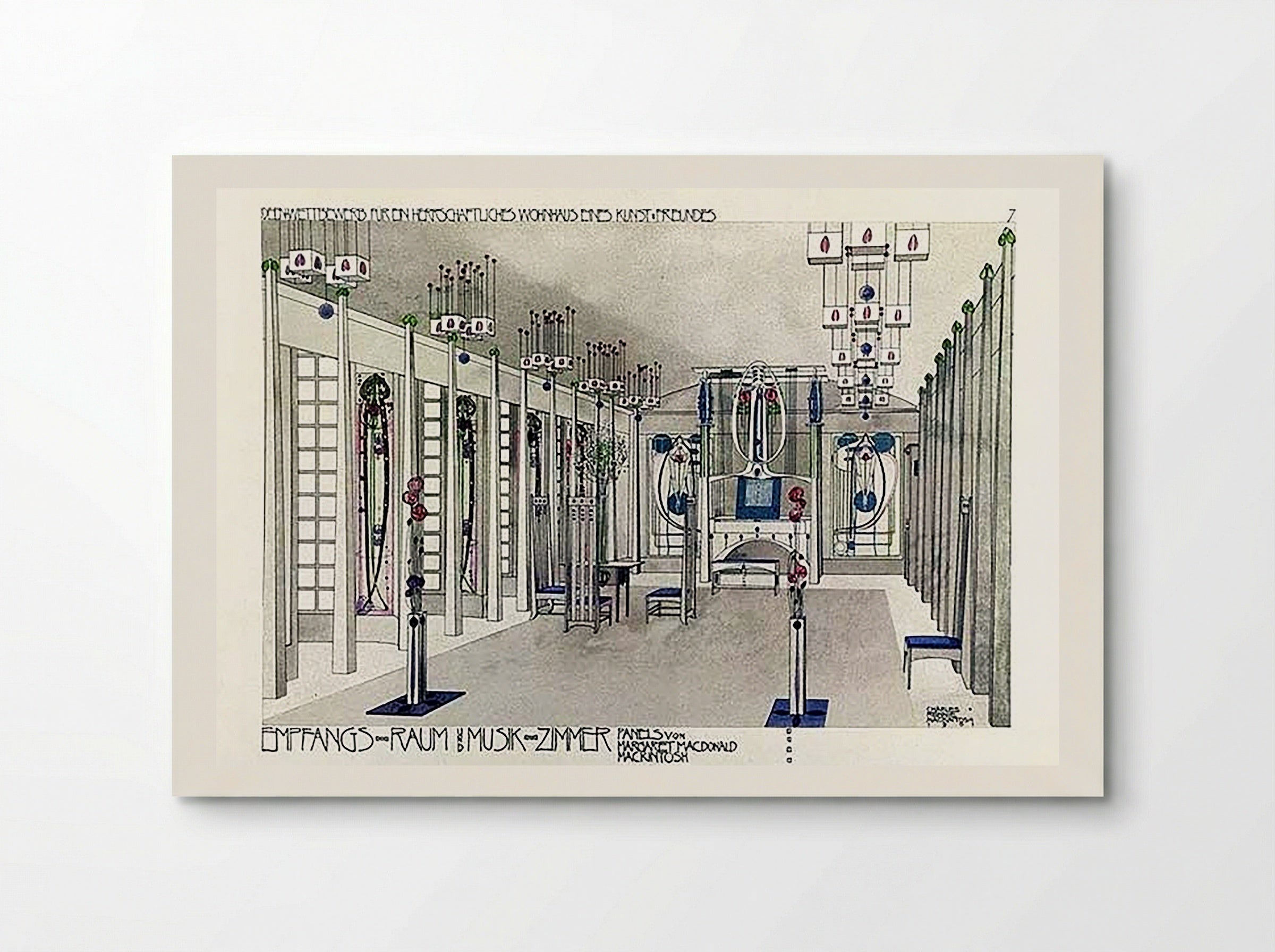
A music room interior design by Charles Rennie Mackintosh, showcasing his distinctive geometric and floral style, characteristic of the Glasgow School Art Nouveau movement.
This interior design rendering, titled 'Music Room', is attributed to Charles Rennie Mackintosh, a Scottish architect, designer, and artist. Mackintosh, along with his wife Margaret Macdonald Mackintosh, was a leading figure in the Glasgow School, an important branch of the Art Nouveau movement in Britain. The design showcases Mackintosh's distinctive style, characterised by geometric forms, stylised floral motifs, and a restrained colour palette. The drawing depicts a music room interior, featuring tall, slender vertical elements, grid-like patterns, and abstracted floral decorations. The composition is symmetrical, with a focus on linear perspective. The colour scheme is dominated by muted tones of grey, white, and blue, with touches of pink and green. The overall effect is one of understated elegance and refined simplicity, reflecting the Glasgow School's emphasis on functional design and artistic expression. The panels are noted as being by Margaret Macdonald Mackintosh, indicating a collaborative design process.
Because every print is made to order, we don't offer change-of-mind returns, refunds or exchanges. If your order arrives faulty, damaged or incorrect, we'll replace it free of charge — just contact us within 48 hours of delivery. See our refunds page for full details.
We ship worldwide, printing at the production hub nearest to your delivery address. Delivery times and costs vary by destination — you'll see the options available to you at checkout.
Each print is produced to order using 12-colour giclée printing on FSC-certified archival paper. Designed in Britain and printed at your nearest production hub to reduce waste and speed up delivery.

Artist Biography
Our Features
Designed for Lasting Impact
Every Solis piece is made to order with archival, gallery-quality materials built to last.
To keep your artwork looking its best:
Museum-grade giclée on FSC-certified archival matte paper, with framed and canvas options.
Made to order
Every piece is printed to order. These are the five finishes, and what makes each one different.
From £28
A giclée print on 200gsm matte fine art paper, using a twelve-colour process for accurate, fade-resistant colour. Supplied unframed, delivered flat or rolled.

From £45
The same fine art print in a solid wood frame with UV-protective acrylic glaze and rigid backing. Five frame colours. Arrives ready to hang.
Why Choose Us ?
Damage-free delivery guarantee
Fast Shipping
Museum-Quality Materials
Artist Biography
Charles Rennie Mackintosh
You May Also Like
Cookies show us which prints people love, so we hang the right art. Help us fill it?
Essential cookies only if you prefer · Privacy Policy