

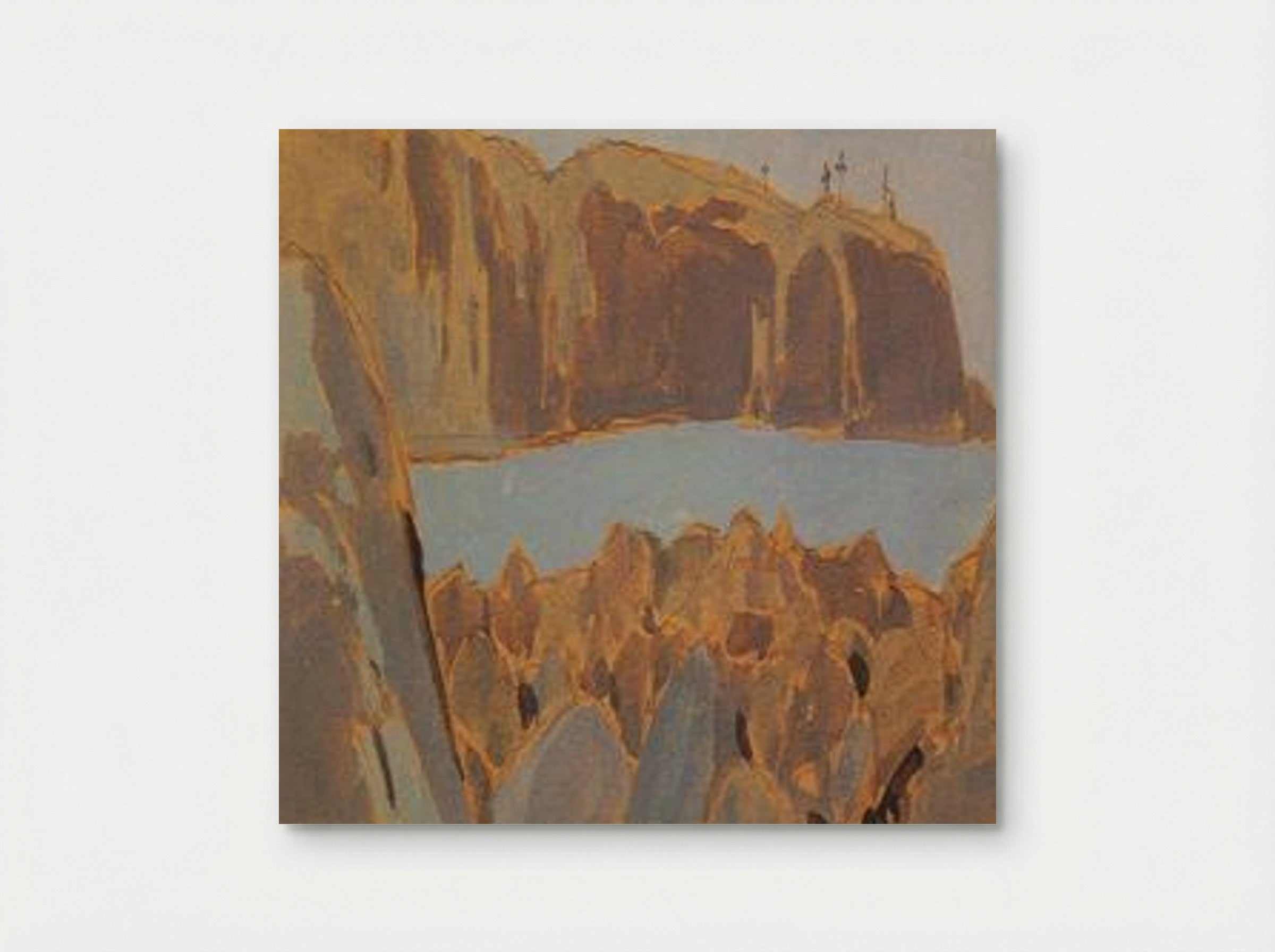
Murman Coast (Pomor Crosses) - Konstantin Korovin
Archival giclée
Frames arrive ready to hang
Secure checkout
Made to order
Description
Painted in 1894, this work captures the rugged beauty of the Russian North. Konstantin Korovin uses a muted palette of ochre and grey to depict the rocky Murman coastline.
Konstantin Korovin painted this work in 1894 during an expedition to the Far North of Russia. Accompanied by fellow artist Valentin Serov, Korovin travelled through Murmansk and the Arkhangelsk region. This journey was funded by the industrialist Savva Mamontov to document the northern territories for the All-Russian Exhibition in Nizhny Novgorod. The trip resulted in a series of paintings that departed from the traditional, dark palettes of earlier Russian realism. In this composition, Korovin captures the austere environment of the Barents Sea. The foreground is dominated by jagged, ochre-coloured rocks that lead the eye toward a narrow strip of pale blue water. Beyond the water, steep cliffs rise against a grey sky. On the highest point of the ridge, three Pomor crosses are visible. These wooden structures were erected by local seafaring communities as navigational aids or memorials. Their presence provides a human element to the otherwise desolate terrain. The artist uses a limited palette of earthy tones, muted blues, silvery greys, and soft ochres. This choice of colour reflects the unique light conditions of the subarctic summer. Korovin applied the paint with broad, rapid strokes, prioritising the overall atmosphere over minute details. This approach was characteristic of his contribution to Russian Impressionism. He focused on the immediate impression of the cold, damp air and the rugged texture of the stone. The work is a study of light and form in a region that was then considered remote. It avoids the sentimentalism often found in 19th-century landscape painting. Instead, it presents a direct observation of the northern coast. The painting is now part of the collection at the State Tretyakov Gallery in Moscow. It remains a significant example of how Korovin adapted Impressionist techniques to the specific environmental conditions of the Russian North.
Return policy
Because every print is made to order, we don't offer change-of-mind returns, refunds or exchanges. If your order arrives faulty, damaged or incorrect, we'll replace it free of charge — just contact us within 48 hours of delivery. See our refunds page for full details.
Shipping
We ship worldwide, printing at the production hub nearest to your delivery address. Delivery times and costs vary by destination — you'll see the options available to you at checkout.
Manufacturing
Each print is produced to order using 12-colour giclée printing on FSC-certified archival paper. Designed in Britain and printed at your nearest production hub to reduce waste and speed up delivery.
Care and materials
Specific Features
Every Solis piece is made to order with archival, gallery-quality materials built to last.
- Museum-grade giclée printing for rich, fade-resistant colour
- Archival matte fine-art paper, FSC-certified
- Multiple sizes and framing options available
- Frames in black, natural wood, dark wood or white
- Framed prints arrive ready to hang
Care & Cleaning
To keep your artwork looking its best:
- Dust gently with a soft, dry cloth
- Avoid prolonged direct sunlight
- Never use liquid cleaners on the print or canvas surface
- Keep in a dry, room-temperature space
- Handle prints with clean, dry hands
Materials & Sizing
Museum-grade giclée on FSC-certified archival matte paper, with framed and canvas options.
- Paper sizes: A4, A3, A2, A1, A0 and B2 (50×70 cm)
- Canvas: XS (20×30 cm) to Large (60×90 cm)
- Frames: black, natural wood, dark wood or white
Murman Coast (Pomor Crosses) - Konstantin Korovin

Artist Biography
Konstantin Korovin
He was born in Moscow in 1861 and studied under Savrasov and Polenov at the Moscow School. He was close to Mamontov's Abramtsevo circle and designed prolifically for the Bolshoi and Mariinsky theatres. His Parisian cafe scenes and Crimean landscapes use loose, luminous brushwork. After the Revolution he emigrated to Paris in 1923. He died in Paris in 1939.
Why Choose Us ?
Damage-free delivery guarantee
Fast Shipping
Museum-Quality Materials
You May Also Like