

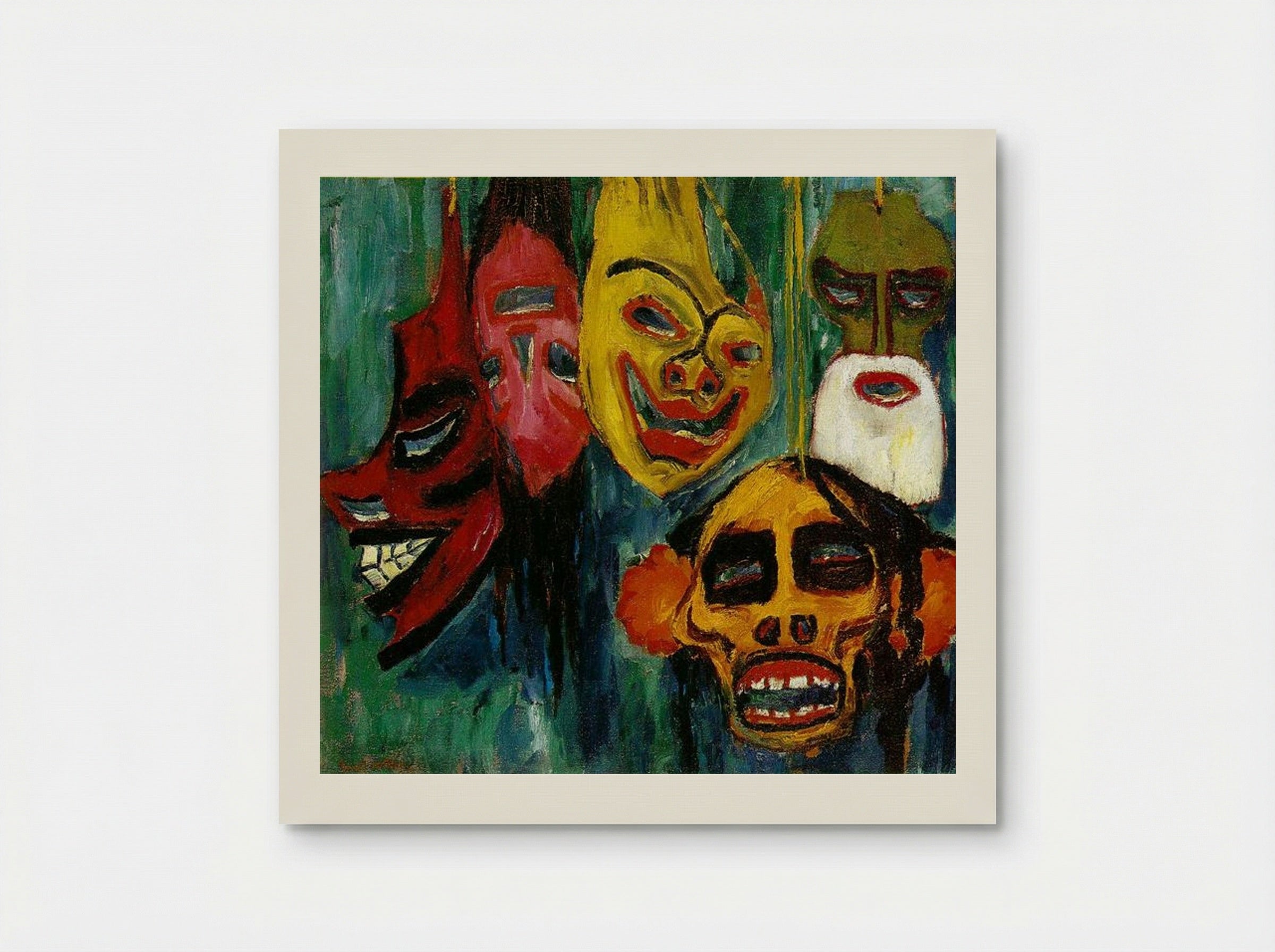
Mask Still Life III - Emil Nolde
Archival giclée
Frames arrive ready to hang
Secure checkout
Made to order
Description
A striking 1911 Expressionist work by Emil Nolde, featuring a collection of suspended masks rendered with bold, gestural brushwork and saturated colours.
Emil Nolde painted Mask Still Life III in 1911, a period during which he explored the expressive potential of non-Western artefacts. The composition features a collection of masks suspended against a dark, atmospheric background. Nolde, a member of the Die Brücke group for a brief time, utilised a palette of saturated reds, yellows, and greens to create a sense of psychological tension. The brushwork is heavy and gestural, reflecting the artist's interest in the raw, emotive power of the paint itself rather than a precise representation of the objects. These masks were part of the artist's personal collection, which he acquired from ethnographic museums in Berlin. Nolde was fascinated by the perceived authenticity and spiritual intensity of these items. In this work, the masks appear to float in a shallow space, their exaggerated features and wide, staring eyes confronting the viewer directly. The lack of a clear setting or table surface removes the traditional context of a still life, forcing the focus onto the distorted faces and their unsettling expressions. This painting demonstrates the German Expressionist interest in primitive art as a means to escape the perceived constraints of academic tradition. Nolde applied the paint with a directness that emphasises the physical texture of the canvas. The contrast between the dark, murky background and the bright, almost aggressive colours of the masks creates a jarring visual experience. By isolating these objects, Nolde transformed them from ethnographic specimens into subjects of intense, subjective interpretation. The work remains a primary example of how early twentieth-century artists engaged with global art forms to reshape their own visual language, prioritising emotional impact over objective observation.
Return policy
Because every print is made to order, we don't offer change-of-mind returns, refunds or exchanges. If your order arrives faulty, damaged or incorrect, we'll replace it free of charge — just contact us within 48 hours of delivery. See our refunds page for full details.
Shipping
We ship worldwide, printing at the production hub nearest to your delivery address. Delivery times and costs vary by destination — you'll see the options available to you at checkout.
Manufacturing
Each print is produced to order using 12-colour giclée printing on FSC-certified archival paper. Designed in Britain and printed at your nearest production hub to reduce waste and speed up delivery.
Mask Still Life III - Emil Nolde

Artist Biography
Emil Nolde
He was born Emil Hansen in Nolde, a village on the Danish-German border, and took the village name as his surname. He was self-taught until his late twenties, when he studied briefly in Munich and Paris. He joined Die Brücke (The Bridge), the German Expressionist group, in 1906 but left after eighteen months, finding group membership constraining. He preferred to work alone.
His religious paintings, The Life of Christ and the multi-panel Pentecost altarpiece, are violent and ecstatic. The faces are distorted, the colours clashing, the compositions compressed. They are closer to medieval devotional painting than to anything being produced in early twentieth-century Europe. The Catholic Church was unenthusiastic.
He joined the Nazi Party in 1934, apparently believing that Expressionism would be embraced as authentically German. He was wrong. The Nazis declared his work 'degenerate' in 1937, confiscated over a thousand of his paintings from German museums, and eventually forbade him from painting. He continued to work in secret, producing small watercolours he called his 'unpainted paintings.' Over 1,300 of them.
After the war he was rehabilitated and honoured. He lived to ninety-one. His Nazi Party membership has complicated his legacy permanently, and should.
Our Features
Designed for Lasting Impact
Specific Features
Every Solis piece is made to order with archival, gallery-quality materials built to last.
- Museum-grade giclée printing for rich, fade-resistant colour
- Archival matte fine-art paper, FSC-certified
- Multiple sizes and framing options available
- Frames in black, natural wood, dark wood or white
- Framed prints arrive ready to hang
Care & Cleaning
To keep your artwork looking its best:
- Dust gently with a soft, dry cloth
- Avoid prolonged direct sunlight
- Never use liquid cleaners on the print or canvas surface
- Keep in a dry, room-temperature space
- Handle prints with clean, dry hands
Materials & Sizing
Museum-grade giclée on FSC-certified archival matte paper, with framed and canvas options.
- Paper sizes: A4, A3, A2, A1, A0 and B2 (50×70 cm)
- Canvas: XS (20×30 cm) to Large (60×90 cm)
- Frames: black, natural wood, dark wood or white
Why Choose Us ?
Damage-free delivery guarantee
Fast Shipping
Museum-Quality Materials
Artist Biography
Emil Nolde
He was born Emil Hansen in Nolde, a village on the Danish-German border, and took the village name as his surname. He was self-taught until his late twenties, when he studied briefly in Munich and Paris. He joined Die Brücke (The Bridge), the German Expressionist group, in 1906 but left after eighteen months, finding group membership constraining. He preferred to work alone.
His religious paintings, The Life of Christ and the multi-panel Pentecost altarpiece, are violent and ecstatic. The faces are distorted, the colours clashing, the compositions compressed. They are closer to medieval devotional painting than to anything being produced in early twentieth-century Europe. The Catholic Church was unenthusiastic.
He joined the Nazi Party in 1934, apparently believing that Expressionism would be embraced as authentically German. He was wrong. The Nazis declared his work 'degenerate' in 1937, confiscated over a thousand of his paintings from German museums, and eventually forbade him from painting. He continued to work in secret, producing small watercolours he called his 'unpainted paintings.' Over 1,300 of them.
After the war he was rehabilitated and honoured. He lived to ninety-one. His Nazi Party membership has complicated his legacy permanently, and should.
You May Also Like