

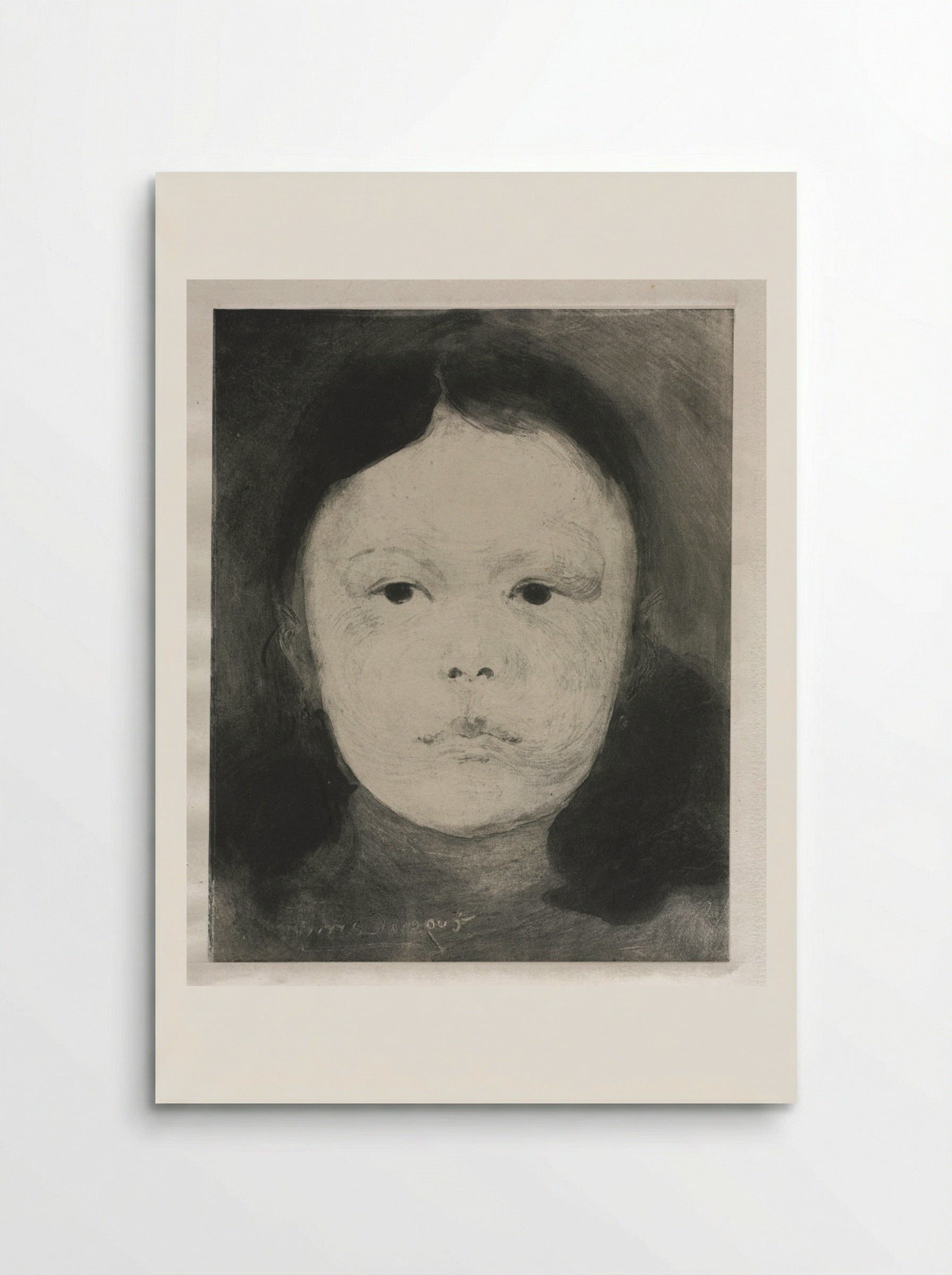
Marguerite Carrière - Eugène Carrière
Archival giclée
Ready to hang
Secure checkout
Made to order
Description
A delicate lithographic portrait by Eugène Carrière, featuring his signature monochromatic style and atmospheric sfumato technique.
This portrait of Marguerite Carrière captures the distinct aesthetic approach of the French Symbolist painter Eugène Carrière. Known for his monochromatic palette and the use of sfumato, Carrière creates an atmospheric quality that obscures the sharp boundaries between the subject and the surrounding space. The image emerges from a veil of shadow, where the light focuses primarily on the face of the child, leaving the periphery in deep, indistinct tones. Carrière often utilised a limited range of greys, browns, and blacks to evoke a sense of intimacy and psychological depth. In this lithograph, the soft transitions of tone suggest a dreamlike state, moving away from the rigid realism popular in the nineteenth century. The features of the face are rendered with delicate precision, yet they appear to dissolve into the dark background, a technique that became the hallmark of his work. By reducing the visual information to essential forms and light, the artist directs the viewer toward the quiet expression of the subject. This work reflects the broader Symbolist interest in the subjective experience and the internal world. Rather than documenting a precise likeness, Carrière prioritises the emotional resonance of the portrait. The lack of environmental detail ensures that the focus remains entirely on the human presence. The print demonstrates the artist's mastery of lithographic techniques, allowing for subtle gradations of ink that mimic the softness of his oil paintings. It is a study in light and shadow, presenting a contemplative view of childhood through a lens of muted, atmospheric abstraction.
Return policy
Because every print is made to order, we don't offer change-of-mind returns, refunds or exchanges. If your order arrives faulty, damaged or incorrect, we'll replace it free of charge — just contact us within 48 hours of delivery. EU customers have a 14-day cooling-off right. See our refunds page for full details.
Shipping
We ship worldwide, printing at the production hub nearest to your delivery address. Delivery times and costs vary by destination — you'll see the options available to you at checkout.
Manufacturing
Each print is produced to order using 12-colour giclée printing on FSC-certified archival paper. Designed in Britain and printed at your nearest production hub to reduce waste and speed up delivery.
Marguerite Carrière - Eugène Carrière
Our Features
Designed for Lasting Impact
Specific Features
Every Solis piece is made to order with archival, gallery-quality materials built to last.
- Museum-grade giclée printing for rich, fade-resistant colour
- Archival matte fine-art paper, FSC-certified
- Choose poster, framed print, canvas or framed canvas
- Frames in black, natural wood, dark wood or white
- Framed prints arrive ready to hang
Care & Cleaning
To keep your artwork looking its best:
- Dust gently with a soft, dry cloth
- Avoid prolonged direct sunlight
- Never use liquid cleaners on the print or canvas surface
- Keep in a dry, room-temperature space
- Handle prints with clean, dry hands
Materials & Sizing
Museum-grade giclée on FSC-certified archival matte paper, with framed and canvas options.
- Paper sizes: A4, A3, A2, A1, A0 and B2 (50×70 cm)
- Canvas: XS (20×30 cm) to Large (60×90 cm)
- Frames: black, natural wood, dark wood or white
Why Choose Us ?
100% Satisfaction Guarantee
Fast Shipping
Museum-Quality Materials

Artist Biography
Eugène Carrière
Born in Gournay-sur-Marne in 1849, Carrière came from Flemish and Alsatian stock and trained first as a lithographer before entering Alexandre Cabanel's atelier at the École des Beaux-Arts. A visit to London in 1876 introduced him to Turner, whose atmospheric dissolution of form left a lasting impression. His early Salon paintings were unremarkable naturalism; by the late 1880s he had arrived at something altogether stranger.
The mature Carrière works are almost entirely monochromatic: figures emerging from brown-grey shadow, outlines dissolving before they resolve, light used not to illuminate but to suggest. He returned obsessively to maternal subjects, mothers and infants locked in physical closeness that reads as both tender and slightly suffocating. Paul Verlaine and Edmond de Goncourt sat for him; he painted his own family with the same concentrated attention.
During the Dreyfus Affair he signed Zola's petition and campaigned publicly for women's education. Auguste Rodin organised a tribute dinner in his honour in 1904. Two years later Carrière died of throat cancer, the surgery intended to treat it having left him partly paralysed. The Musée d'Orsay mounted a centenary retrospective in 2006 and published the catalogue raisonné.
You May Also Like