

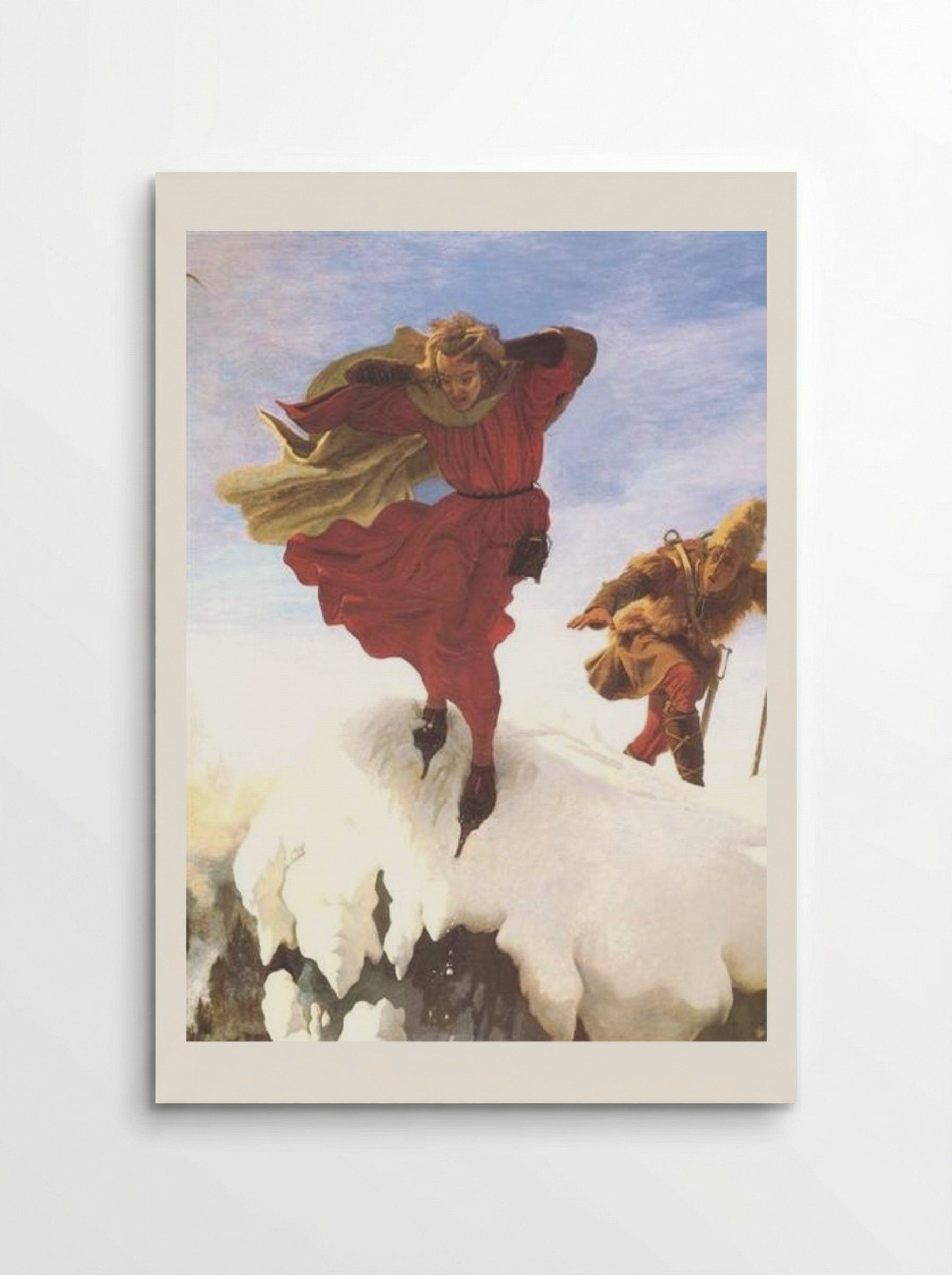
Manfred on the Jungfrau - Ford Madox Brown
Archival giclée
Frames arrive ready to hang
Secure checkout
Made to order
Description
A dramatic depiction of Lord Byron's Manfred on a Swiss mountain peak, painted by Ford Madox Brown in 1842. The scene captures the moment a hunter intervenes to save the despairing protagonist.
Ford Madox Brown painted this scene based on Lord Byron's 1817 dramatic poem, Manfred. The composition depicts the protagonist, a Faustian noble, standing on a precipice of the Jungfrau mountain in the Swiss Alps. Manfred is shown in a state of mental distress, his red robes and tan cloak billowing in the high-altitude wind. He clutches his head in a gesture of despair as he prepares to leap from the icy ledge. Behind him, a Chamois Hunter approaches to intervene, his body tensed as he reaches out to prevent the tragedy. The work demonstrates Brown's interest in the Sublime, a theme in Romantic art that focuses on the awe-inspiring power of nature. The sharp contrast between the bright white snow and the deep red of Manfred's tunic creates a strong visual tension. Brown used a high-key palette for the sky and snow, which was unusual for the period and prefigured the bright colours later adopted by the Pre-Raphaelite Brotherhood. The artist paid close attention to the physical exertion of the figures, particularly the hunter who struggles against the terrain. Brown began this work in Paris in 1841 and completed it in 1842. It represents an early stage in his career before he became a mentor to the younger Pre-Raphaelite artists. The painting captures the psychological intensity of Byron's character, reflecting the Victorian fascination with tragic literary figures and dramatic alpine settings. The sense of movement is conveyed through the diagonal lines of the figures and the swirling fabric of their clothing against the vast, open sky.
Return policy
Because every print is made to order, we don't offer change-of-mind returns, refunds or exchanges. If your order arrives faulty, damaged or incorrect, we'll replace it free of charge — just contact us within 48 hours of delivery. See our refunds page for full details.
Shipping
We ship worldwide, printing at the production hub nearest to your delivery address. Delivery times and costs vary by destination — you'll see the options available to you at checkout.
Manufacturing
Each print is produced to order using 12-colour giclée printing on FSC-certified archival paper. Designed in Britain and printed at your nearest production hub to reduce waste and speed up delivery.
Manfred on the Jungfrau - Ford Madox Brown

Artist Biography
Ford Madox Brown
He was born in Calais in 1821, trained across Europe, and settled in London. Though never an official member of the Pre-Raphaelite Brotherhood, he was their most important older ally and the teacher who most shaped their ambitions. His insistence on painting outdoors in natural light, often to the point of physical discomfort, and his dense, moralising compositions made him a bridge between the Nazarenes he had studied with in Rome and the young English radicals who followed.
He also designed stained glass and furniture for Morris and Co. He died in 1893, at seventy-two.
Our Features
Designed for Lasting Impact
Specific Features
Every Solis piece is made to order with archival, gallery-quality materials built to last.
- Museum-grade giclée printing for rich, fade-resistant colour
- Archival matte fine-art paper, FSC-certified
- Multiple sizes and framing options available
- Frames in black, natural wood, dark wood or white
- Framed prints arrive ready to hang
Care & Cleaning
To keep your artwork looking its best:
- Dust gently with a soft, dry cloth
- Avoid prolonged direct sunlight
- Never use liquid cleaners on the print or canvas surface
- Keep in a dry, room-temperature space
- Handle prints with clean, dry hands
Materials & Sizing
Museum-grade giclée on FSC-certified archival matte paper, with framed and canvas options.
- Paper sizes: A4, A3, A2, A1, A0 and B2 (50×70 cm)
- Canvas: XS (20×30 cm) to Large (60×90 cm)
- Frames: black, natural wood, dark wood or white
Why Choose Us ?
Damage-free delivery guarantee
Fast Shipping
Museum-Quality Materials
Artist Biography
Ford Madox Brown
He was born in Calais in 1821, trained across Europe, and settled in London. Though never an official member of the Pre-Raphaelite Brotherhood, he was their most important older ally and the teacher who most shaped their ambitions. His insistence on painting outdoors in natural light, often to the point of physical discomfort, and his dense, moralising compositions made him a bridge between the Nazarenes he had studied with in Rome and the young English radicals who followed.
He also designed stained glass and furniture for Morris and Co. He died in 1893, at seventy-two.
You May Also Like