

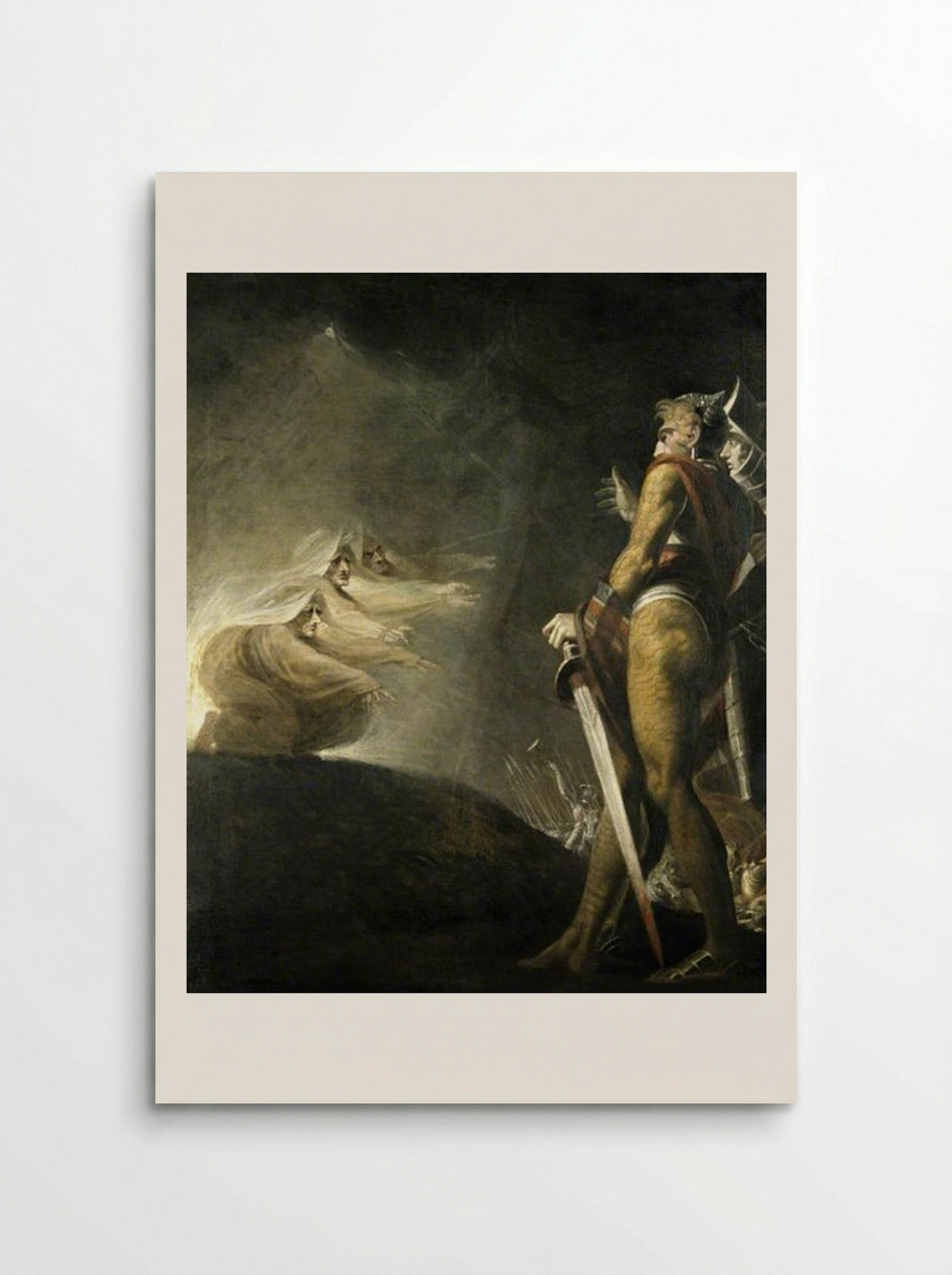
Macbeth, Banquo and the Witches - Henry Fuseli
Archival giclée
Frames arrive ready to hang
Secure checkout
Made to order
Description
A dramatic interpretation of the encounter between Macbeth and the witches, rendered in the dark, expressive style of Henry Fuseli.
Henry Fuseli, a Swiss-born painter who spent much of his career in London, possessed a fascination with the supernatural and the dramatic tension found in Shakespearean literature. This work depicts the moment from Act 1, Scene 3 of Macbeth, where the protagonist and his companion Banquo encounter the three witches upon a desolate heath. Fuseli captures the eerie atmosphere through a stark contrast between light and shadow, a technique known as chiaroscuro, which draws the viewer into the unsettling narrative. The composition is dominated by the looming, muscular figure of Macbeth, whose posture conveys a mixture of curiosity and apprehension. Opposite him, the witches appear as spectral, ethereal entities, their forms partially obscured by mist and darkness. Their outstretched arms and hunched postures suggest a malevolent influence, while the surrounding gloom reinforces the sense of impending doom that permeates the play. Fuseli avoids realistic proportions in favour of expressive, elongated figures, a hallmark of his personal style that prioritises emotional impact over anatomical precision. This painting reflects the late eighteenth-century interest in the sublime, an aesthetic category concerned with awe, terror, and the vastness of the unknown. By focusing on the psychological weight of the encounter rather than a literal interpretation of the scene, Fuseli creates a visual experience that mirrors the internal conflict of the characters. The muted palette, consisting primarily of dark browns, greys, and pale highlights, serves to isolate the figures against the void, ensuring that the focus remains on the interaction between the mortal men and the supernatural forces. The work remains a primary example of how Romantic artists engaged with literary sources to explore themes of ambition, fate, and the darker aspects of the human condition.
Return policy
Because every print is made to order, we don't offer change-of-mind returns, refunds or exchanges. If your order arrives faulty, damaged or incorrect, we'll replace it free of charge — just contact us within 48 hours of delivery. See our refunds page for full details.
Shipping
We ship worldwide, printing at the production hub nearest to your delivery address. Delivery times and costs vary by destination — you'll see the options available to you at checkout.
Manufacturing
Each print is produced to order using 12-colour giclée printing on FSC-certified archival paper. Designed in Britain and printed at your nearest production hub to reduce waste and speed up delivery.
Care and materials
Specific Features
Every Solis piece is made to order with archival, gallery-quality materials built to last.
- Museum-grade giclée printing for rich, fade-resistant colour
- Archival matte fine-art paper, FSC-certified
- Multiple sizes and framing options available
- Frames in black, natural wood, dark wood or white
- Framed prints arrive ready to hang
Care & Cleaning
To keep your artwork looking its best:
- Dust gently with a soft, dry cloth
- Avoid prolonged direct sunlight
- Never use liquid cleaners on the print or canvas surface
- Keep in a dry, room-temperature space
- Handle prints with clean, dry hands
Materials & Sizing
Museum-grade giclée on FSC-certified archival matte paper, with framed and canvas options.
- Paper sizes: A4, A3, A2, A1, A0 and B2 (50×70 cm)
- Canvas: XS (20×30 cm) to Large (60×90 cm)
- Frames: black, natural wood, dark wood or white
Macbeth, Banquo and the Witches - Henry Fuseli

Artist Biography
Henry Fuseli
He was born Johann Heinrich Fussli in Zurich in 1741, the second of eighteen children. He was ordained as a minister in 1761 but forced to leave Switzerland after helping expose a corrupt magistrate. He spent eight years in Rome, changed his name from Fussli to the Italianate Fuseli, and arrived in London with a taste for the violent, the erotic, and the supernatural.
William Blake, not easily impressed, said of him: the only man that e'er I knew who did not make me almost spew. This was a compliment. Blake meant Fuseli was the only person who did not disgust him. Their friendship lasted decades. Fuseli married his model Sophia Rawlins in 1788. He became Keeper of the Royal Academy and grew increasingly conservative in his politics despite having started as a radical. He died in 1825, aged eighty-four, and was buried in St Paul's Cathedral.
Why Choose Us ?
Damage-free delivery guarantee
Fast Shipping
Museum-Quality Materials
You May Also Like