

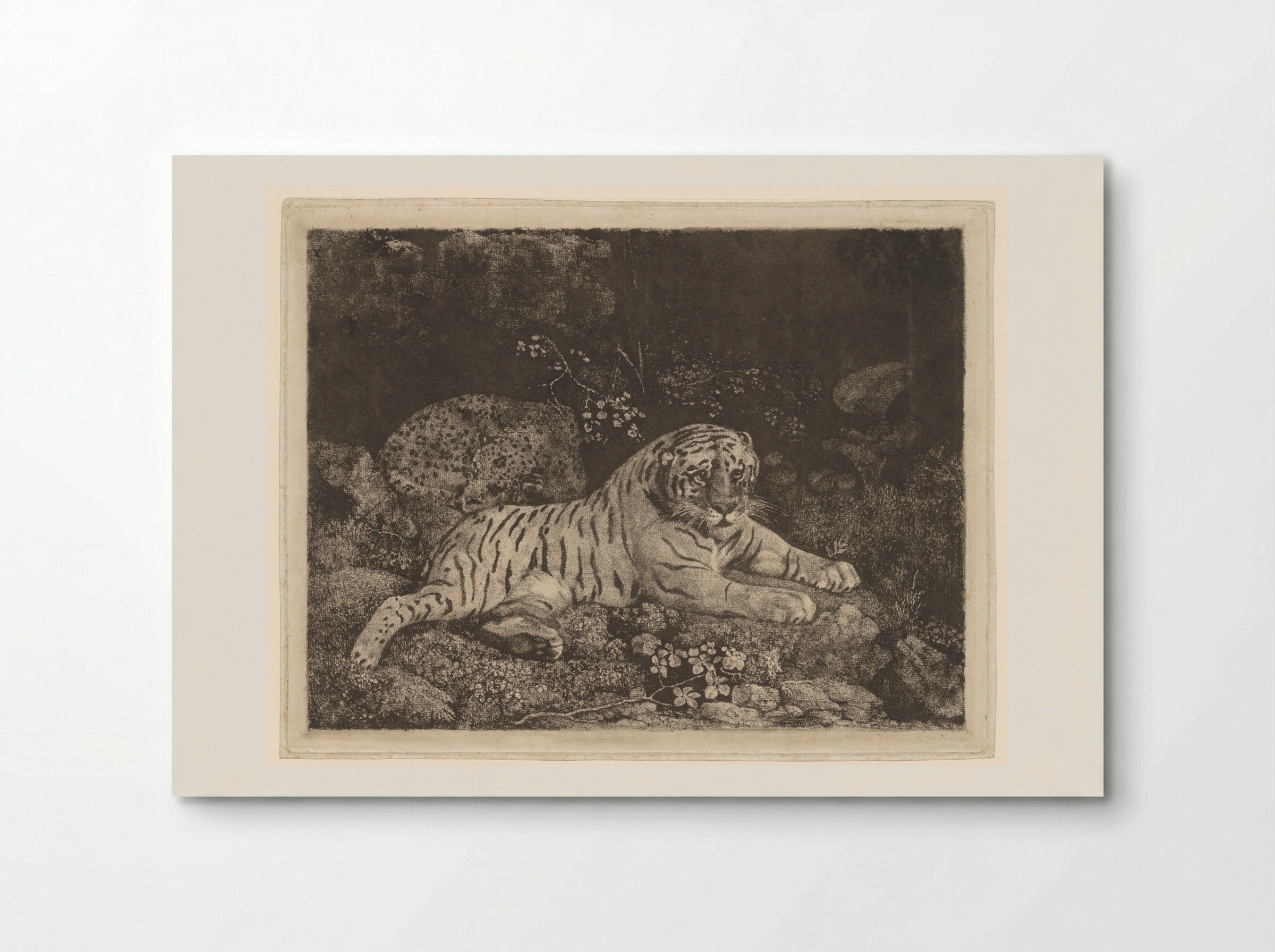
Liggende tijger en slapend jachtluipaard - George Stubbs
Archival giclée
Frames arrive ready to hang
Secure checkout
Made to order
Description
A detailed etching by George Stubbs depicting a resting tiger and a sleeping leopard, showcasing his mastery of animal anatomy and printmaking techniques.
George Stubbs, a British painter and printmaker, possessed a scientific curiosity regarding animal anatomy. This work, titled Liggende tijger en slapend jachtluipaard, demonstrates his technical precision in capturing the physical form of exotic predators. Stubbs spent years studying the musculature and skeletal structures of horses and wild animals, which allowed him to render these creatures with anatomical accuracy. The composition features a tiger in a recumbent position, its gaze directed toward the viewer, while a leopard rests in the background. The use of etching and engraving allows for a range of textures, from the coarse fur of the animals to the rocky, mossy terrain they occupy. The dark, atmospheric background provides a contrast to the lighter tones of the animals, drawing attention to their physical presence. Stubbs often worked from direct observation, frequently visiting menageries in London to sketch live specimens. This practice informed his ability to convey the quiet tension inherent in these animals, even when they are at rest. This print reflects the eighteenth-century fascination with natural history and the classification of the natural world. Stubbs avoids romanticising the scene, opting instead for a grounded, observational approach. The careful hatching and cross-hatching techniques create depth and volume, giving the animals a tangible quality. The work remains a fine example of his ability to merge artistic skill with a rigorous, almost clinical, interest in the natural world. It is an exercise in form and light, stripped of unnecessary narrative elements, focusing entirely on the biological reality of the subjects.
Return policy
Because every print is made to order, we don't offer change-of-mind returns, refunds or exchanges. If your order arrives faulty, damaged or incorrect, we'll replace it free of charge — just contact us within 48 hours of delivery. See our refunds page for full details.
Shipping
We ship worldwide, printing at the production hub nearest to your delivery address. Delivery times and costs vary by destination — you'll see the options available to you at checkout.
Manufacturing
Each print is produced to order using 12-colour giclée printing on FSC-certified archival paper. Designed in Britain and printed at your nearest production hub to reduce waste and speed up delivery.
Care and materials
Specific Features
Every Solis piece is made to order with archival, gallery-quality materials built to last.
- Museum-grade giclée printing for rich, fade-resistant colour
- Archival matte fine-art paper, FSC-certified
- Multiple sizes and framing options available
- Frames in black, natural wood, dark wood or white
- Framed prints arrive ready to hang
Care & Cleaning
To keep your artwork looking its best:
- Dust gently with a soft, dry cloth
- Avoid prolonged direct sunlight
- Never use liquid cleaners on the print or canvas surface
- Keep in a dry, room-temperature space
- Handle prints with clean, dry hands
Materials & Sizing
Museum-grade giclée on FSC-certified archival matte paper, with framed and canvas options.
- Paper sizes: A4, A3, A2, A1, A0 and B2 (50×70 cm)
- Canvas: XS (20×30 cm) to Large (60×90 cm)
- Frames: black, natural wood, dark wood or white
Liggende tijger en slapend jachtluipaard - George Stubbs

Artist Biography
George Stubbs
He was born in Liverpool, the son of a currier (a leather worker). He was largely self-taught. In his twenties he spent eighteen months in a farmhouse in Horkstow, Lincolnshire, dissecting horses. He suspended the carcasses from the ceiling using hooks and pulleys, peeled back the layers of skin and muscle, and drew every stage. The results were published as The Anatomy of the Horse (1766), one of the most accurate anatomical studies ever produced by an artist. The book established his reputation.
His horse portraits are commissioned works: wealthy landowners wanted their racehorses painted. Stubbs obliged, but his understanding of equine anatomy gave the paintings a presence that other sporting painters could not match. Whistlejacket, a life-size portrait of a chestnut stallion rearing against a plain background, is among the most striking animal paintings ever made. There is no landscape, no rider, no context. Just the horse.
He also painted dogs, exotic animals (a zebra, a rhinoceros, a moose), and rural scenes with labourers and haymakers. He experimented with enamel painting on ceramic tablets made by Josiah Wedgwood. He was elected to the Royal Academy but refused to submit a diploma piece, which meant he was never made a full Academician. He died in 1806, at eighty-one.
Why Choose Us ?
Damage-free delivery guarantee
Fast Shipping
Museum-Quality Materials
You May Also Like