

Le Poker - Félix Vallotton
Archival giclée
Frames arrive ready to hang
Secure checkout
Made to order
Description
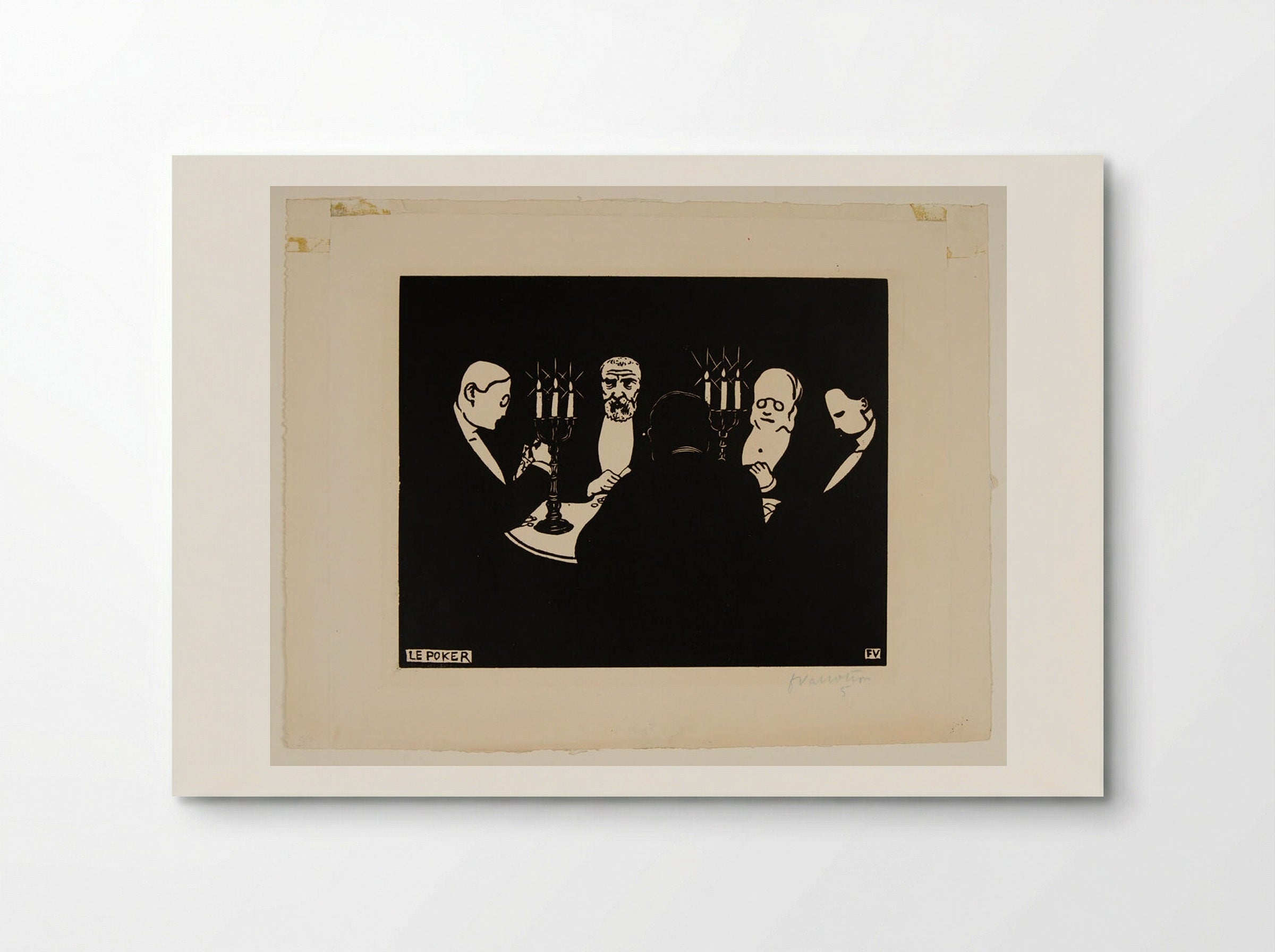
Félix Vallotton's woodcut *Le Poker* (1902) depicts a tense card game with stark contrasts and caricatured figures, showcasing his graphic style and social commentary.
Félix Vallotton's 1902 woodcut, *Le Poker*, presents a darkly humorous scene of men engaged in a card game. Vallotton, a Swiss artist associated with the Post-Impressionist movement and a member of the Nabis group, was known for his stark, graphic style and his ability to convey complex social commentary through simplified forms. This print exemplifies his skill in reducing figures and settings to their essential elements, creating a powerful visual impact. The composition is dominated by strong contrasts of black and white. Five figures are seated around a table, illuminated by the flickering light of candles. The faces of the men are rendered with a caricatured quality, their expressions suggesting a mixture of concentration, suspicion, and perhaps a hint of malice. The stark lighting casts deep shadows, heightening the sense of drama and intrigue. Vallotton's use of the woodcut medium lends itself perfectly to this aesthetic, with its bold lines and flat planes of colour contributing to the overall sense of tension and unease. *Le Poker* is a striking example of Vallotton's ability to capture the complexities of human interaction through a distinctive and compelling visual language.
Return policy
Because every print is made to order, we don't offer change-of-mind returns, refunds or exchanges. If your order arrives faulty, damaged or incorrect, we'll replace it free of charge — just contact us within 48 hours of delivery. See our refunds page for full details.
Shipping
We ship worldwide, printing at the production hub nearest to your delivery address. Delivery times and costs vary by destination — you'll see the options available to you at checkout.
Manufacturing
Each print is produced to order using 12-colour giclée printing on FSC-certified archival paper. Designed in Britain and printed at your nearest production hub to reduce waste and speed up delivery.
Care and materials
Specific Features
Every Solis piece is made to order with archival, gallery-quality materials built to last.
- Museum-grade giclée printing for rich, fade-resistant colour
- Archival matte fine-art paper, FSC-certified
- Multiple sizes and framing options available
- Frames in black, natural wood, dark wood or white
- Framed prints arrive ready to hang
Care & Cleaning
To keep your artwork looking its best:
- Dust gently with a soft, dry cloth
- Avoid prolonged direct sunlight
- Never use liquid cleaners on the print or canvas surface
- Keep in a dry, room-temperature space
- Handle prints with clean, dry hands
Materials & Sizing
Museum-grade giclée on FSC-certified archival matte paper, with framed and canvas options.
- Paper sizes: A4, A3, A2, A1, A0 and B2 (50×70 cm)
- Canvas: XS (20×30 cm) to Large (60×90 cm)
- Frames: black, natural wood, dark wood or white
Le Poker - Félix Vallotton

Artist Biography
Felix Vallotton
He moved to Paris at seventeen and studied at the Academie Julian. His woodcuts, made in the 1890s, revived a medium that most printmakers had abandoned in favour of colour lithography. Working in pure black and white, he carved domestic interiors, street scenes, and a series called Intimites: ten prints depicting the private moments of married life, with an emphasis on adultery, deception and the particular loneliness of two people in the same room. The images are flat, graphic and psychologically sharp.
His support for Alfred Dreyfus, the Jewish officer falsely convicted of espionage, strained his relationship with several of the Nabis. He bought a Kodak camera in 1899 and began using photographs as source material for paintings, manipulating compositions into fictionalised versions of observed reality.
He married the daughter of the art dealer Alexandre Bernheim in 1899, which gave him financial security and access to the Parisian art market. He painted nudes, still lifes and landscapes with a smooth, almost clinical finish that disturbed viewers who expected warmth from pictures of naked women.
He wrote three novels and eight plays, none of which were published in his lifetime. His first novel, La Vie Meurtriere (The Murderous Life), appeared posthumously in 1930. He died the day after his sixtieth birthday.
Why Choose Us ?
Damage-free delivery guarantee
Fast Shipping
Museum-Quality Materials
You May Also Like