

Fine Art Poster
From £28
A giclée print on 200gsm matte fine art paper, using a twelve-colour process for accurate, fade-resistant colour. Supplied unframed, delivered flat or rolled.



Archival giclée
Frames arrive ready to hang
Secure checkout
Made to order
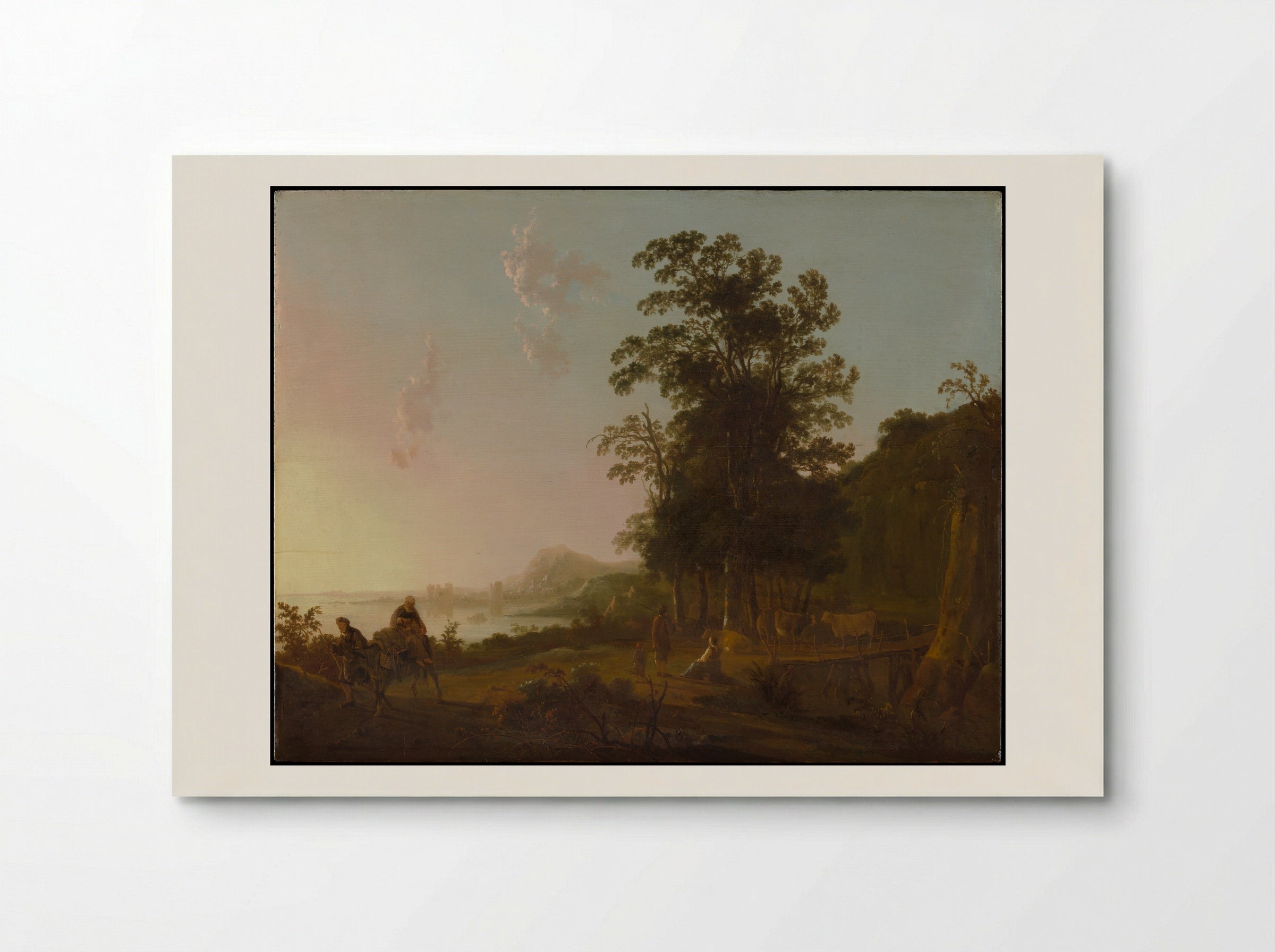
A serene pastoral scene by Aelbert Cuyp, featuring the Holy Family in a golden, sun-drenched Dutch countryside.
Aelbert Cuyp, a master of the Dutch Golden Age, produced this work during a period when he refined his approach to light and atmospheric perspective. The composition depicts the biblical narrative of the Flight into Egypt, yet the subject is secondary to the expansive, golden-hued environment. The scene is bathed in the warm, low-angled light characteristic of the artist, which unifies the foreground figures with the distant, hazy horizon. To the left, the Holy Family travels on a donkey, moving through a quiet, rural setting. The right side of the canvas is dominated by a cluster of trees, their dark, silhouetted forms providing a contrast to the luminous sky. Beneath these trees, figures and cattle rest near a wooden bridge, adding a sense of everyday life to the religious theme. The distant town, rendered with soft, muted tones, suggests a Mediterranean influence, a common stylistic choice for Dutch painters of the era who sought to evoke an idealised, classical atmosphere. Cuyp was particularly skilled at capturing the transition between the immediate foreground and the far distance. He used a subtle gradation of colour, moving from the earthy browns and greens of the path to the pale blues and yellows of the sky. This technique draws the eye across the scene, creating a sense of depth without relying on rigid geometric perspective. The painting reflects the period's interest in the interplay between human activity and the natural world, presenting a calm, harmonious vision of the countryside. The brushwork is precise yet fluid, allowing for the textures of the foliage and the soft glow of the sun to emerge with clarity. This print captures the specific tonal qualities of the original oil painting, preserving the atmospheric depth that defines Cuyp's work.
Because every print is made to order, we don't offer change-of-mind returns, refunds or exchanges. If your order arrives faulty, damaged or incorrect, we'll replace it free of charge — just contact us within 48 hours of delivery. See our refunds page for full details.
We ship worldwide, printing at the production hub nearest to your delivery address. Delivery times and costs vary by destination — you'll see the options available to you at checkout.
Each print is produced to order using 12-colour giclée printing on FSC-certified archival paper. Designed in Britain and printed at your nearest production hub to reduce waste and speed up delivery.

Artist Biography
Our Features
Designed for Lasting Impact
Every Solis piece is made to order with archival, gallery-quality materials built to last.
To keep your artwork looking its best:
Museum-grade giclée on FSC-certified archival matte paper, with framed and canvas options.
Made to order
Every piece is printed to order. These are the five finishes, and what makes each one different.
From £28
A giclée print on 200gsm matte fine art paper, using a twelve-colour process for accurate, fade-resistant colour. Supplied unframed, delivered flat or rolled.

From £45
The same fine art print in a solid wood frame with UV-protective acrylic glaze and rigid backing. Five frame colours. Arrives ready to hang.

From £85
A deeper solid wood frame: 33mm deep with a 20mm face and Perspex glaze. The print sits unmounted for a clean gallery presentation. Black, white or natural.

From £30
Hand-stretched canvas with neat gallery-wrapped edges, giving the artwork surface texture and depth. Arrives ready to hang.

From £135
Stretched canvas set in a floating wood frame, our most substantial finish. Arrives ready to hang.
Why Choose Us ?
Damage-free delivery guarantee
Fast Shipping
Museum-Quality Materials
Artist Biography
Aelbert Cuyp
You May Also Like
Cookies show us which prints people love, so we hang the right art. Help us fill it?
Essential cookies only if you prefer · Privacy Policy