

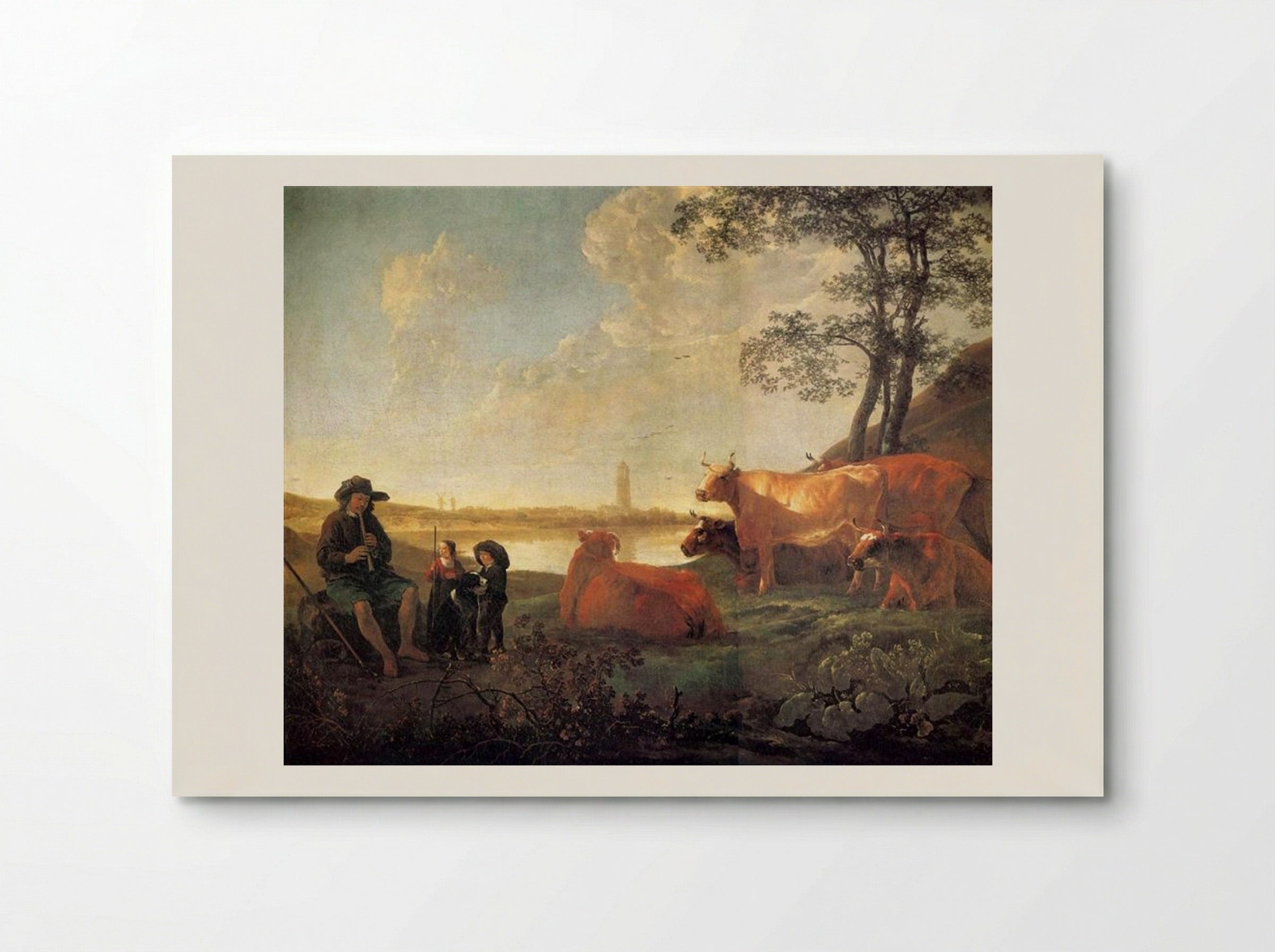
Landscape with Shepherds and Flock, Near Rhenen - Aelbert Cuyp
Archival giclée
Frames arrive ready to hang
Secure checkout
Made to order
Description
A pastoral scene by Aelbert Cuyp, 'Landscape with Shepherds and Flock, Near Rhenen' captures the serene beauty of the Dutch countryside with warm, golden light and detailed depictions of rural life.
Aelbert Cuyp, a prominent figure in Dutch Golden Age painting, is celebrated for his serene and luminous landscapes. Born in Dordrecht, Cuyp specialised in pastoral scenes, often featuring golden light and detailed depictions of the Dutch countryside. His works capture the tranquil atmosphere of rural life, reflecting the prosperity and peace of the Netherlands during the 17th century. Cuyp's style blends realism with an idealised vision of nature, influencing generations of landscape painters. 'Landscape with Shepherds and Flock, Near Rhenen' exemplifies Cuyp's mastery of light and composition. The painting depicts a tranquil scene with shepherds and their flock of cows resting near the town of Rhenen. The warm, golden light bathes the landscape, creating a sense of calm and harmony. The composition is carefully balanced, with the figures and animals arranged to lead the eye through the scene. In the background, the town of Rhenen is visible, adding a sense of place and scale. The overall effect is one of idyllic beauty, capturing the essence of the Dutch countryside.
Return policy
Because every print is made to order, we don't offer change-of-mind returns, refunds or exchanges. If your order arrives faulty, damaged or incorrect, we'll replace it free of charge — just contact us within 48 hours of delivery. See our refunds page for full details.
Shipping
We ship worldwide, printing at the production hub nearest to your delivery address. Delivery times and costs vary by destination — you'll see the options available to you at checkout.
Manufacturing
Each print is produced to order using 12-colour giclée printing on FSC-certified archival paper. Designed in Britain and printed at your nearest production hub to reduce waste and speed up delivery.
Landscape with Shepherds and Flock, Near Rhenen - Aelbert Cuyp

Artist Biography
Aelbert Cuyp
He was born in Dordrecht in 1620, the most gifted member of a family of artists. His father Jacob Gerritsz Cuyp taught him; his uncle Benjamin and grandfather Gerrit were stained glass cartoon designers. His early landscapes were conventional, but in the mid-1640s he absorbed the golden, Italianate light of painters who had travelled to Rome, particularly Jan Both, and transformed his palette. The result was a body of riverside scenes bathed in warm early morning or late afternoon light that became his signature: cows standing in water, boats on the Maas, herdsmen silhouetted against amber skies.
He rarely dated his works, which has made reconstructing his career difficult. A large number of paintings attributed to him are probably by other hands, particularly Abraham Calraert, whose initials A.C. invite confusion. Cuyp was almost forgotten for two generations after his death, then was rediscovered in the late eighteenth century by British collectors, who bought so enthusiastically that the National Gallery in London holds more of his work than any Dutch museum.
He is thought to have painted Landscape with Cattle at around nineteen, showing precocious command of the golden tonality that would define his maturity. He died in Dordrecht in 1691, at seventy-one.
Our Features
Designed for Lasting Impact
Specific Features
Every Solis piece is made to order with archival, gallery-quality materials built to last.
- Museum-grade giclée printing for rich, fade-resistant colour
- Archival matte fine-art paper, FSC-certified
- Multiple sizes and framing options available
- Frames in black, natural wood, dark wood or white
- Framed prints arrive ready to hang
Care & Cleaning
To keep your artwork looking its best:
- Dust gently with a soft, dry cloth
- Avoid prolonged direct sunlight
- Never use liquid cleaners on the print or canvas surface
- Keep in a dry, room-temperature space
- Handle prints with clean, dry hands
Materials & Sizing
Museum-grade giclée on FSC-certified archival matte paper, with framed and canvas options.
- Paper sizes: A4, A3, A2, A1, A0 and B2 (50×70 cm)
- Canvas: XS (20×30 cm) to Large (60×90 cm)
- Frames: black, natural wood, dark wood or white
Why Choose Us ?
Damage-free delivery guarantee
Fast Shipping
Museum-Quality Materials
Artist Biography
Aelbert Cuyp
He was born in Dordrecht in 1620, the most gifted member of a family of artists. His father Jacob Gerritsz Cuyp taught him; his uncle Benjamin and grandfather Gerrit were stained glass cartoon designers. His early landscapes were conventional, but in the mid-1640s he absorbed the golden, Italianate light of painters who had travelled to Rome, particularly Jan Both, and transformed his palette. The result was a body of riverside scenes bathed in warm early morning or late afternoon light that became his signature: cows standing in water, boats on the Maas, herdsmen silhouetted against amber skies.
He rarely dated his works, which has made reconstructing his career difficult. A large number of paintings attributed to him are probably by other hands, particularly Abraham Calraert, whose initials A.C. invite confusion. Cuyp was almost forgotten for two generations after his death, then was rediscovered in the late eighteenth century by British collectors, who bought so enthusiastically that the National Gallery in London holds more of his work than any Dutch museum.
He is thought to have painted Landscape with Cattle at around nineteen, showing precocious command of the golden tonality that would define his maturity. He died in Dordrecht in 1691, at seventy-one.
You May Also Like