

Fine Art Poster
From £28
A giclée print on 200gsm matte fine art paper, using a twelve-colour process for accurate, fade-resistant colour. Supplied unframed, delivered flat or rolled.



Archival giclée
Frames arrive ready to hang
Secure checkout
Made to order
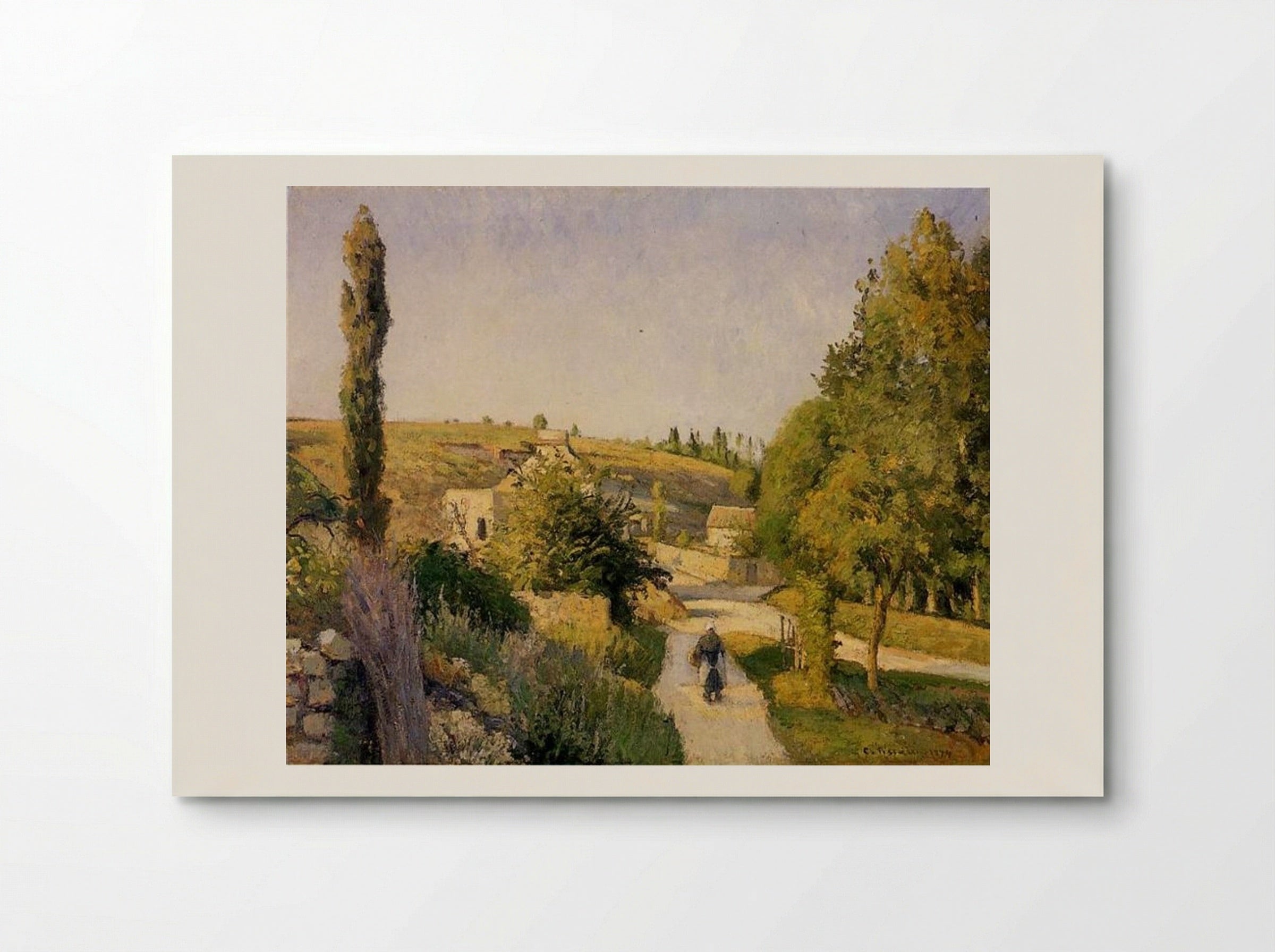
A serene rural scene by Camille Pissarro, capturing a quiet path in Pontoise through the characteristic light and brushwork of the Impressionist movement.
Camille Pissarro painted this view of the Hermitage district in Pontoise during his most productive period in the town. The composition captures a quiet, rural path winding through the hillside, flanked by a tall, solitary poplar on the left and a cluster of trees on the right. A single figure walks along the path, providing a sense of scale to the quiet, sun-drenched environment. Pissarro employed a technique of broken brushstrokes to render the textures of the foliage and the dusty road, allowing the light to appear as if it is filtering through the atmosphere. The palette consists of earthy ochres, soft greens, and pale blues, reflecting the specific light conditions of the French countryside. Pissarro lived in Pontoise for many years, and his work from this time demonstrates a close observation of the changing seasons and the daily life of the local inhabitants. He avoided the dramatic or the picturesque, preferring instead to document the modest reality of the rural environment. The structure of the painting relies on the diagonal movement of the path, which draws the eye towards the distant houses nestled into the slope. This work is representative of the Impressionist interest in capturing a fleeting moment through the application of colour and light, rather than through rigid outlines or formal composition. The paint application is deliberate, with visible texture that adds a tactile quality to the surface of the canvas. By focusing on the mundane aspects of the Pontoise outskirts, Pissarro provides a clear view into the aesthetic concerns that occupied the Impressionist circle during the late 1870s.
Because every print is made to order, we don't offer change-of-mind returns, refunds or exchanges. If your order arrives faulty, damaged or incorrect, we'll replace it free of charge — just contact us within 48 hours of delivery. See our refunds page for full details.
We ship worldwide, printing at the production hub nearest to your delivery address. Delivery times and costs vary by destination — you'll see the options available to you at checkout.
Each print is produced to order using 12-colour giclée printing on FSC-certified archival paper. Designed in Britain and printed at your nearest production hub to reduce waste and speed up delivery.

Artist Biography
Our Features
Designed for Lasting Impact
Every Solis piece is made to order with archival, gallery-quality materials built to last.
To keep your artwork looking its best:
Museum-grade giclée on FSC-certified archival matte paper, with framed and canvas options.
Made to order
Every piece is printed to order. These are the five finishes, and what makes each one different.
From £28
A giclée print on 200gsm matte fine art paper, using a twelve-colour process for accurate, fade-resistant colour. Supplied unframed, delivered flat or rolled.

From £45
The same fine art print in a solid wood frame with UV-protective acrylic glaze and rigid backing. Five frame colours. Arrives ready to hang.

From £85
A deeper solid wood frame: 33mm deep with a 20mm face and Perspex glaze. The print sits unmounted for a clean gallery presentation. Black, white or natural.

From £30
Hand-stretched canvas with neat gallery-wrapped edges, giving the artwork surface texture and depth. Arrives ready to hang.

From £135
Stretched canvas set in a floating wood frame, our most substantial finish. Arrives ready to hang.
Why Choose Us ?
Damage-free delivery guarantee
Fast Shipping
Museum-Quality Materials
Artist Biography
Camille Pissarro
You May Also Like
We use cookies to measure our marketing and see which prints people love.We use cookies to measure our marketing.
By continuing to browse, you agree · Privacy Policy