

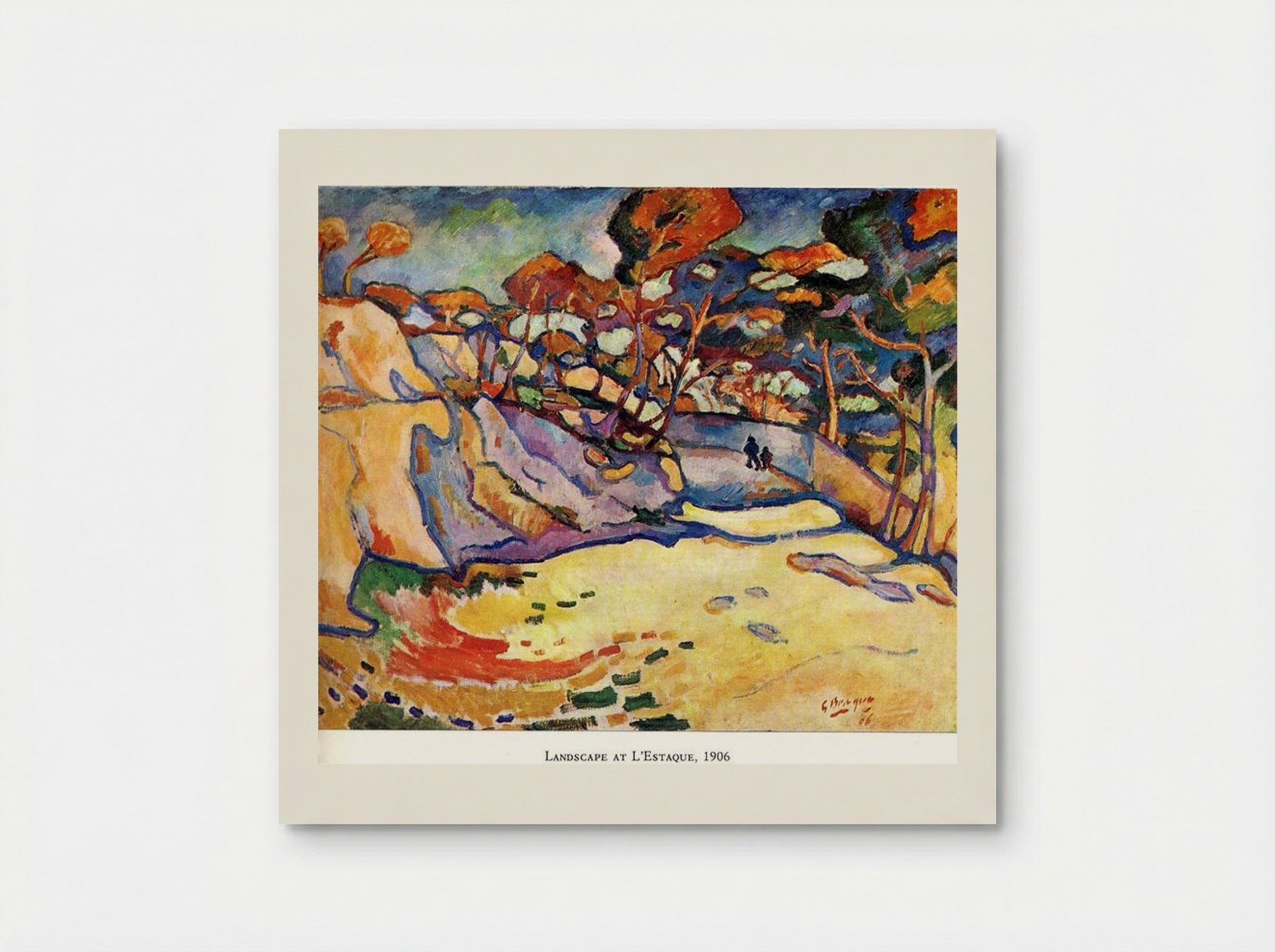
Landscape at L'Estaque - Georges Braque
Archival giclée
Frames arrive ready to hang
Secure checkout
Made to order
Description
A 1906 Fauvist work by Georges Braque, featuring the coastal terrain of L'Estaque rendered in bold, non-naturalistic colours and expressive brushwork.
Painted in 1906, this work captures the coastal region of L'Estaque in southern France, a location that drew many artists during the early twentieth century. Georges Braque, before his collaboration with Pablo Picasso on the development of Cubism, experimented with the bold, non-naturalistic colour palettes associated with the Fauvist movement. In this composition, the artist employs arbitrary, saturated hues to define the terrain and foliage, prioritising expressive impact over descriptive accuracy. The scene is constructed through broad, visible brushstrokes that flatten the pictorial space. The trees, rendered in shades of orange and deep blue, frame the composition, while the ground is depicted in warm, golden tones that contrast with the violet shadows cast across the rocks. The human figures are reduced to simple, dark silhouettes, serving as small markers of scale within the broader, stylised environment. Braque uses heavy outlines to separate these colour fields, a technique that emphasises the two-dimensional nature of the canvas. This period of Braque's career reflects a transition from the influence of Impressionism toward a more structured, analytical approach to form. By rejecting traditional perspective, the artist invites the viewer to engage with the painting as an arrangement of colour and shape. The work demonstrates the early stages of his interest in the geometric potential of the natural world, which would soon lead him to explore the fragmented planes characteristic of his later output. The application of paint is energetic and direct, revealing the artist's process and his focus on the autonomy of the painted surface.
Return policy
Because every print is made to order, we don't offer change-of-mind returns, refunds or exchanges. If your order arrives faulty, damaged or incorrect, we'll replace it free of charge — just contact us within 48 hours of delivery. See our refunds page for full details.
Shipping
We ship worldwide, printing at the production hub nearest to your delivery address. Delivery times and costs vary by destination — you'll see the options available to you at checkout.
Manufacturing
Each print is produced to order using 12-colour giclée printing on FSC-certified archival paper. Designed in Britain and printed at your nearest production hub to reduce waste and speed up delivery.
Care and materials
Specific Features
Every Solis piece is made to order with archival, gallery-quality materials built to last.
- Museum-grade giclée printing for rich, fade-resistant colour
- Archival matte fine-art paper, FSC-certified
- Multiple sizes and framing options available
- Frames in black, natural wood, dark wood or white
- Framed prints arrive ready to hang
Care & Cleaning
To keep your artwork looking its best:
- Dust gently with a soft, dry cloth
- Avoid prolonged direct sunlight
- Never use liquid cleaners on the print or canvas surface
- Keep in a dry, room-temperature space
- Handle prints with clean, dry hands
Materials & Sizing
Museum-grade giclée on FSC-certified archival matte paper, with framed and canvas options.
- Paper sizes: A4, A3, A2, A1, A0 and B2 (50×70 cm)
- Canvas: XS (20×30 cm) to Large (60×90 cm)
- Frames: black, natural wood, dark wood or white
Landscape at L'Estaque - Georges Braque

Artist Biography
Georges Braque
He grew up in Argenteuil and Le Havre, the son and grandson of house painters. He apprenticed as a decorative painter, learning to imitate wood grain and marble, techniques he later used in his Cubist papiers colles. He studied at the Ecole des Beaux-Arts in Paris and exhibited with the Fauves in 1906, painting bright, loose landscapes influenced by Matisse.
Everything changed when he saw Picasso's Les Demoiselles d'Avignon in 1907. He went to L'Estaque that summer and painted landscapes that broke the scenery into geometric facets, which is what a critic called 'cubes.' The name stuck. Between 1908 and 1914 he and Picasso worked so closely that their paintings from this period are sometimes difficult to tell apart. They showed each other everything. They finished each other's ideas.
The war separated them. Braque was severely wounded at Carency in 1915: a head injury that left him temporarily blind and required trepanning. He did not paint for over a year. When he returned to work, the collaboration with Picasso was over. They remained on good terms but never worked together again.
His post-war paintings are quieter, more resolved, less competitive. The Studio series, large paintings of the interior of his Normandy studio with birds flying through the space, occupied him through the 1950s. He died in 1963, at eighty-one. Picasso outlived him by ten years.
Why Choose Us ?
Damage-free delivery guarantee
Fast Shipping
Museum-Quality Materials
You May Also Like