

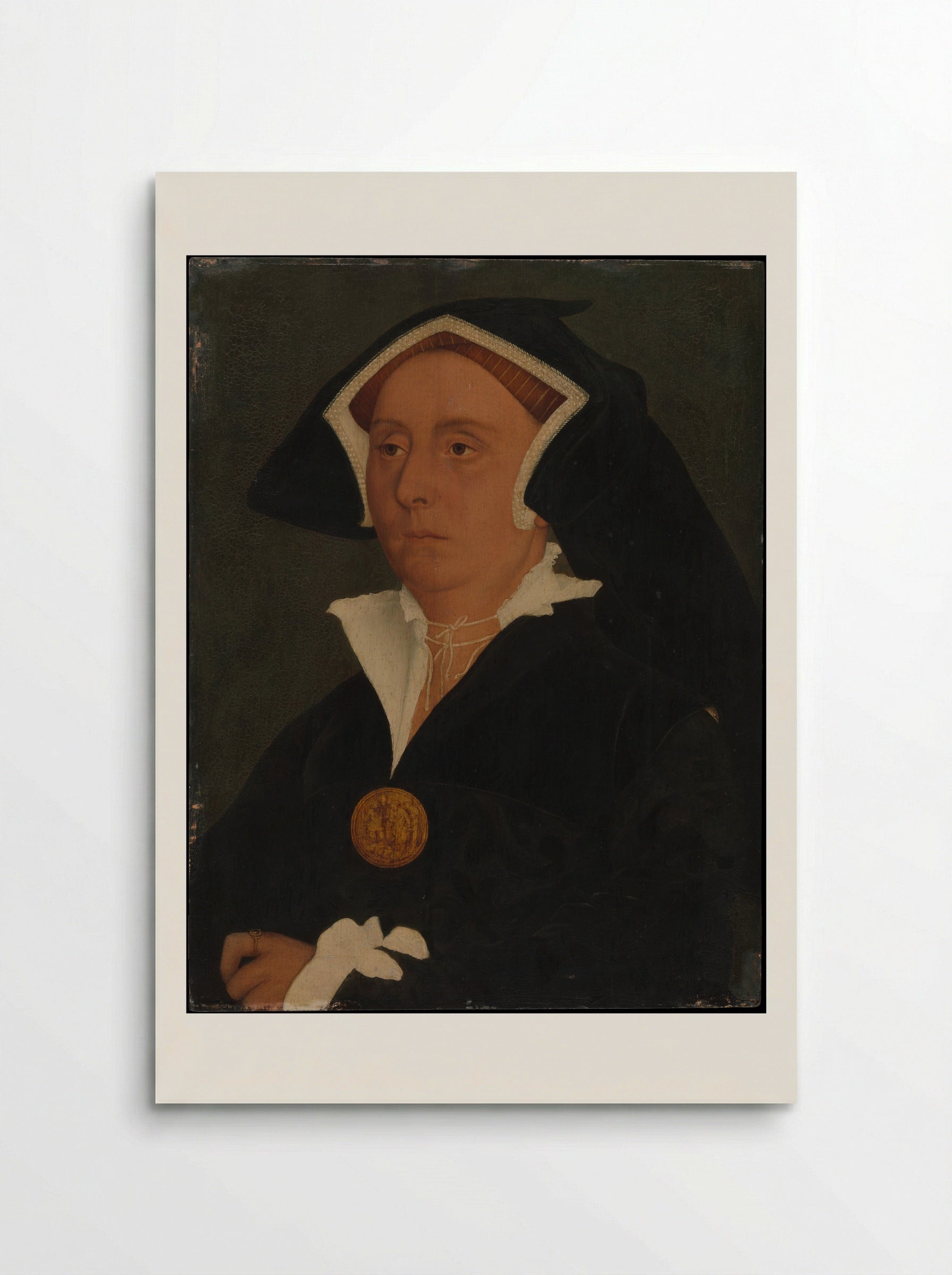
Lady Rich (Elizabeth Jenks) - Hans Holbein the Younger
Archival giclée
Frames arrive ready to hang
Secure checkout
Made to order
Description
A portrait of Elizabeth Jenks, Lady Rich, by Hans Holbein the Younger, capturing the precise detail and formal style of Tudor court painting.
This portrait depicts Elizabeth Jenks, Lady Rich, a figure of the Tudor court. Attributed to Hans Holbein the Younger, the work reflects the precise observation characteristic of his tenure as court painter to Henry VIII. The subject is presented in a three-quarter view, a standard format for Holbein’s portraiture, which allows for a clear examination of both the sitter's features and her attire. Lady Rich wears a dark, sombre gown, which provides a neutral backdrop for the white linen of her collar and the distinctive headpiece. The headpiece, a variation of the French hood, is rendered with attention to the texture of the fabric and the subtle light catching its edges. A notable detail is the circular gold medallion pinned to her bodice, which adds a touch of material wealth to the otherwise restrained composition. Her expression is composed, with a steady gaze directed slightly away from the viewer, suggesting a sense of detachment common in the formal portraiture of the period. Holbein’s technique relies on a smooth application of paint, minimising visible brushwork to create a realistic surface. The background is a uniform, dark tone, which pushes the figure forward and focuses attention on the sitter's face and hands. The lighting is soft, modelling the contours of her face with subtle gradations of shadow. This approach captures the physical presence of the sitter without resorting to idealisation. The painting remains a primary example of the mid-sixteenth-century style, where the focus is on the accurate representation of the individual and their social status through costume and posture. The work provides a clear view into the aesthetic preferences of the English aristocracy during the reign of Henry VIII, where modesty in colour was often balanced by the quality of materials and the precision of the artist's hand.
Return policy
Because every print is made to order, we don't offer change-of-mind returns, refunds or exchanges. If your order arrives faulty, damaged or incorrect, we'll replace it free of charge — just contact us within 48 hours of delivery. See our refunds page for full details.
Shipping
We ship worldwide, printing at the production hub nearest to your delivery address. Delivery times and costs vary by destination — you'll see the options available to you at checkout.
Manufacturing
Each print is produced to order using 12-colour giclée printing on FSC-certified archival paper. Designed in Britain and printed at your nearest production hub to reduce waste and speed up delivery.
Lady Rich (Elizabeth Jenks) - Hans Holbein the Younger

Artist Biography
Hans Holbein The Younger
He was born in Augsburg, Germany, the son of a painter also called Hans Holbein. He studied under his father and was working independently by his late teens. He moved to Basel, where he painted portraits and religious works and illustrated Erasmus's In Praise of Folly with marginal drawings. Erasmus recommended him to Thomas More in England, writing that 'the arts are freezing' in Basel and Holbein should try his luck elsewhere.
He arrived in London in 1526 and painted More's family portrait, the first group portrait of a domestic scene in Northern European art. He returned to Basel, found the Reformation had destroyed the market for religious art, and went back to England permanently in 1532.
His portraits of the Tudor court are the visual record of the period: Thomas More, Thomas Cromwell, Anne Boleyn (probably), Jane Seymour, and the succession of courtiers and merchants who populated Henry's orbit. The technique is almost supernaturally precise. The textures of fur, velvet, jewellery, and skin are rendered with a fidelity that makes other portraitists look approximate.
He was sent to paint prospective brides for Henry, including Anne of Cleves, whose portrait Henry found more attractive than the person. Holbein was not blamed. He died during a plague outbreak in London in 1543, at forty-five.
Our Features
Designed for Lasting Impact
Specific Features
Every Solis piece is made to order with archival, gallery-quality materials built to last.
- Museum-grade giclée printing for rich, fade-resistant colour
- Archival matte fine-art paper, FSC-certified
- Multiple sizes and framing options available
- Frames in black, natural wood, dark wood or white
- Framed prints arrive ready to hang
Care & Cleaning
To keep your artwork looking its best:
- Dust gently with a soft, dry cloth
- Avoid prolonged direct sunlight
- Never use liquid cleaners on the print or canvas surface
- Keep in a dry, room-temperature space
- Handle prints with clean, dry hands
Materials & Sizing
Museum-grade giclée on FSC-certified archival matte paper, with framed and canvas options.
- Paper sizes: A4, A3, A2, A1, A0 and B2 (50×70 cm)
- Canvas: XS (20×30 cm) to Large (60×90 cm)
- Frames: black, natural wood, dark wood or white
Why Choose Us ?
Damage-free delivery guarantee
Fast Shipping
Museum-Quality Materials
Artist Biography
Hans Holbein the Younger
He was born in Augsburg, Germany, the son of a painter also called Hans Holbein. He studied under his father and was working independently by his late teens. He moved to Basel, where he painted portraits and religious works and illustrated Erasmus's In Praise of Folly with marginal drawings. Erasmus recommended him to Thomas More in England, writing that 'the arts are freezing' in Basel and Holbein should try his luck elsewhere.
He arrived in London in 1526 and painted More's family portrait, the first group portrait of a domestic scene in Northern European art. He returned to Basel, found the Reformation had destroyed the market for religious art, and went back to England permanently in 1532.
His portraits of the Tudor court are the visual record of the period: Thomas More, Thomas Cromwell, Anne Boleyn (probably), Jane Seymour, and the succession of courtiers and merchants who populated Henry's orbit. The technique is almost supernaturally precise. The textures of fur, velvet, jewellery, and skin are rendered with a fidelity that makes other portraitists look approximate.
He was sent to paint prospective brides for Henry, including Anne of Cleves, whose portrait Henry found more attractive than the person. Holbein was not blamed. He died during a plague outbreak in London in 1543, at forty-five.
You May Also Like