

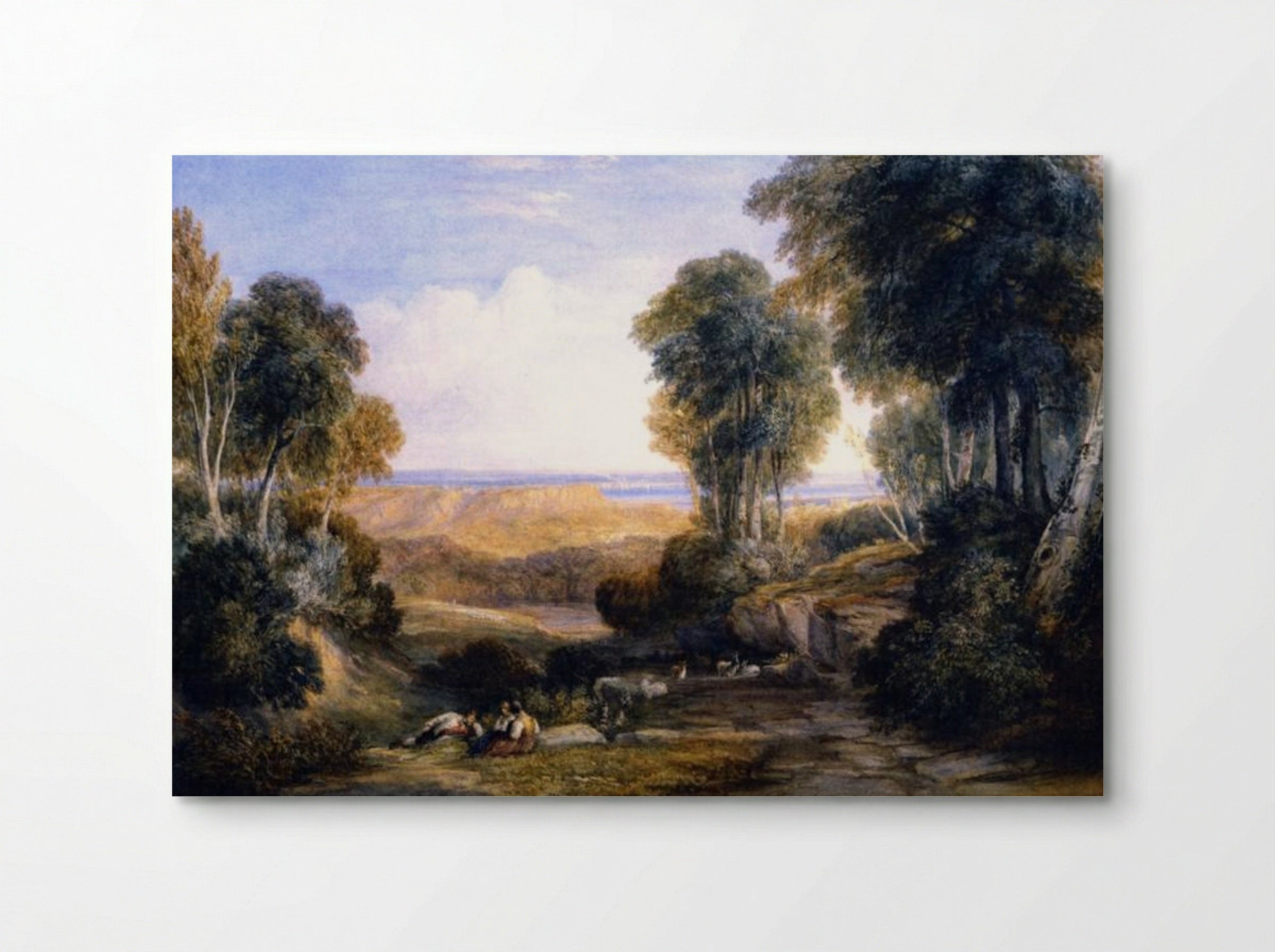
Junction of the Severn and the Wye with Chepstow in the Distance - David Cox
Archival giclée
Frames arrive ready to hang
Secure checkout
Made to order
Description
A nineteenth-century watercolour by David Cox depicting the meeting of the Severn and Wye rivers. The scene features a framed view of the distant horizon with figures resting in the foreground.
David Cox was a prominent member of the English watercolour school and a significant figure in the Birmingham School of artists. This work depicts the confluence of the River Severn and the River Wye near Chepstow, a region known for its dramatic topography. The composition uses a classic framing device with tall, slender trees on either side of the foreground. These vertical elements guide the eye toward the distant horizon where the water meets the sky. In the lower left, small figures rest on a grassy bank. Their presence provides a sense of scale to the wide terrain and suggests a moment of quiet observation. Cox used a loose, atmospheric technique to capture the light and weather of the Welsh Marches. The sky occupies a large portion of the upper half, filled with soft white clouds and pale blue washes. This approach to light and air preceded later developments in nineteenth-century painting, particularly the work of the Impressionists. The colour palette consists of earthy greens and ochres with soft blues. Cox applied the paint in broad strokes, avoiding fine detail to capture the general impression of the scene. The rocky path in the foreground and the distant cliffs are rendered with subtle tonal shifts. He often used a rough paper known as Cox paper which helped to create the textured, broken surfaces seen in his later watercolours. This piece is a representative example of Cox's ability to translate the specific character of the British countryside into a cohesive visual form. It reflects his interest in the changing effects of light on the land. The distant view of Chepstow is suggested through delicate washes rather than precise architectural drawing. This emphasis on mood and atmosphere over topographical accuracy defines his mature style.
Return policy
Because every print is made to order, we don't offer change-of-mind returns, refunds or exchanges. If your order arrives faulty, damaged or incorrect, we'll replace it free of charge — just contact us within 48 hours of delivery. See our refunds page for full details.
Shipping
We ship worldwide, printing at the production hub nearest to your delivery address. Delivery times and costs vary by destination — you'll see the options available to you at checkout.
Manufacturing
Each print is produced to order using 12-colour giclée printing on FSC-certified archival paper. Designed in Britain and printed at your nearest production hub to reduce waste and speed up delivery.
Junction of the Severn and the Wye with Chepstow in the Distance - David Cox

Artist Biography
David Cox
He was born in Birmingham in 1783 and was largely self-taught. He became one of the great masters of the English watercolour tradition, painting Welsh and English landscapes with a directness that his contemporaries found crude. He taught drawing for much of his life and published influential treatises on watercolour technique. He died in 1859.
Our Features
Designed for Lasting Impact
Specific Features
Every Solis piece is made to order with archival, gallery-quality materials built to last.
- Museum-grade giclée printing for rich, fade-resistant colour
- Archival matte fine-art paper, FSC-certified
- Multiple sizes and framing options available
- Frames in black, natural wood, dark wood or white
- Framed prints arrive ready to hang
Care & Cleaning
To keep your artwork looking its best:
- Dust gently with a soft, dry cloth
- Avoid prolonged direct sunlight
- Never use liquid cleaners on the print or canvas surface
- Keep in a dry, room-temperature space
- Handle prints with clean, dry hands
Materials & Sizing
Museum-grade giclée on FSC-certified archival matte paper, with framed and canvas options.
- Paper sizes: A4, A3, A2, A1, A0 and B2 (50×70 cm)
- Canvas: XS (20×30 cm) to Large (60×90 cm)
- Frames: black, natural wood, dark wood or white
Why Choose Us ?
Damage-free delivery guarantee
Fast Shipping
Museum-Quality Materials
Artist Biography
David Cox
He was born in Birmingham in 1783 and was largely self-taught. He became one of the great masters of the English watercolour tradition, painting Welsh and English landscapes with a directness that his contemporaries found crude. He taught drawing for much of his life and published influential treatises on watercolour technique. He died in 1859.
You May Also Like