

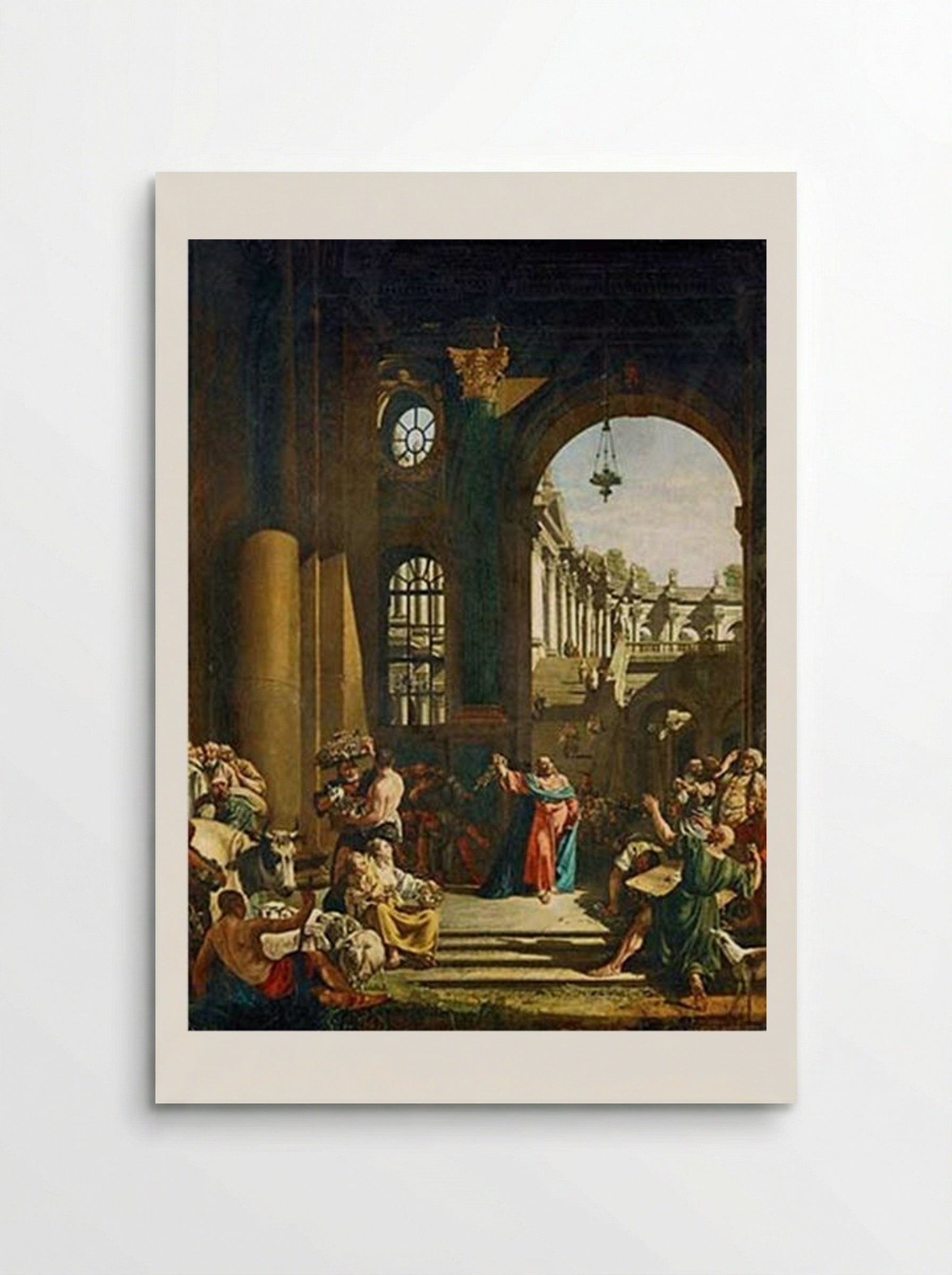
Jesus Cleansing the Temple - Bernardo Bellotto
Archival giclée
Frames arrive ready to hang
Secure checkout
Made to order
Description
A dramatic scene from the New Testament, 'Jesus Cleansing the Temple' by Bernardo Bellotto captures the moment Jesus drives the merchants from the Temple in Jerusalem. The painting showcases Bellotto's skill in rendering architectural details and dynamic human figures.
Bernardo Bellotto, an Italian urban landscape painter and printmaker, was born in Venice. He is also known by his mother's surname, Canaletto, and is considered an important member of the Canaletto school. He painted city views of European cities such as Dresden, Vienna, and Warsaw. Bellotto's style is characterised by its precision and attention to detail, often using a camera obscura to achieve accurate perspective. His paintings are known for their clarity and realism, capturing the architectural details and atmosphere of the cities he depicted. 'Jesus Cleansing the Temple' depicts a scene from the New Testament. Jesus is shown driving out the merchants and money changers from the Temple in Jerusalem. The composition is divided into two main areas: the interior of the temple, where the cleansing is taking place, and the exterior, which shows a colonnaded courtyard. The figures are arranged in dynamic poses, conveying a sense of movement and chaos. The architecture is rendered with meticulous detail, showcasing Bellotto's skill in capturing the grandeur of the temple.
Return policy
Because every print is made to order, we don't offer change-of-mind returns, refunds or exchanges. If your order arrives faulty, damaged or incorrect, we'll replace it free of charge — just contact us within 48 hours of delivery. See our refunds page for full details.
Shipping
We ship worldwide, printing at the production hub nearest to your delivery address. Delivery times and costs vary by destination — you'll see the options available to you at checkout.
Manufacturing
Each print is produced to order using 12-colour giclée printing on FSC-certified archival paper. Designed in Britain and printed at your nearest production hub to reduce waste and speed up delivery.
Jesus Cleansing the Temple - Bernardo Bellotto

Artist Biography
Bernardo Bellotto
Born in Venice in 1721, Bellotto was the nephew of Giovanni Antonio Canal on his mother's side and trained in his uncle's studio from early adolescence. By his mid-teens he was a registered member of the Venetian painters' guild. His early work so closely followed Canaletto's manner that he occasionally signed canvases "Canaletto" himself, a habit that has tangled attribution ever since. He left Venice in 1746 for a long Italian tour before heading north; in 1747, aged twenty-six, he accepted an invitation to Dresden from Frederick-Augustus II, Elector of Saxony, who paid him twenty thalers a year as court painter.
The Dresden commissions produced some of his finest work: The Moat of the Zwinger (1749-53, 133 x 235 cm, Gemaldegalerie) and a series of Neumarkt views including the Frauenkirche, in which extreme diagonal compositions amplify the spatial depth of the city's Baroque squares. Empress Maria Theresa summoned him to Vienna in 1758, where he painted View from the Belvedere (1759-60, Kunsthistorisches Museum); in 1767 he moved to Warsaw, entering the service of Stanislaw II of Poland and beginning the topographical documentation that would outlast the city itself.
His palette runs consistently cooler and crisper than Canaletto's; he paid more attention to cloud formations, deep shadows, and foliage, and packed his views with more figure groups. Where Canaletto often revisited the same standpoints, Bellotto almost always sought new vantage points. Scholars read his documentary precision as a function of his market: not Venice's tourist trade but the royal courts of Europe, patrons who wanted their capitals recorded with near-surveyor exactitude.
Our Features
Designed for Lasting Impact
Specific Features
Every Solis piece is made to order with archival, gallery-quality materials built to last.
- Museum-grade giclée printing for rich, fade-resistant colour
- Archival matte fine-art paper, FSC-certified
- Multiple sizes and framing options available
- Frames in black, natural wood, dark wood or white
- Framed prints arrive ready to hang
Care & Cleaning
To keep your artwork looking its best:
- Dust gently with a soft, dry cloth
- Avoid prolonged direct sunlight
- Never use liquid cleaners on the print or canvas surface
- Keep in a dry, room-temperature space
- Handle prints with clean, dry hands
Materials & Sizing
Museum-grade giclée on FSC-certified archival matte paper, with framed and canvas options.
- Paper sizes: A4, A3, A2, A1, A0 and B2 (50×70 cm)
- Canvas: XS (20×30 cm) to Large (60×90 cm)
- Frames: black, natural wood, dark wood or white
Why Choose Us ?
Damage-free delivery guarantee
Fast Shipping
Museum-Quality Materials
Artist Biography
Bernardo Bellotto
Born in Venice in 1721, Bellotto was the nephew of Giovanni Antonio Canal on his mother's side and trained in his uncle's studio from early adolescence. By his mid-teens he was a registered member of the Venetian painters' guild. His early work so closely followed Canaletto's manner that he occasionally signed canvases "Canaletto" himself, a habit that has tangled attribution ever since. He left Venice in 1746 for a long Italian tour before heading north; in 1747, aged twenty-six, he accepted an invitation to Dresden from Frederick-Augustus II, Elector of Saxony, who paid him twenty thalers a year as court painter.
The Dresden commissions produced some of his finest work: The Moat of the Zwinger (1749-53, 133 x 235 cm, Gemaldegalerie) and a series of Neumarkt views including the Frauenkirche, in which extreme diagonal compositions amplify the spatial depth of the city's Baroque squares. Empress Maria Theresa summoned him to Vienna in 1758, where he painted View from the Belvedere (1759-60, Kunsthistorisches Museum); in 1767 he moved to Warsaw, entering the service of Stanislaw II of Poland and beginning the topographical documentation that would outlast the city itself.
His palette runs consistently cooler and crisper than Canaletto's; he paid more attention to cloud formations, deep shadows, and foliage, and packed his views with more figure groups. Where Canaletto often revisited the same standpoints, Bellotto almost always sought new vantage points. Scholars read his documentary precision as a function of his market: not Venice's tourist trade but the royal courts of Europe, patrons who wanted their capitals recorded with near-surveyor exactitude.
You May Also Like