

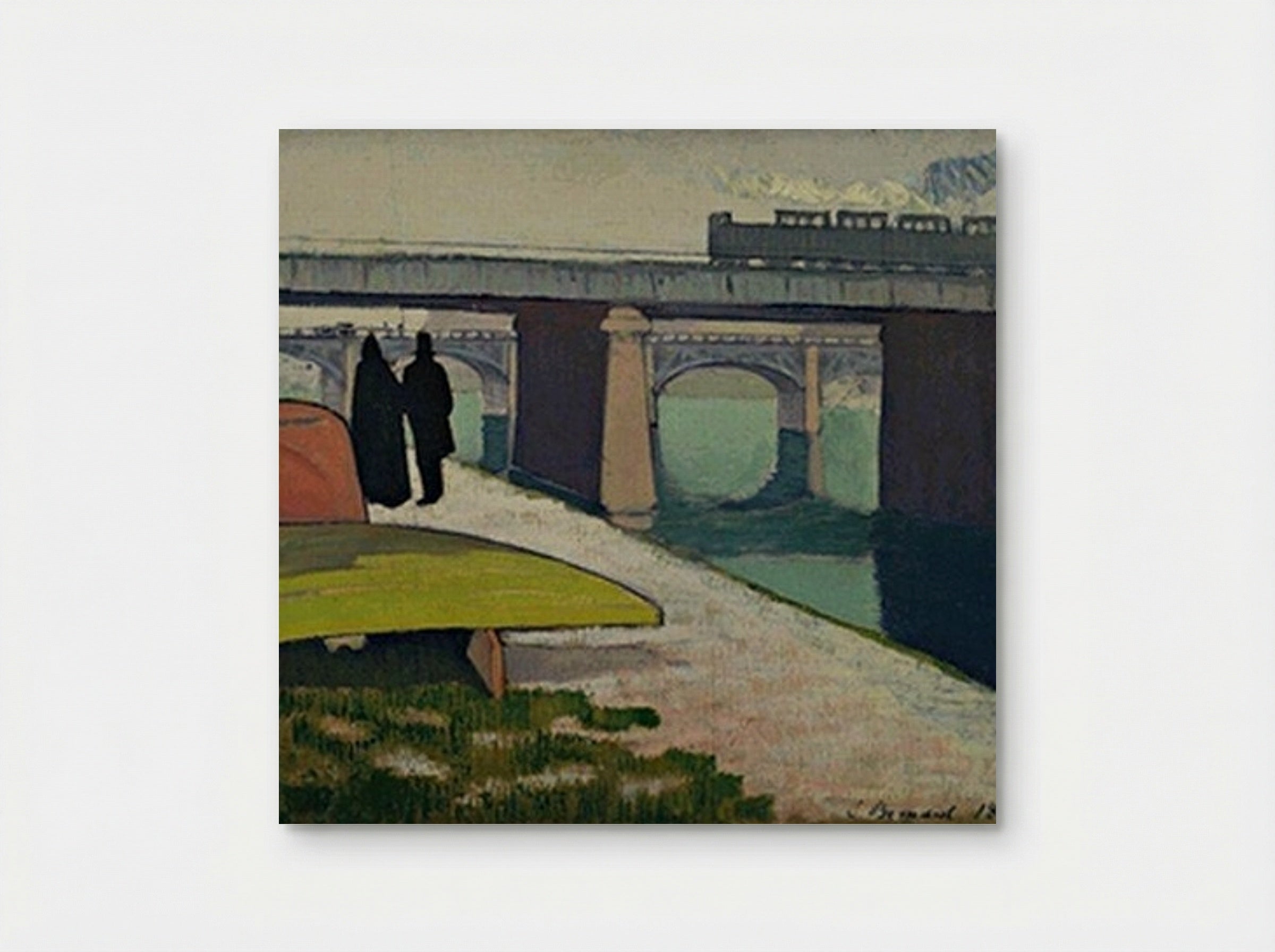


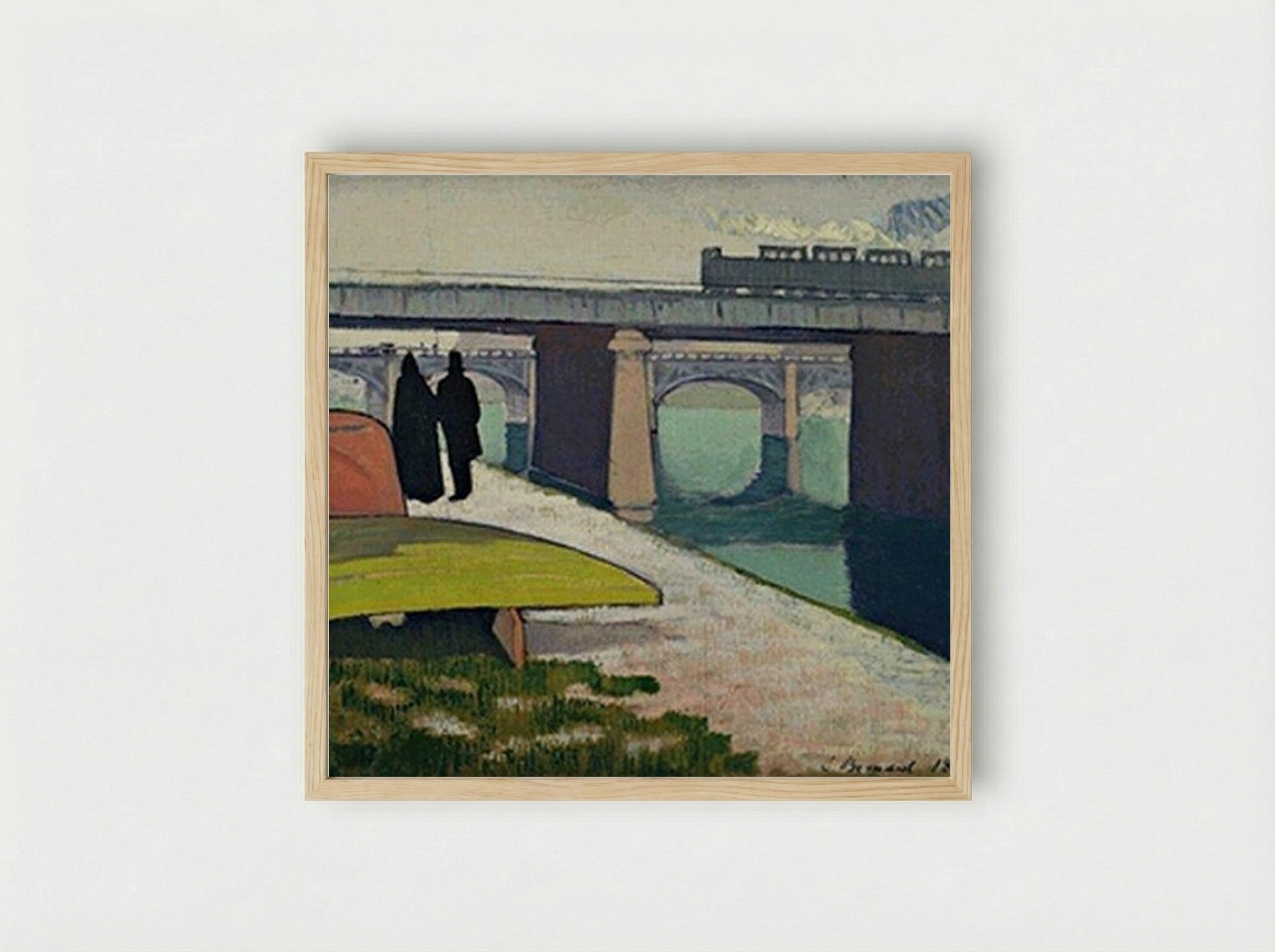
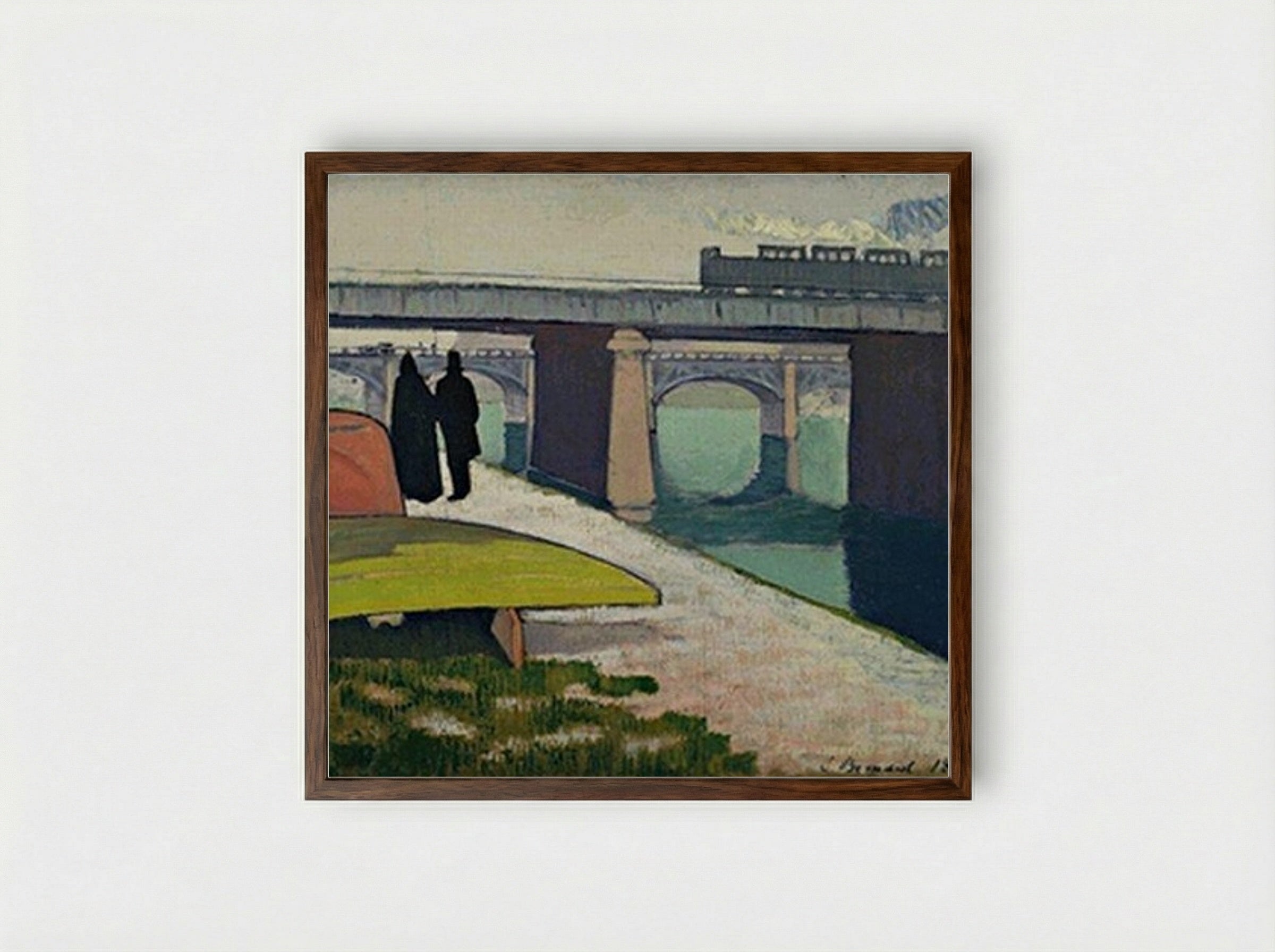
Iron Bridges at Asnières - Émile Bernard
Archival giclée
Frames arrive ready to hang
Secure checkout
Made to order
Description
Painted in 1887, Émile Bernard's *Iron Bridges at Asnières* depicts a modern industrial scene on the Seine. The painting features simplified forms, muted colours, and visible brushwork, reflecting the artist's Post-Impressionist style.
Émile Bernard's 1887 painting, *Iron Bridges at Asnières*, captures a scene of industrial modernity on the outskirts of Paris. Bernard, a French Post-Impressionist painter, was associated with artists such as Paul Gauguin and Vincent van Gogh. This work reflects the influence of Cloisonnism, a style he helped develop, characterised by bold forms separated by dark outlines. The painting depicts the railway bridges spanning the Seine at Asnières-sur-Seine, a suburb northwest of Paris. The composition is divided into distinct zones, with the bridges and a passing train dominating the background. Two figures, rendered as dark silhouettes, stand on the riverbank in the middle ground, adding a human element to the industrial setting. In the foreground, a boat rests on the bank, its form simplified and abstracted. Bernard's use of colour is restrained, with muted tones of green, grey, and brown creating a somewhat melancholic atmosphere. The brushwork is visible, contributing to the painting's textured surface and sense of immediacy. The painting offers a glimpse into the changing urban environment of late 19th-century France, where industrial progress coexisted with traditional ways of life.
Return policy
Because every print is made to order, we don't offer change-of-mind returns, refunds or exchanges. If your order arrives faulty, damaged or incorrect, we'll replace it free of charge — just contact us within 48 hours of delivery. See our refunds page for full details.
Shipping
We ship worldwide, printing at the production hub nearest to your delivery address. Delivery times and costs vary by destination — you'll see the options available to you at checkout.
Manufacturing
Each print is produced to order using 12-colour giclée printing on FSC-certified archival paper. Designed in Britain and printed at your nearest production hub to reduce waste and speed up delivery.
Iron Bridges at Asnières - Émile Bernard
Our Features
Designed for Lasting Impact
Specific Features
Every Solis piece is made to order with archival, gallery-quality materials built to last.
- Museum-grade giclée printing for rich, fade-resistant colour
- Archival matte fine-art paper, FSC-certified
- Multiple sizes and framing options available
- Frames in black, natural wood, dark wood or white
- Framed prints arrive ready to hang
Care & Cleaning
To keep your artwork looking its best:
- Dust gently with a soft, dry cloth
- Avoid prolonged direct sunlight
- Never use liquid cleaners on the print or canvas surface
- Keep in a dry, room-temperature space
- Handle prints with clean, dry hands
Materials & Sizing
Museum-grade giclée on FSC-certified archival matte paper, with framed and canvas options.
- Paper sizes: A4, A3, A2, A1, A0 and B2 (50×70 cm)
- Canvas: XS (20×30 cm) to Large (60×90 cm)
- Frames: black, natural wood, dark wood or white
Why Choose Us ?
Damage-free delivery guarantee
Fast Shipping
Museum-Quality Materials

Artist Biography
Émile Bernard
He was raised by his grandmother, who owned a laundry in Lille, because his younger sister was ill and required his parents' full attention. He entered the Ecole des Beaux-Arts in Paris but was expelled for insubordination. At the Academie Cormon he met Toulouse-Lautrec and Van Gogh; his friendship with Van Gogh produced some of the most important letters in art history.
Bernard and Gauguin fell out definitively in 1891 over the paternity of Symbolism and cloisonnism. Bernard believed he had been written out of the story, which he had. He spent years writing criticism and art history to set the record straight, producing first-hand accounts of the period that remain primary sources.
His later work turned conservative. He travelled to Egypt, studied the Old Masters, and repudiated the avant-garde experiments of his youth. The early paintings, made between 1886 and 1897 when he was barely out of his teens, are the ones that matter. He was brilliant too young and spent the rest of his career looking backwards. His correspondence with Van Gogh, preserved and published, is one of the most direct records of how two young painters in the 1880s thought about colour, composition and what painting was for.
You May Also Like