

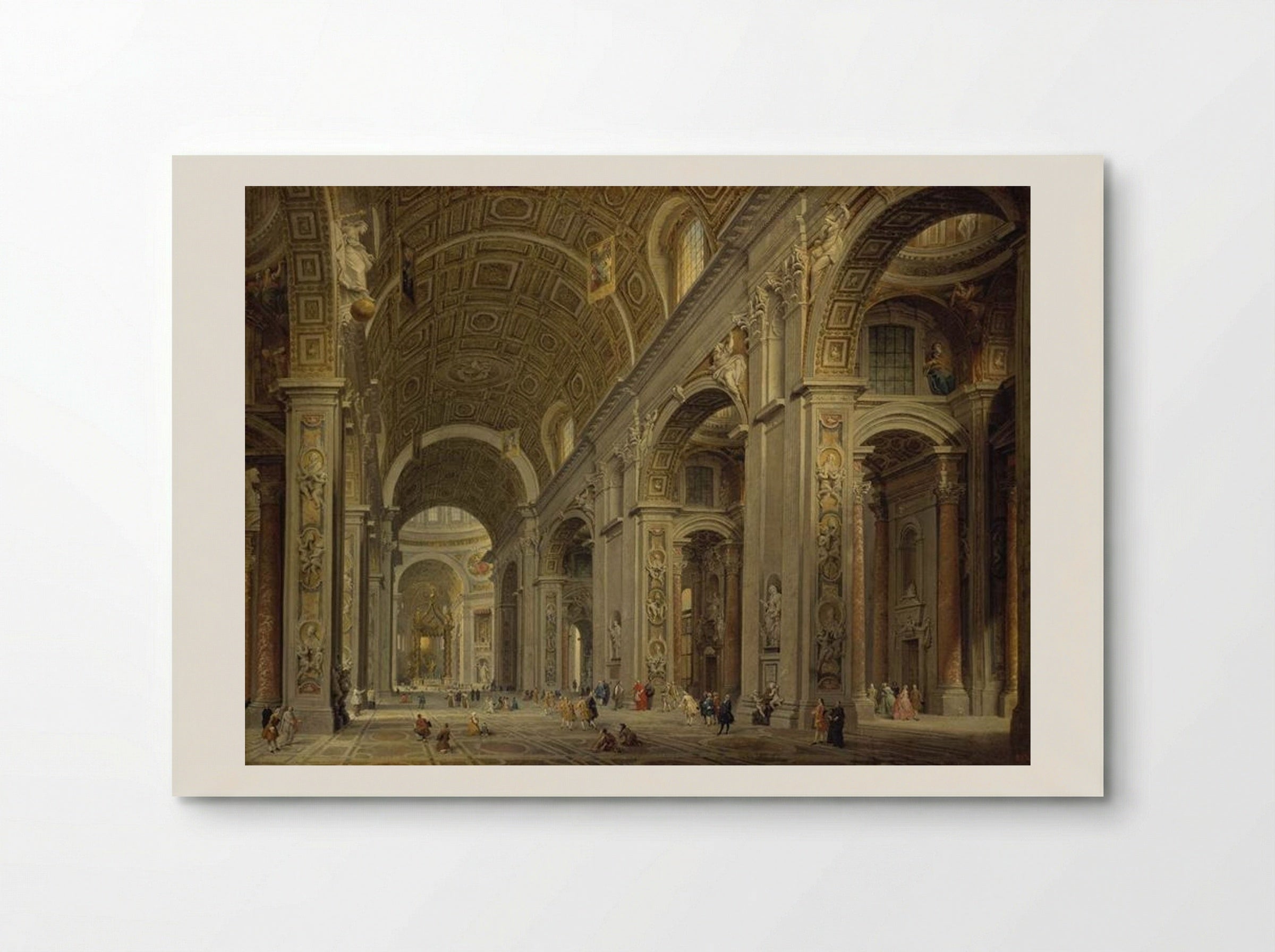
Interior of St Peter's in Rome - Giovanni Paolo Panini
Archival giclée
Frames arrive ready to hang
Secure checkout
Made to order
Description
A masterful depiction of the interior of St Peter's Basilica, showcasing Panini's command of perspective and the scale of Roman Baroque architecture.
Giovanni Paolo Panini, a master of the veduta tradition, captures the immense scale of St Peter's Basilica in this detailed composition. The painting demonstrates his technical command of linear perspective, guiding the viewer from the foreground figures toward the distant, light-filled apse. Panini was known for his ability to balance architectural precision with the human element, populating the vast nave with small, animated groups of visitors and clergy. These figures provide a sense of scale, emphasising the monumental proportions of the barrel-vaulted ceiling and the massive piers. The palette is dominated by warm, earthy tones, reflecting the marble and stone surfaces of the basilica. Light enters from the clerestory windows, creating soft transitions across the coffered ceiling and the ornate pilasters. Panini’s work was highly sought after by travellers on the Grand Tour, who desired accurate yet atmospheric depictions of Roman monuments. This particular view avoids the rigid dryness of a purely technical drawing, opting instead for a painterly approach that conveys the atmosphere of the space. The inclusion of decorative elements, such as the statues nestled within the niches and the intricate floor patterns, demonstrates the artist's attention to the specific architectural features of the site. Panini’s influence on the genre of architectural painting was significant, as he moved away from the purely topographical to a more theatrical presentation of space. His work remains a primary visual record of how these historic interiors appeared to eighteenth-century observers. By focusing on the interplay between the permanent structure of the basilica and the transient presence of the people within it, Panini creates a narrative of the building as a living, functioning space rather than a static monument. This print reproduces the depth and tonal range of the original oil painting, offering a clear view of the architectural details that define the Roman Baroque style.
Return policy
Because every print is made to order, we don't offer change-of-mind returns, refunds or exchanges. If your order arrives faulty, damaged or incorrect, we'll replace it free of charge — just contact us within 48 hours of delivery. See our refunds page for full details.
Shipping
We ship worldwide, printing at the production hub nearest to your delivery address. Delivery times and costs vary by destination — you'll see the options available to you at checkout.
Manufacturing
Each print is produced to order using 12-colour giclée printing on FSC-certified archival paper. Designed in Britain and printed at your nearest production hub to reduce waste and speed up delivery.
Interior of St Peter's in Rome - Giovanni Paolo Panini

Artist Biography
Giovanni Paolo Panini
He was born in Piacenza in 1691 and trained under Giuseppe Natali, the stage designer Francesco Galli-Bibiena, and Andrea Galluzzi. He settled in Rome in 1711 and entered the studio of Benedetto Luti. His early career was in palace decoration: the Villa Patrizi (1719), the Palazzo de Carolis (1720) and the Seminario Romano (1721). But veduta painting, views of real and imagined Rome, became his principal occupation.
His vedute split into two modes. Some were topographically faithful; others were capricci, fanciful rearrangements of monuments that compressed centuries of Roman architecture into a single composition. Both types were bought by European collectors, royalty and Grand Tourists who wanted a portable version of the city to take home. The Spanish monarchs were particularly avid patrons; several Panini paintings remain in the Prado.
He taught perspective and optics at the French Academy in Rome, where his students included Hubert Robert and the stage designer Giovanni Niccolo Servandoni. His methods were later formalised into the "Panini projection", a mathematical technique for rendering panoramic views. He was elected director of the Accademia di San Luca in 1754. He died in Rome in 1765.
Our Features
Designed for Lasting Impact
Specific Features
Every Solis piece is made to order with archival, gallery-quality materials built to last.
- Museum-grade giclée printing for rich, fade-resistant colour
- Archival matte fine-art paper, FSC-certified
- Multiple sizes and framing options available
- Frames in black, natural wood, dark wood or white
- Framed prints arrive ready to hang
Care & Cleaning
To keep your artwork looking its best:
- Dust gently with a soft, dry cloth
- Avoid prolonged direct sunlight
- Never use liquid cleaners on the print or canvas surface
- Keep in a dry, room-temperature space
- Handle prints with clean, dry hands
Materials & Sizing
Museum-grade giclée on FSC-certified archival matte paper, with framed and canvas options.
- Paper sizes: A4, A3, A2, A1, A0 and B2 (50×70 cm)
- Canvas: XS (20×30 cm) to Large (60×90 cm)
- Frames: black, natural wood, dark wood or white
Why Choose Us ?
Damage-free delivery guarantee
Fast Shipping
Museum-Quality Materials
Artist Biography
Giovanni Paolo Panini
He was born in Piacenza in 1691 and trained under Giuseppe Natali, the stage designer Francesco Galli-Bibiena, and Andrea Galluzzi. He settled in Rome in 1711 and entered the studio of Benedetto Luti. His early career was in palace decoration: the Villa Patrizi (1719), the Palazzo de Carolis (1720) and the Seminario Romano (1721). But veduta painting, views of real and imagined Rome, became his principal occupation.
His vedute split into two modes. Some were topographically faithful; others were capricci, fanciful rearrangements of monuments that compressed centuries of Roman architecture into a single composition. Both types were bought by European collectors, royalty and Grand Tourists who wanted a portable version of the city to take home. The Spanish monarchs were particularly avid patrons; several Panini paintings remain in the Prado.
He taught perspective and optics at the French Academy in Rome, where his students included Hubert Robert and the stage designer Giovanni Niccolo Servandoni. His methods were later formalised into the "Panini projection", a mathematical technique for rendering panoramic views. He was elected director of the Accademia di San Luca in 1754. He died in Rome in 1765.
You May Also Like