

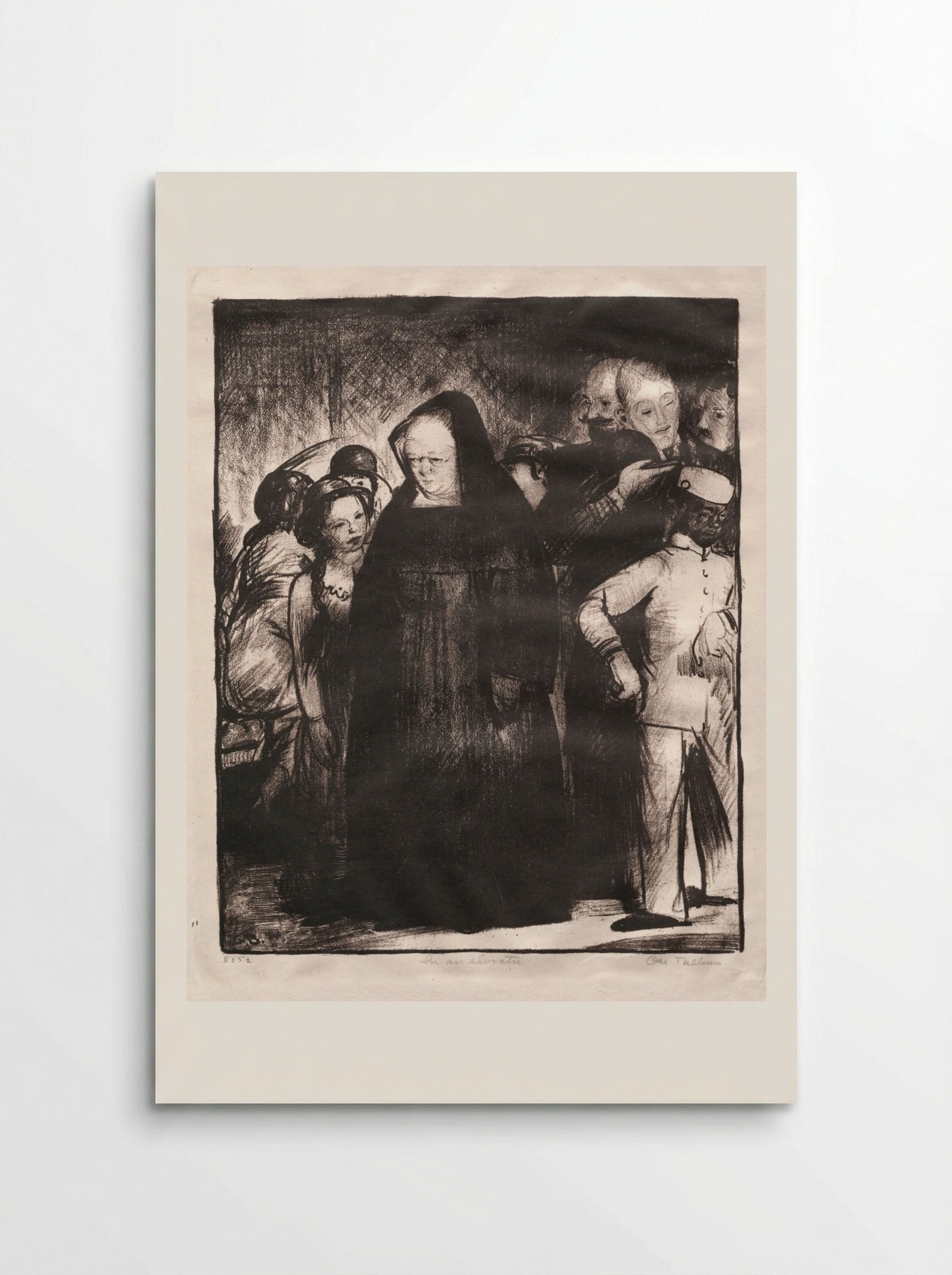
In an Elevator - George Bellows
Archival giclée
Frames arrive ready to hang
Secure checkout
Made to order
Description
A striking 1910 lithograph by George Bellows, capturing the quiet tension and social dynamics of passengers within a New York City elevator.
George Bellows, a central figure of the Ashcan School, produced this lithograph in 1910. The work captures a mundane moment of urban life in early twentieth-century New York. Within the confined space of an elevator, a group of passengers stands in close proximity. The composition focuses on a central, older woman dressed in dark, mourning-like attire, who stands as a static presence amidst the surrounding crowd. Bellows employs a dramatic use of light and shadow to define the figures, creating a sense of psychological weight and social observation. The artist uses lithography to achieve a range of textures, from the deep, velvety blacks of the woman's coat to the lighter, sketch-like marks that suggest the faces and clothing of the other commuters. The elevator operator, positioned to the right, provides a vertical counterpoint to the central figure. Bellows was known for his interest in the raw, unvarnished reality of city life, and this print reflects his ability to find narrative tension in everyday encounters. The figures appear caught in a moment of shared silence, their expressions varied and individualised, suggesting the anonymity of modern metropolitan existence. This print demonstrates Bellows' technical proficiency with the lithographic stone, where he manipulated the medium to create atmospheric depth. The lack of a clear background forces the viewer to engage directly with the social dynamics of the group. It is a study of human interaction, class, and the claustrophobic nature of public transport during the period. The work remains a clear example of the artist's commitment to documenting the American experience without idealisation or sentimentality. By focusing on the interplay of light and form, Bellows transforms a routine transit experience into a compelling visual record of his time.
Return policy
Because every print is made to order, we don't offer change-of-mind returns, refunds or exchanges. If your order arrives faulty, damaged or incorrect, we'll replace it free of charge — just contact us within 48 hours of delivery. See our refunds page for full details.
Shipping
We ship worldwide, printing at the production hub nearest to your delivery address. Delivery times and costs vary by destination — you'll see the options available to you at checkout.
Manufacturing
Each print is produced to order using 12-colour giclée printing on FSC-certified archival paper. Designed in Britain and printed at your nearest production hub to reduce waste and speed up delivery.
In an Elevator - George Bellows
Our Features
Designed for Lasting Impact
Specific Features
Every Solis piece is made to order with archival, gallery-quality materials built to last.
- Museum-grade giclée printing for rich, fade-resistant colour
- Archival matte fine-art paper, FSC-certified
- Multiple sizes and framing options available
- Frames in black, natural wood, dark wood or white
- Framed prints arrive ready to hang
Care & Cleaning
To keep your artwork looking its best:
- Dust gently with a soft, dry cloth
- Avoid prolonged direct sunlight
- Never use liquid cleaners on the print or canvas surface
- Keep in a dry, room-temperature space
- Handle prints with clean, dry hands
Materials & Sizing
Museum-grade giclée on FSC-certified archival matte paper, with framed and canvas options.
- Paper sizes: A4, A3, A2, A1, A0 and B2 (50×70 cm)
- Canvas: XS (20×30 cm) to Large (60×90 cm)
- Frames: black, natural wood, dark wood or white
Why Choose Us ?
Damage-free delivery guarantee
Fast Shipping
Museum-Quality Materials

Artist Biography
George Bellows
He painted boxing matches at Tom Sharkey's saloon, an illegal club near the Brooklyn waterfront where bare-knuckle fights happened in a back room. Stag at Sharkey's, painted in 1909 when he was twenty-six, shows two fighters locked together under electric light, the crowd surging at the edges of the canvas. The paint is applied with a violence that matches the subject.
He was the youngest artist associated with the Ashcan School and the boldest. While other members painted park benches and tenement laundry lines, Bellows painted excavation sites, shipyards, snow-covered lots, and river swimmers. The compositions are physically large, thickly painted, and arranged with an energy that makes the viewer feel as though the scene is still happening.
He worked as a newspaper sports illustrator to pay the bills, and the events he covered became paintings. In 1923 he was at the Polo Grounds on assignment for the New York Evening Journal when Luis Firpo knocked Jack Dempsey out of the ring and nearly into his lap. The painting he made of the moment reversed the punch to a left hook because the composition worked better that way. Accuracy was less important than impact.
He died of a ruptured appendix in 1925, at forty-two.
You May Also Like