

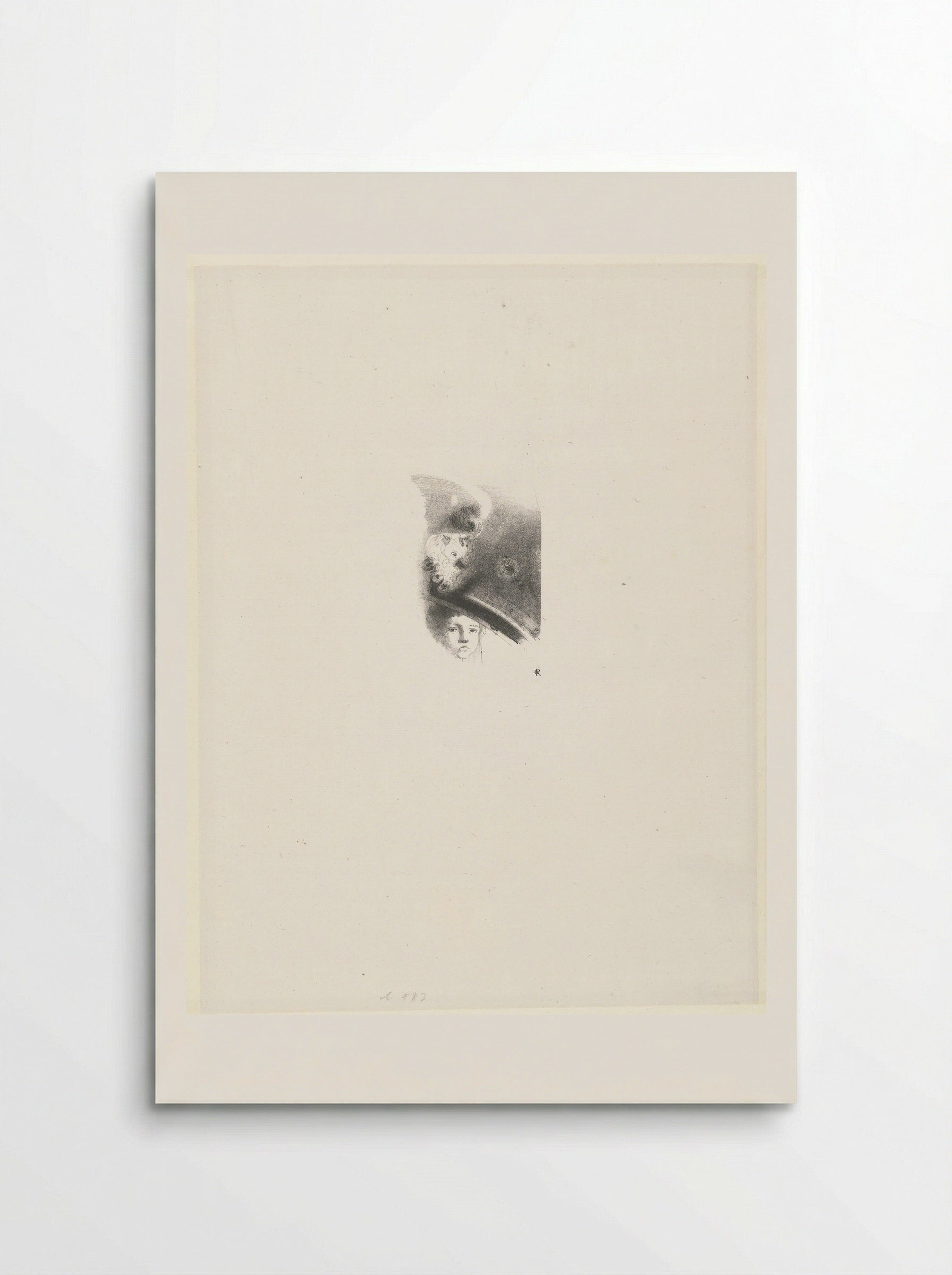
Hoofd van kind - Odilon Redon
Archival giclée
Frames arrive ready to hang
Secure checkout
Made to order
Description
A delicate lithograph by Symbolist artist Odilon Redon, featuring a child's head emerging from a deep, atmospheric shadow.
This lithograph by Odilon Redon presents a singular, ethereal vision. The artist, a figure associated with the Symbolist movement, often explored the boundaries between the conscious mind and the dream state. In this work, the subject is a child's head, emerging from a dense, atmospheric darkness. Redon employs the medium of lithography to achieve a range of tonal values, moving from the stark white of the paper to deep, velvety blacks. The composition is unconventional, as the figure occupies only a small portion of the total sheet. This choice directs the viewer's attention to the delicate features of the child, which appear almost spectral against the surrounding void. The shading is soft, creating a sense of mystery and introspection. Redon was known for his 'noirs', a series of charcoal drawings and lithographs that prioritised internal experience over external reality. This piece aligns with that practice, as it avoids narrative clarity in favour of a suggestive, quiet mood. The technical execution demonstrates Redon's mastery of light and shadow. By leaving much of the paper blank, he creates a stark contrast that makes the central image appear to float. The child's expression is neutral, yet the surrounding darkness imbues the work with a sense of gravity. This print is an example of the artist's ability to transform simple subjects into objects of contemplation. It invites the viewer to look beyond the surface and engage with the suggestive power of the image. The work is a fine example of late nineteenth-century French printmaking, where the focus shifted toward the subjective and the psychological.
Return policy
Because every print is made to order, we don't offer change-of-mind returns, refunds or exchanges. If your order arrives faulty, damaged or incorrect, we'll replace it free of charge — just contact us within 48 hours of delivery. See our refunds page for full details.
Shipping
We ship worldwide, printing at the production hub nearest to your delivery address. Delivery times and costs vary by destination — you'll see the options available to you at checkout.
Manufacturing
Each print is produced to order using 12-colour giclée printing on FSC-certified archival paper. Designed in Britain and printed at your nearest production hub to reduce waste and speed up delivery.
Hoofd van kind - Odilon Redon

Artist Biography
Odilon Redon
For the first two decades of his career he worked exclusively in black: charcoal drawings and lithographs he called his noirs. Floating eyeballs, severed heads with closed lids, spiders with human faces, plants that grow teeth. The images are hallucinatory but precisely rendered, closer to medical illustration than fantasy. He published his first lithograph album, Dans le Reve, in 1879. Nobody noticed.
Recognition came sideways. In 1884, Joris-Karl Huysmans published A rebours, a novel about a reclusive aesthete who decorates his rooms with Redon's prints. The book became a cult text for the Symbolist movement and Redon became famous by association. Stephane Mallarme, the Symbolist poet, became a close friend. Redon also completed a series of lithographs dedicated to Edgar Allan Poe, whose poems Mallarme and Baudelaire had translated into French.
After 1900 he stopped making noirs entirely and shifted to colour: pastels and oils of flowers, mythological figures and butterflies in palettes that anticipate Matisse. The transition was so complete that the Surrealists later claimed the black work while the Fauves claimed the colour, and neither group seemed to notice they were talking about the same person.
He studied under Jean-Leon Gerome at the Ecole des Beaux-Arts, which is an unlikely pairing: Gerome painted Roman gladiators with photographic precision. Redon painted eyeballs attached to balloons. Goya and Delacroix were the influences that actually stuck.
Our Features
Designed for Lasting Impact
Specific Features
Every Solis piece is made to order with archival, gallery-quality materials built to last.
- Museum-grade giclée printing for rich, fade-resistant colour
- Archival matte fine-art paper, FSC-certified
- Multiple sizes and framing options available
- Frames in black, natural wood, dark wood or white
- Framed prints arrive ready to hang
Care & Cleaning
To keep your artwork looking its best:
- Dust gently with a soft, dry cloth
- Avoid prolonged direct sunlight
- Never use liquid cleaners on the print or canvas surface
- Keep in a dry, room-temperature space
- Handle prints with clean, dry hands
Materials & Sizing
Museum-grade giclée on FSC-certified archival matte paper, with framed and canvas options.
- Paper sizes: A4, A3, A2, A1, A0 and B2 (50×70 cm)
- Canvas: XS (20×30 cm) to Large (60×90 cm)
- Frames: black, natural wood, dark wood or white
Why Choose Us ?
Damage-free delivery guarantee
Fast Shipping
Museum-Quality Materials
Artist Biography
Odilon Redon
For the first two decades of his career he worked exclusively in black: charcoal drawings and lithographs he called his noirs. Floating eyeballs, severed heads with closed lids, spiders with human faces, plants that grow teeth. The images are hallucinatory but precisely rendered, closer to medical illustration than fantasy. He published his first lithograph album, Dans le Reve, in 1879. Nobody noticed.
Recognition came sideways. In 1884, Joris-Karl Huysmans published A rebours, a novel about a reclusive aesthete who decorates his rooms with Redon's prints. The book became a cult text for the Symbolist movement and Redon became famous by association. Stephane Mallarme, the Symbolist poet, became a close friend. Redon also completed a series of lithographs dedicated to Edgar Allan Poe, whose poems Mallarme and Baudelaire had translated into French.
After 1900 he stopped making noirs entirely and shifted to colour: pastels and oils of flowers, mythological figures and butterflies in palettes that anticipate Matisse. The transition was so complete that the Surrealists later claimed the black work while the Fauves claimed the colour, and neither group seemed to notice they were talking about the same person.
He studied under Jean-Leon Gerome at the Ecole des Beaux-Arts, which is an unlikely pairing: Gerome painted Roman gladiators with photographic precision. Redon painted eyeballs attached to balloons. Goya and Delacroix were the influences that actually stuck.
You May Also Like