

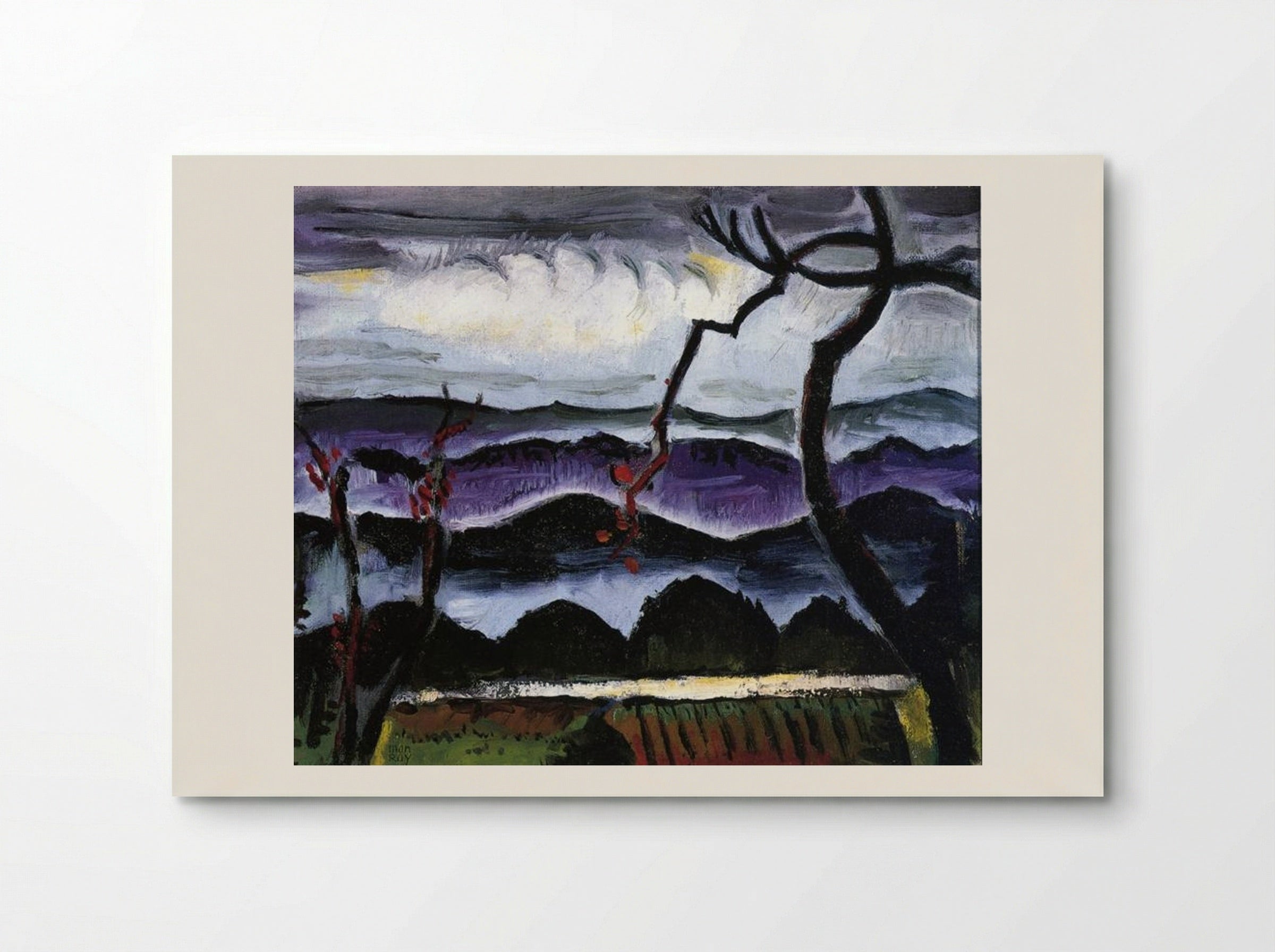
Hills - Man Ray
Archival giclée
Frames arrive ready to hang
Secure checkout
Made to order
Description
An early modernist oil painting by Man Ray, featuring bold, expressive brushwork and a dramatic, high-contrast palette of deep purples and dark silhouettes.
Painted in 1913, this work captures a period of experimentation in the early career of Man Ray. Before he became associated with the Dada and Surrealist movements, he explored the possibilities of oil paint through a lens influenced by European modernism. The composition presents a series of rolling forms that recede into the distance, framed by the dark, skeletal silhouettes of trees in the foreground. The colour palette relies on high-contrast pairings. Deep purples and blacks define the mountainous shapes, while the sky is rendered in cooler, lighter tones. The application of paint is deliberate and heavy, with visible brushwork that gives the surface a tactile quality. The foreground features a structured, almost rhythmic treatment of the earth, contrasting with the fluid, organic curves of the hills above. This piece demonstrates an interest in the simplification of form. Rather than seeking a precise representation of a specific location, the artist focuses on the emotional resonance of the scene. The stark, dark branches that reach into the frame act as a visual anchor, drawing the viewer into the space while simultaneously asserting the flatness of the picture plane. It is an example of how early twentieth-century artists moved away from traditional academic techniques to prioritise subjective expression. The work remains a clear indicator of the stylistic shifts occurring in American art during the early 1900s, as painters began to absorb the lessons of European avant-garde movements. By stripping away unnecessary detail, the artist creates a sense of atmosphere that relies on the interplay of light, shadow, and bold colour choices.
You might also like
Return policy
Because every print is made to order, we don't offer change-of-mind returns, refunds or exchanges. If your order arrives faulty, damaged or incorrect, we'll replace it free of charge — just contact us within 48 hours of delivery. See our refunds page for full details.
Shipping
We ship worldwide, printing at the production hub nearest to your delivery address. Delivery times and costs vary by destination — you'll see the options available to you at checkout.
Manufacturing
Each print is produced to order using 12-colour giclée printing on FSC-certified archival paper. Designed in Britain and printed at your nearest production hub to reduce waste and speed up delivery.
Care and materials
Specific Features
Every Solis piece is made to order with archival, gallery-quality materials built to last.
- Museum-grade giclée printing for rich, fade-resistant colour
- Archival matte fine-art paper, FSC-certified
- Multiple sizes and framing options available
- Frames in black, natural wood, dark wood or white
- Framed prints arrive ready to hang
Care & Cleaning
To keep your artwork looking its best:
- Dust gently with a soft, dry cloth
- Avoid prolonged direct sunlight
- Never use liquid cleaners on the print or canvas surface
- Keep in a dry, room-temperature space
- Handle prints with clean, dry hands
Materials & Sizing
Museum-grade giclée on FSC-certified archival matte paper, with framed and canvas options.
- Paper sizes: A4, A3, A2, A1, A0 and B2 (50×70 cm)
- Canvas: XS (20×30 cm) to Large (60×90 cm)
- Frames: black, natural wood, dark wood or white
Hills - Man Ray

Artist Biography
Man Ray
He moved to Paris in 1921 and stayed for twenty years. He arrived knowing Marcel Duchamp, who had been his closest collaborator in New York. The two of them shared an instinct for provocation. Man Ray's contribution to Dada was the 'rayograph', made by placing objects directly on photographic paper and exposing them to light. No camera, no lens. The results look like X-rays of the unconscious: keys, springs, hands, fabrics, rendered as white silhouettes on black.
He became the portrait photographer of the Parisian avant-garde. Picasso, Hemingway, Gertrude Stein, Jean Cocteau, the Surrealists. The portraits are sharp, well-lit, and respectful, which is not what you would expect from a Dadaist. He also worked in fashion photography for Vogue and Harper's Bazaar, which paid the bills and gave him access to models and studios.
The most famous image is Le Violon d'Ingres (1924): a photograph of Kiki de Montparnasse's back with f-holes painted on it, turning a woman into a cello. It is witty, elegant, and uncomfortable in exactly the way Surrealism intended. He claimed to value his paintings more than his photographs. The world disagreed, and he never entirely forgave it.
He returned to Paris after the war and stayed until his death in 1976, at eighty-six.
Why Choose Us ?
Damage-free delivery guarantee
Fast Shipping
Museum-Quality Materials
You May Also Like