

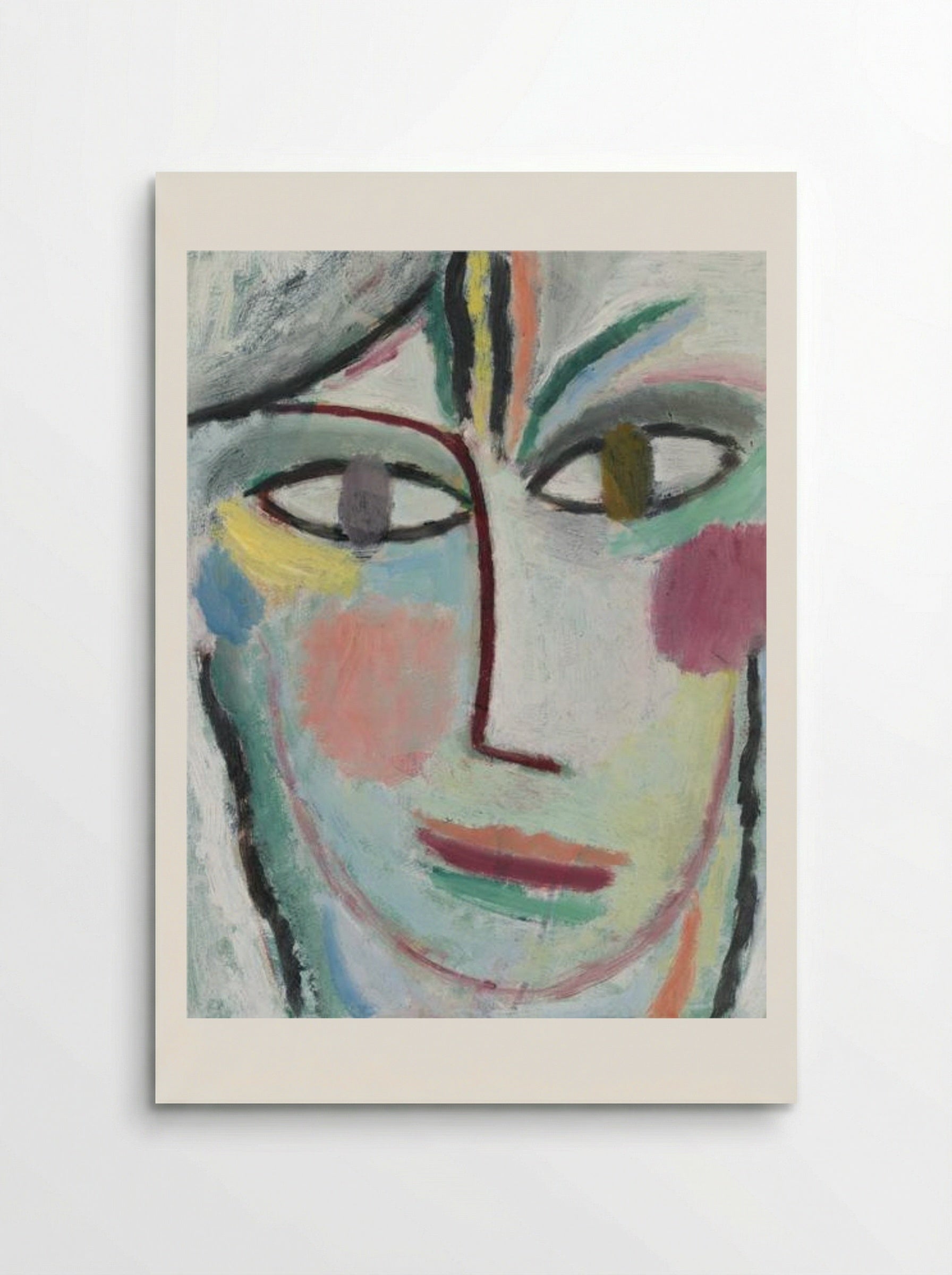
Head of a Woman, Femina - Alexej von Jawlensky
Archival giclée
Frames arrive ready to hang
Secure checkout
Made to order
Description
This portrait by Alexej von Jawlensky exemplifies his Expressionist style, featuring bold colours and simplified forms to convey inner emotion. 'Head of a Woman, Femina' captures the essence of the human spirit through its intense gaze and expressive brushwork.
Alexej von Jawlensky, a Russian Expressionist painter, is known for his intense, spiritual portraits. Born in 1864, Jawlensky's artistic journey took him from Russia to Germany, where he became a central figure in the Expressionist movement. His work explores the human face as a vehicle for expressing inner emotions and spiritual states. Jawlensky's style is characterised by bold colours, simplified forms, and a focus on the eyes as windows to the soul. He sought to capture the essence of the human spirit through his art. 'Head of a Woman, Femina' exemplifies Jawlensky's mature style. The portrait features a simplified, almost mask-like face, rendered in a palette of pastel colours. The eyes, a focal point, are given particular attention, with contrasting colours used to create a sense of depth and intensity. The brushwork is loose and expressive, adding to the emotional impact of the piece. The composition is simple, with the face dominating the frame, drawing the viewer into an intimate encounter with the subject.
Return policy
Because every print is made to order, we don't offer change-of-mind returns, refunds or exchanges. If your order arrives faulty, damaged or incorrect, we'll replace it free of charge — just contact us within 48 hours of delivery. See our refunds page for full details.
Shipping
We ship worldwide, printing at the production hub nearest to your delivery address. Delivery times and costs vary by destination — you'll see the options available to you at checkout.
Manufacturing
Each print is produced to order using 12-colour giclée printing on FSC-certified archival paper. Designed in Britain and printed at your nearest production hub to reduce waste and speed up delivery.
Head of a Woman, Femina - Alexej von Jawlensky

Artist Biography
Alexej Von Jawlensky
Jawlensky was born in Torzhok, Russia, in 1864, the fifth child of a military family. He trained as an officer in the Imperial Guard before abandoning that career in 1889 to study painting under Ilya Repin in St Petersburg. His patron and companion Marianne von Werefkin, herself a successful painter, financed their move to Munich in 1896. There he met Kandinsky, beginning a friendship that would shape both their careers.
Matisse, Van Gogh and Gauguin all pushed Jawlensky toward bolder colour, but his real catalyst was a trip to Provence in 1905 that convinced him colour could carry spiritual weight without representational accuracy. Back in Munich he produced intense, mask-like portraits: the Mystical Heads (1917 to 1919) and Saviour's Faces (1918 to 1920) drew directly on Russian Orthodox icon traditions from his childhood. He studied theosophy, yoga and Rudolf Steiner's anthroposophy, seeking a synthesis of Eastern and Western spiritual practice through paint.
He co-founded the New Munich Artists' Association with Kandinsky and later joined Der Blaue Reiter. In 1924, Emmy Scheyer (whom Jawlensky nicknamed "Galka", Russian for jackdaw) abandoned her own painting career to promote his work in America, forming Die Blaue Vier with Jawlensky, Kandinsky, Klee and Feininger. The First World War had already forced Jawlensky from Germany to Switzerland; he returned to Wiesbaden in 1921 and stayed until his death in 1941, increasingly isolated as the Nazis classified his work as degenerate.
Our Features
Designed for Lasting Impact
Specific Features
Every Solis piece is made to order with archival, gallery-quality materials built to last.
- Museum-grade giclée printing for rich, fade-resistant colour
- Archival matte fine-art paper, FSC-certified
- Multiple sizes and framing options available
- Frames in black, natural wood, dark wood or white
- Framed prints arrive ready to hang
Care & Cleaning
To keep your artwork looking its best:
- Dust gently with a soft, dry cloth
- Avoid prolonged direct sunlight
- Never use liquid cleaners on the print or canvas surface
- Keep in a dry, room-temperature space
- Handle prints with clean, dry hands
Materials & Sizing
Museum-grade giclée on FSC-certified archival matte paper, with framed and canvas options.
- Paper sizes: A4, A3, A2, A1, A0 and B2 (50×70 cm)
- Canvas: XS (20×30 cm) to Large (60×90 cm)
- Frames: black, natural wood, dark wood or white
Why Choose Us ?
Damage-free delivery guarantee
Fast Shipping
Museum-Quality Materials
Artist Biography
Alexej von Jawlensky
Jawlensky was born in Torzhok, Russia, in 1864, the fifth child of a military family. He trained as an officer in the Imperial Guard before abandoning that career in 1889 to study painting under Ilya Repin in St Petersburg. His patron and companion Marianne von Werefkin, herself a successful painter, financed their move to Munich in 1896. There he met Kandinsky, beginning a friendship that would shape both their careers.
Matisse, Van Gogh and Gauguin all pushed Jawlensky toward bolder colour, but his real catalyst was a trip to Provence in 1905 that convinced him colour could carry spiritual weight without representational accuracy. Back in Munich he produced intense, mask-like portraits: the Mystical Heads (1917 to 1919) and Saviour's Faces (1918 to 1920) drew directly on Russian Orthodox icon traditions from his childhood. He studied theosophy, yoga and Rudolf Steiner's anthroposophy, seeking a synthesis of Eastern and Western spiritual practice through paint.
He co-founded the New Munich Artists' Association with Kandinsky and later joined Der Blaue Reiter. In 1924, Emmy Scheyer (whom Jawlensky nicknamed "Galka", Russian for jackdaw) abandoned her own painting career to promote his work in America, forming Die Blaue Vier with Jawlensky, Kandinsky, Klee and Feininger. The First World War had already forced Jawlensky from Germany to Switzerland; he returned to Wiesbaden in 1921 and stayed until his death in 1941, increasingly isolated as the Nazis classified his work as degenerate.
You May Also Like