

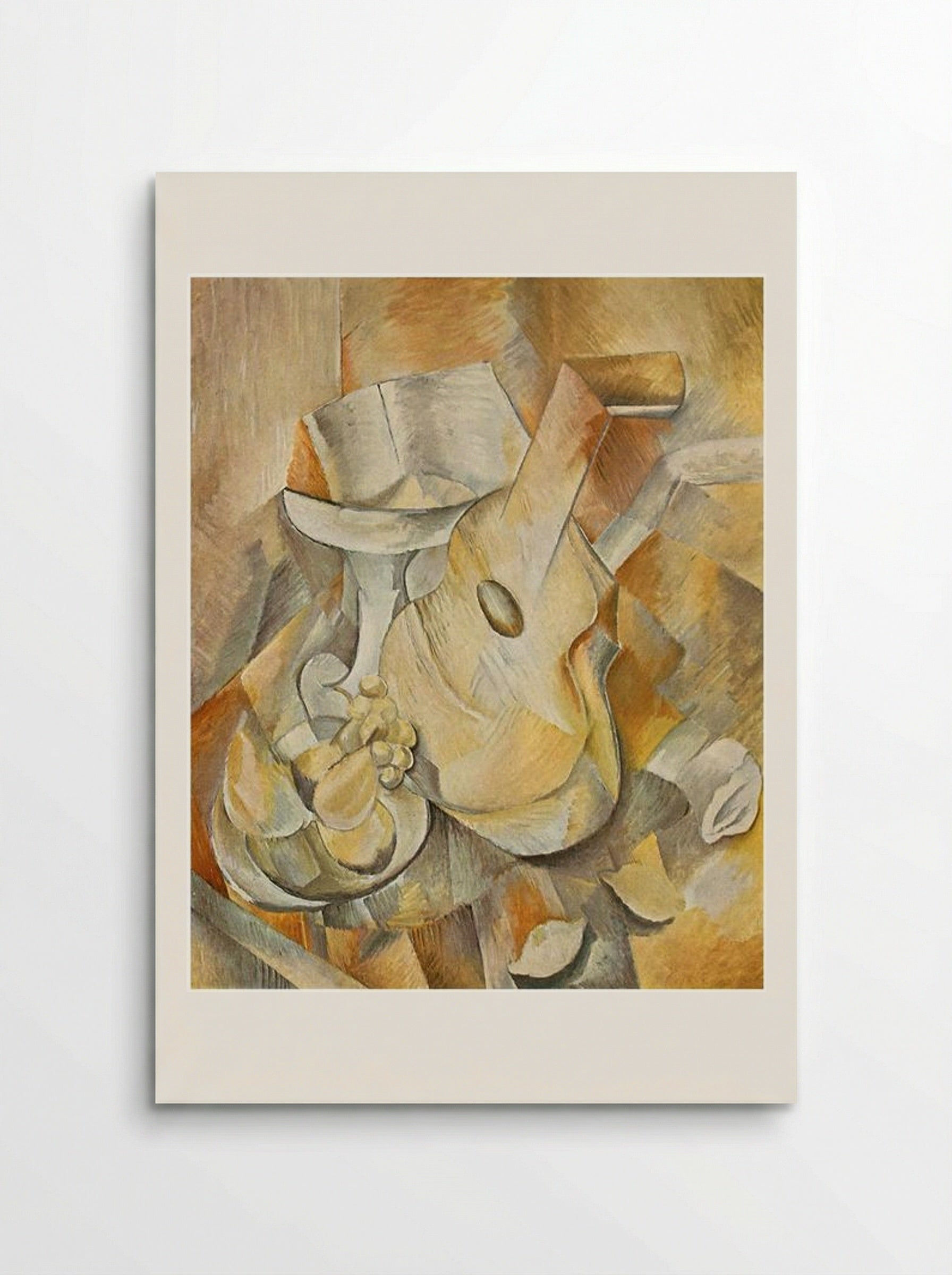
Guitar and Fruit Dish - Georges Braque
Archival giclée
Frames arrive ready to hang
Secure checkout
Made to order
Description
A seminal work of Analytic Cubism, this still life by Georges Braque deconstructs a guitar and fruit dish into a series of geometric planes.
Georges Braque produced this work during the early phase of Analytic Cubism. The composition deconstructs traditional still life subjects, specifically a guitar and a bowl of fruit, into a series of overlapping geometric planes. By breaking down the objects into these facets, Braque rejects the conventional single-point perspective that had dominated Western art since the Renaissance. Instead, he presents multiple viewpoints simultaneously, allowing the viewer to perceive the structure of the objects from various angles at once. The palette is restricted to a range of ochres, browns, and greys. This choice of colour serves to focus the viewer on the formal arrangement of space and volume rather than on the descriptive qualities of the objects themselves. The light source is inconsistent, further flattening the pictorial space and merging the objects with the surrounding environment. The guitar, while recognisable by its sound hole and neck, is fragmented, its form echoing the angularity of the table and the background planes. Braque, working in close collaboration with Pablo Picasso during this period, sought to analyse the nature of vision and representation. This painting demonstrates his interest in the tactile quality of objects, which he achieves through subtle variations in brushwork and tone. The work avoids decorative detail, prioritising the intellectual rigour of the Cubist method. It remains a clear example of the movement's attempt to reconcile the three-dimensional world with the two-dimensional surface of the canvas, stripping away unnecessary artifice to reveal the underlying geometry of the subject matter.
Return policy
Because every print is made to order, we don't offer change-of-mind returns, refunds or exchanges. If your order arrives faulty, damaged or incorrect, we'll replace it free of charge — just contact us within 48 hours of delivery. See our refunds page for full details.
Shipping
We ship worldwide, printing at the production hub nearest to your delivery address. Delivery times and costs vary by destination — you'll see the options available to you at checkout.
Manufacturing
Each print is produced to order using 12-colour giclée printing on FSC-certified archival paper. Designed in Britain and printed at your nearest production hub to reduce waste and speed up delivery.
Guitar and Fruit Dish - Georges Braque

Artist Biography
Georges Braque
He grew up in Argenteuil and Le Havre, the son and grandson of house painters. He apprenticed as a decorative painter, learning to imitate wood grain and marble, techniques he later used in his Cubist papiers colles. He studied at the Ecole des Beaux-Arts in Paris and exhibited with the Fauves in 1906, painting bright, loose landscapes influenced by Matisse.
Everything changed when he saw Picasso's Les Demoiselles d'Avignon in 1907. He went to L'Estaque that summer and painted landscapes that broke the scenery into geometric facets, which is what a critic called 'cubes.' The name stuck. Between 1908 and 1914 he and Picasso worked so closely that their paintings from this period are sometimes difficult to tell apart. They showed each other everything. They finished each other's ideas.
The war separated them. Braque was severely wounded at Carency in 1915: a head injury that left him temporarily blind and required trepanning. He did not paint for over a year. When he returned to work, the collaboration with Picasso was over. They remained on good terms but never worked together again.
His post-war paintings are quieter, more resolved, less competitive. The Studio series, large paintings of the interior of his Normandy studio with birds flying through the space, occupied him through the 1950s. He died in 1963, at eighty-one. Picasso outlived him by ten years.
Our Features
Designed for Lasting Impact
Specific Features
Every Solis piece is made to order with archival, gallery-quality materials built to last.
- Museum-grade giclée printing for rich, fade-resistant colour
- Archival matte fine-art paper, FSC-certified
- Multiple sizes and framing options available
- Frames in black, natural wood, dark wood or white
- Framed prints arrive ready to hang
Care & Cleaning
To keep your artwork looking its best:
- Dust gently with a soft, dry cloth
- Avoid prolonged direct sunlight
- Never use liquid cleaners on the print or canvas surface
- Keep in a dry, room-temperature space
- Handle prints with clean, dry hands
Materials & Sizing
Museum-grade giclée on FSC-certified archival matte paper, with framed and canvas options.
- Paper sizes: A4, A3, A2, A1, A0 and B2 (50×70 cm)
- Canvas: XS (20×30 cm) to Large (60×90 cm)
- Frames: black, natural wood, dark wood or white
Why Choose Us ?
Damage-free delivery guarantee
Fast Shipping
Museum-Quality Materials
Artist Biography
Georges Braque
He grew up in Argenteuil and Le Havre, the son and grandson of house painters. He apprenticed as a decorative painter, learning to imitate wood grain and marble, techniques he later used in his Cubist papiers colles. He studied at the Ecole des Beaux-Arts in Paris and exhibited with the Fauves in 1906, painting bright, loose landscapes influenced by Matisse.
Everything changed when he saw Picasso's Les Demoiselles d'Avignon in 1907. He went to L'Estaque that summer and painted landscapes that broke the scenery into geometric facets, which is what a critic called 'cubes.' The name stuck. Between 1908 and 1914 he and Picasso worked so closely that their paintings from this period are sometimes difficult to tell apart. They showed each other everything. They finished each other's ideas.
The war separated them. Braque was severely wounded at Carency in 1915: a head injury that left him temporarily blind and required trepanning. He did not paint for over a year. When he returned to work, the collaboration with Picasso was over. They remained on good terms but never worked together again.
His post-war paintings are quieter, more resolved, less competitive. The Studio series, large paintings of the interior of his Normandy studio with birds flying through the space, occupied him through the 1950s. He died in 1963, at eighty-one. Picasso outlived him by ten years.
You May Also Like