

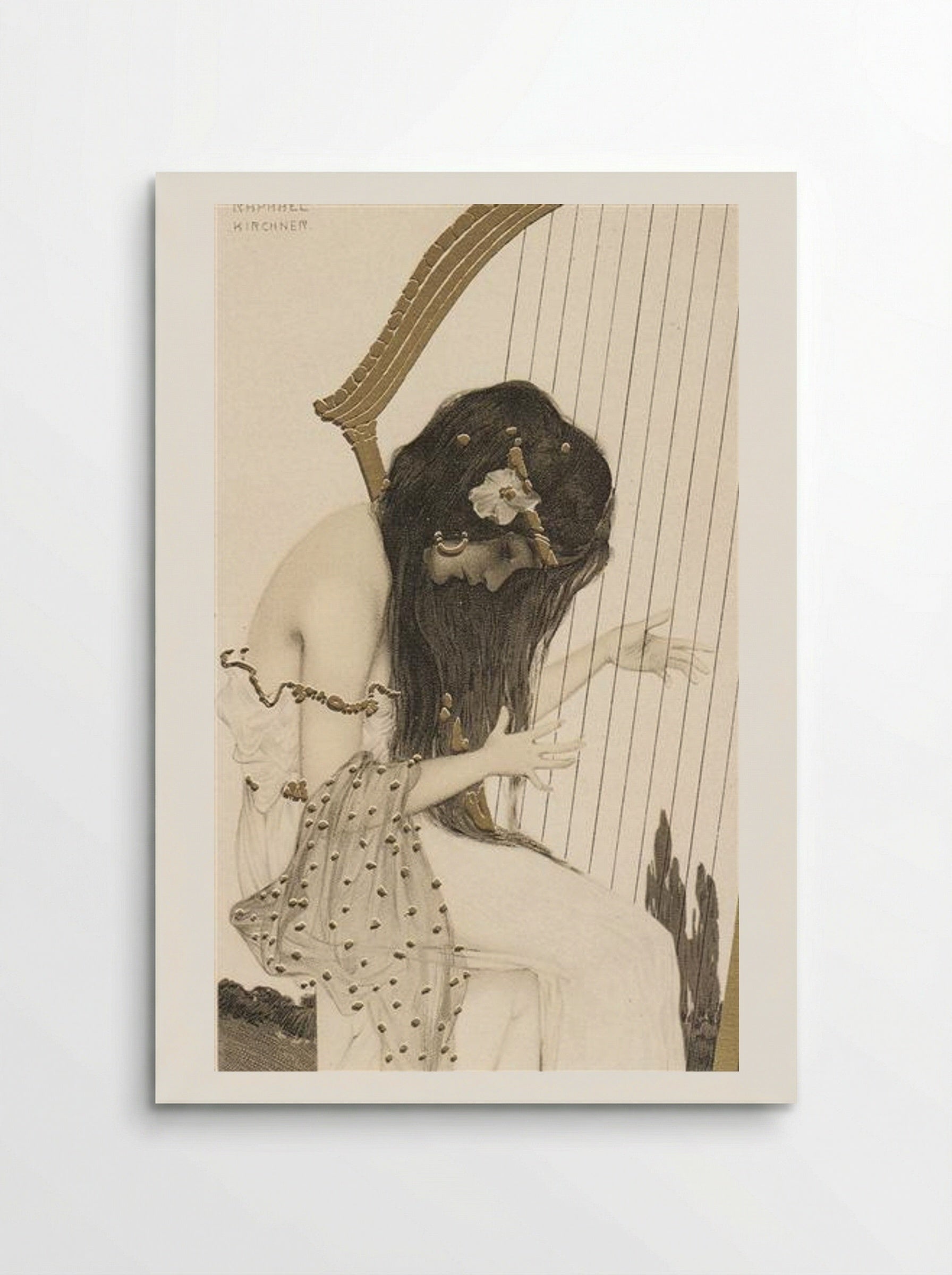
Greek Virgins (Woman with Harp) - Raphael Kirchner
Archival giclée
Ready to hang
Secure checkout
Made to order
Description
An Art Nouveau illustration by Raphael Kirchner depicting a woman in classical dress playing a harp. This c. 1900 work features a muted palette with gold accents and fine line work.
Raphael Kirchner was an Austrian illustrator who gained popularity in Paris during the Belle Époque. This work belongs to his Greek Virgins series, produced around 1900. The series depicts women in classical attire, often accompanied by musical instruments or floral motifs. Kirchner moved to London in 1914, where his work became a staple of magazines like The Sketch. His style influenced the development of early twentieth-century glamour illustration. The composition features a seated woman with long, dark hair that flows over her shoulder. She is positioned behind a large harp, her hands poised to strike the vertical strings. She wears a white, draped garment held by a gold chain across her arm. A patterned shawl with gold spots rests on her lap. Her hair is adorned with a white flower and a gold headband. The background is minimal, showing only a suggestion of dark foliage at the base. The woman's profile is turned downwards, creating a sense of quiet concentration. Kirchner uses a restrained colour palette dominated by cream and gold with dark brown accents. The use of gold ink or paint was a common feature in his printed works from this period. The lines are fine and precise, characteristic of the Art Nouveau preference for decorative contours. This illustration reflects the turn-of-the-century interest in Hellenistic themes, filtered through a modern, stylised lens. The figure is rendered with a soft, almost ethereal quality that was typical of Kirchner's early career before he transitioned to more overt pin-up styles. The artist's signature is visible in the top left corner. This piece demonstrates the transition from traditional academic subjects to the more decorative and commercial aesthetic of the early twentieth century. It remains a representative example of the graphic arts produced during the height of the Art Nouveau movement in Europe. The print captures the elegance of the period through its focus on line and ornamentation.
Return policy
Because every print is made to order, we don't offer change-of-mind returns, refunds or exchanges. If your order arrives faulty, damaged or incorrect, we'll replace it free of charge — just contact us within 48 hours of delivery. EU customers have a 14-day cooling-off right. See our refunds page for full details.
Shipping
We ship worldwide, printing at the production hub nearest to your delivery address. Delivery times and costs vary by destination — you'll see the options available to you at checkout.
Manufacturing
Each print is produced to order using 12-colour giclée printing on FSC-certified archival paper. Designed in Britain and printed at your nearest production hub to reduce waste and speed up delivery.
Greek Virgins (Woman with Harp) - Raphael Kirchner
Our Features
Designed for Lasting Impact
Specific Features
Every Solis piece is made to order with archival, gallery-quality materials built to last.
- Museum-grade giclée printing for rich, fade-resistant colour
- Archival matte fine-art paper, FSC-certified
- Choose poster, framed print, canvas or framed canvas
- Frames in black, natural wood, dark wood or white
- Framed prints arrive ready to hang
Care & Cleaning
To keep your artwork looking its best:
- Dust gently with a soft, dry cloth
- Avoid prolonged direct sunlight
- Never use liquid cleaners on the print or canvas surface
- Keep in a dry, room-temperature space
- Handle prints with clean, dry hands
Materials & Sizing
Museum-grade giclée on FSC-certified archival matte paper, with framed and canvas options.
- Paper sizes: A4, A3, A2, A1, A0 and B2 (50×70 cm)
- Canvas: XS (20×30 cm) to Large (60×90 cm)
- Frames: black, natural wood, dark wood or white
Why Choose Us ?
100% Satisfaction Guarantee
Fast Shipping
Museum-Quality Materials

Artist Biography
Raphael Kirchner
He was born in Vienna in 1875, studied at the Academy of Fine Arts there, and moved to Paris in 1900. At the outbreak of the First World War he relocated to New York, where he spent his final years designing panels, costumes and programmes for Florenz Ziegfeld's Follies at the Century Theatre. He died in New York in 1917, at forty-two.
You May Also Like