

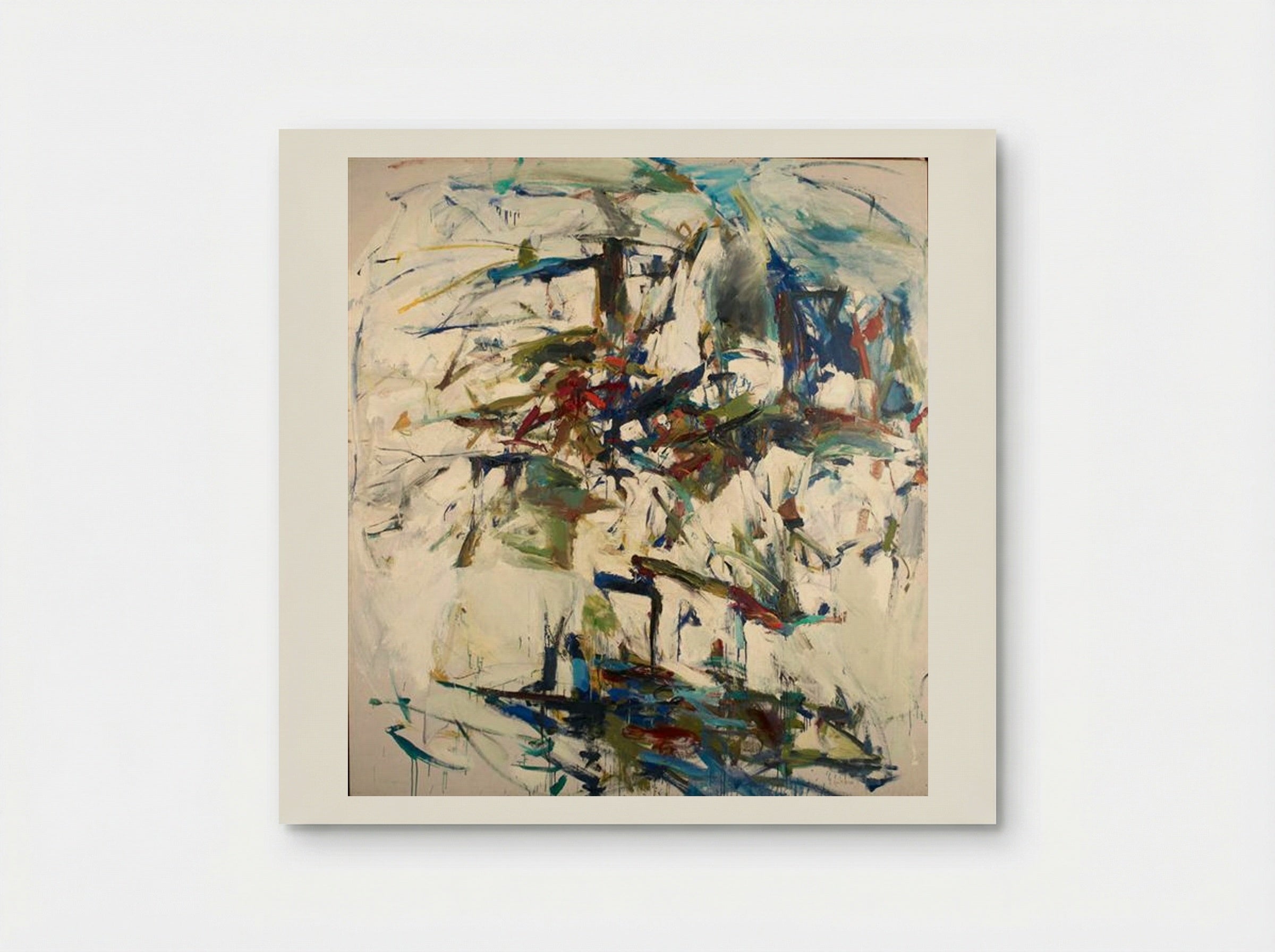
George Went Swimming at Barnes Hole, but It Got Too Cold - Joan Mitchell
Archival giclée
Frames arrive ready to hang
Secure checkout
Made to order
Description
A dynamic 1957 abstract composition by Joan Mitchell, featuring layered, gestural brushwork and a palette of blues, greens, and reds against a white ground.
Joan Mitchell produced this large-scale oil painting in 1957, a period when she was firmly established within the New York School of Abstract Expressionism. The work reflects her characteristic approach to gestural abstraction, where the physical act of painting serves as a conduit for memory and sensory experience. Rather than depicting a literal scene, Mitchell translates the feeling of a specific location, Barnes Hole, into a complex arrangement of marks and colour. The composition is defined by a central density of activity, where aggressive, calligraphic brushstrokes collide with more fluid, thinned applications of paint. The white ground functions as an active element, pushing the darker, more saturated forms forward and creating a sense of atmospheric space. Deep blues, earthy greens, and sharp accents of red are layered across the surface, suggesting the turbulence of water and the chill of the air mentioned in the title. Mitchell often employed this method of layering, allowing drips and splatters to remain visible, which provides a sense of the work's temporal development. Her technique involves a balance between controlled structure and spontaneous energy. The marks do not coalesce into recognisable figures, yet they retain a rhythmic quality that mimics the movement of nature. This piece demonstrates her ability to manage large canvases, maintaining tension across the entire surface without relying on a single focal point. The work remains a primary example of her mid-career style, where she moved away from the more rigid grids of her earlier paintings toward a more open, expansive field of action. By capturing the essence of a fleeting moment, Mitchell invites the viewer to engage with the painting as a visceral, immediate encounter with colour and form.
Return policy
Because every print is made to order, we don't offer change-of-mind returns, refunds or exchanges. If your order arrives faulty, damaged or incorrect, we'll replace it free of charge — just contact us within 48 hours of delivery. See our refunds page for full details.
Shipping
We ship worldwide, printing at the production hub nearest to your delivery address. Delivery times and costs vary by destination — you'll see the options available to you at checkout.
Manufacturing
Each print is produced to order using 12-colour giclée printing on FSC-certified archival paper. Designed in Britain and printed at your nearest production hub to reduce waste and speed up delivery.
Care and materials
Specific Features
Every Solis piece is made to order with archival, gallery-quality materials built to last.
- Museum-grade giclée printing for rich, fade-resistant colour
- Archival matte fine-art paper, FSC-certified
- Multiple sizes and framing options available
- Frames in black, natural wood, dark wood or white
- Framed prints arrive ready to hang
Care & Cleaning
To keep your artwork looking its best:
- Dust gently with a soft, dry cloth
- Avoid prolonged direct sunlight
- Never use liquid cleaners on the print or canvas surface
- Keep in a dry, room-temperature space
- Handle prints with clean, dry hands
Materials & Sizing
Museum-grade giclée on FSC-certified archival matte paper, with framed and canvas options.
- Paper sizes: A4, A3, A2, A1, A0 and B2 (50×70 cm)
- Canvas: XS (20×30 cm) to Large (60×90 cm)
- Frames: black, natural wood, dark wood or white
George Went Swimming at Barnes Hole, but It Got Too Cold - Joan Mitchell

Artist Biography
Joan Mitchell
She grew up in Chicago, the daughter of a dermatologist and a poet. She was a competitive figure skater and diver. The athleticism transferred to her painting: she worked standing, moving around the canvas, using her whole body. She studied at the School of the Art Institute of Chicago and moved to New York in 1949, joining the Cedar Bar circle of de Kooning, Kline, and Pollock.
She moved to France in 1959, first to Paris and then to Vetheuil, the village on the Seine where Monet had lived. The coincidence was not accidental. She painted landscape-derived abstractions that have the luminosity and colour sensitivity of Impressionism executed at Abstract Expressionist scale. La Grande Vallee, a series of large paintings from the 1980s, is a sustained meditation on landscape, memory, and loss.
She drank heavily, was difficult personally, and made no concessions to the market or to critics. She sold well in Europe before America caught up. The retrospective at the Whitney in 2002, three years before her death, confirmed what her collectors had known for decades: she was one of the best painters of the second half of the twentieth century.
Why Choose Us ?
Damage-free delivery guarantee
Fast Shipping
Museum-Quality Materials
You May Also Like